








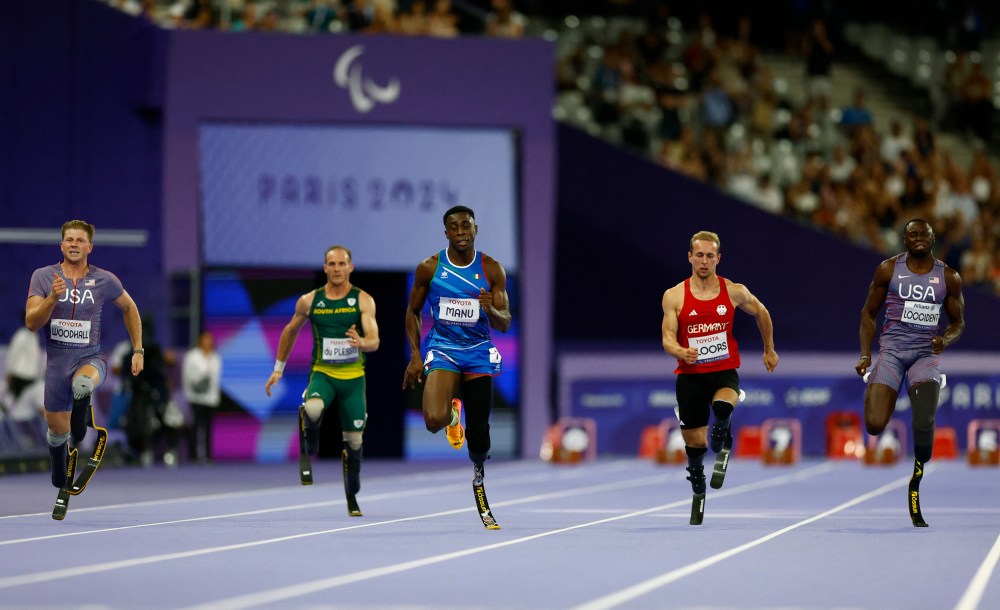
UPDATE (Sept. 6, 2024, 6:10 p.m. ET): On Friday, Hunter Woodhall won gold in the 400-meter T62 event at the Paralympics. On Monday, he finished 6th in the men’s 100-meter T64 final.
With the athletes proceeding down Paris’ Champs-Élysées to Place de la Concorde, the cobblestoned thoroughfare temporarily topped with asphalt to increase accessibility, the 2024 Paralympics kicked off in a spectacular fashion. The games for disabled athletes has also had some high profile cheerleaders. All-time Olympic greats Simone Biles and Katie Ledecky encouraged fans to tune in, and Snoop Dogg, fresh off his run as a hype man for the Olympics in Paris, cut an ad for the Paralympics Games.
One hopes this unprecedented media attention helps sports featuring disabled athletes become more mainstream.
Visibility will be higher than it’s ever been. The International Paralympic Committee announced that more than 225 media rights holders, including broadcasters, streamers, digital, social and audio platforms, will cover the Games.
One hopes this unprecedented media attention helps sports featuring disabled athletes become more mainstream. Indeed, some of the Olympic Games coverage served as a preview for the Paralympic Games when American long jumper Tara Davis Woodhall, who’d just won the gold medal, ran to the stands and jumped into the arms of her husband, Hunter Woodhall, a sprinter who has three medals from the Paralympics in Tokyo and Rio de Janeiro.
Hunter Woodhall, 25, who was born with fibular hemimelia and is a double amputee, competed in the first round of the men’s 100-meter T64 Sunday and will run in the final for the event Monday. He’s scheduled to run in the 400-meter T62 race Friday. (T61-T64 events are for athletes “competing with prosthesis affected by limb deficiency and leg length difference,” according to World Para Athletics.)
GOLD FOR HUNTER WOODHALL IN THE 400M T62. 🥇
— NBC Olympics & Paralympics (@NBCOlympics) September 6, 2024
WHAT A WIN. WHAT A REACTION. #ParisParalympics pic.twitter.com/eeBsvwqpyv
“I’m feeling really good, mentally and physically,” Woodhall told NBC News. “Watching Tara in Paris was a really great visualization. So I’m prepared.”
Unfortunately, as any sports fan knows, the more popular a sport becomes, the more trash opinions abound. As disabled athletes become more visible, nondisabled people who are watching must resist the impulse to chalk up the performances as more inspiring than those from other athletes.
The late disability rights advocate Stella Young articulated the trouble with so-called “inspiration porn” in an April 2014 Ted Talk. She showed images of people with disabilities playing sports alongside unhelpful captions such as “The only disability is a bad attitude;” “Your excuse is invalid” or “Before you quit, try.”
If that’s the reason people are watching the Paralympics, it would be better if they watched something else.
Young used the word “porn” intentionally because she said that images of disabled people, like pornography, can be used to objectify one group of people for the pleasure of another group of people.
“The purpose of these images is to inspire you, to motivate you,” she said, “so that we can look at them and think, ‘Well, however bad my life is, it could be worse. I could be that person.’” If that’s the reason people are watching the Paralympics, it would be better if they watched something else. Watching the games for inspiration, and not for the enjoyment that comes with watching athletes compete, turns the athletes and the Games into a medium to make nondisabled people feel better about themselves. Also, simply deeming paralympians “inspiring” diminishes their real achievements. Like every other athlete, they have put in years of work to reach this stage in their career. Reducing them to symbols of inspiration is condescending and patronizing. The coverage of disabled athletes and the way that viewers respond to that coverage needs to match what happens when nondisabled athletes are playing. We don’t watch the U.S. Women’s National Team in soccer and say how inspiring it is that women can play soccer; we watch because the American women are good and play soccer better than the guys. The popularity of women’s basketball is exploding, in part, because people see Caitlin Clark and Angel Reese as outstanding basketball players and not as symbols of what girls can accomplish if they don’t give up. The Paralympics offers a major opportunity for disabled athletes. Broadcasting the games is not an act of charity. It’s a recognition that the best athletes in the world competing against one another makes for compelling television. Disabled athletes aren’t competing to impress or inspire you. They’re competing for the gold.
Eric Garcia is an author and senior correspondent for The Independent. 


