








After fits and starts and shortages and a confounding array of guidelines and tiers, the effort to vaccinate America against Covid-19 has hit yet another snag. Now that shots are finally available to everyone above the age of 16, states are finding it harder and harder to line up people to inoculate.
The various vaccines, minor miracles that they are, are the best defense the U.S. has against the virus. That’s what makes it baffling, and disturbing, to me that so many of the people sworn to defend Americans are refusing to be vaccinated. For a culture that fetishizes these people as guardians of our freedoms who put themselves in harm’s way daily, that these protectors then leave themselves exposed to the virus — and risk passing it on to others — is unconscionable.
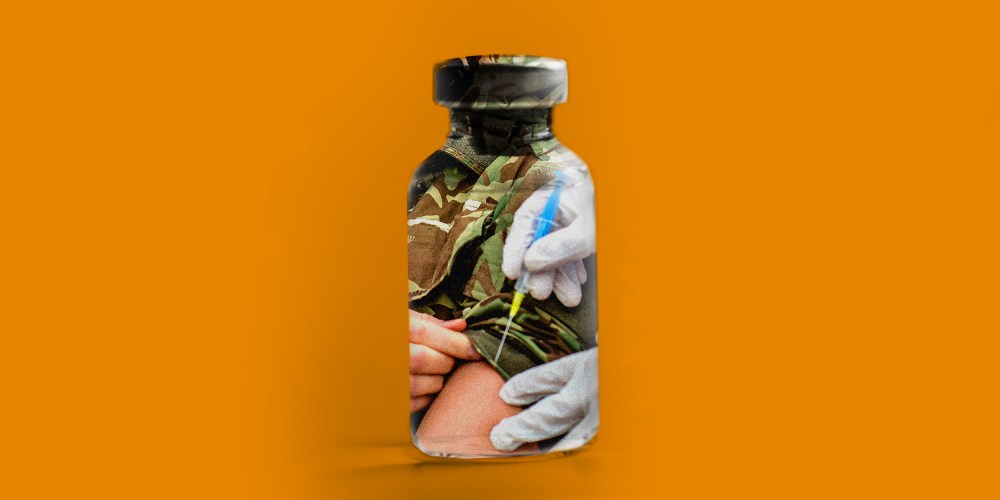
According to the Department of Defense, 521,492 U.S. service members — including active duty, National Guard and reserves — have been fully vaccinated as of April 30. Another 277,438 have had at least one shot. But that only represents about 33 percent of the U.S. armed forces, according to Pentagon’s most recent statistics.
It is baffling, and disturbing, to me that so many of the people sworn to defend Americans are refusing to be vaccinated.
As CNN reported April 23, the number of service members who are accepting vaccinations is plateauing or falling. At the same time, the percentage of doses the Pentagon administers out of its stockpile keeps falling.
There’s a variety of reasons why this might be the case, ranging from the fact that many serving in the military are younger and fitter than the average American to this explanation given to the Military Times in March:
An Air Force Technical Sergeant doesn’t like to put anything foreign into his body and will decline the vaccine as long as it’s voluntary. He plans to “detox” the vaccine out of him when the military makes the immunization mandatory, despite the fact that there exists no scientific basis for purging a vaccine from one’s body. “I know my immune system is strong enough to prevent me from getting it,” he told Military Times.
Why then, you might ask, does President Joe Biden — as commander in chief — not just make vaccination mandatory? Well, that’s an option under the law, but it’s a tricky one. All three vaccines in use in the U.S. were granted emergency use authorization from the Food and Drug Administration. That’s different from normal FDA approval — and therein lies the issue.
Under federal law, members of the public have the right to refuse a product that is authorized but not approved — that’s why we haven’t seen the Biden administration roll out mandatory vaccination requirements. The president can order the military to vaccinate its members anyway, whether they want to be vaccinated or not, but “only if the President determines, in writing, that complying with such requirement is not in the interests of national security.”
You’d think that the current pandemic would count, but in an interview with NBC’s “TODAY” show co-anchor Craig Melvin, Biden didn’t give a straight answer on whether he’ll issue such a waiver.
“I think you’re going to see more and more of them getting it,” Biden predicted. “And I think it’s going to be a tough call as to whether or not they should be required to have to get it in the military, because you’re [in] such close proximity with other military personnel.”
Meanwhile, things are even more grim among police officers. As front-line emergency workers, officers have had priority access to Covid-19 vaccines months before the general population in most places. But The Washington Post reported Sunday that the vaccination rates among major police forces is low — very low: At the Las Vegas Metropolitan Police Department, just 39 percent of employees have gotten at least one dose, officials said, compared to more than 50 percent of eligible adults nationwide. In Atlanta, 36 percent of sworn officers have been vaccinated. And a mere 28 percent of those employed by the Columbus Division of Police — Ohio’s largest police department — report having received a shot. Police officers tend to interact with a lot of people on a daily basis, which makes their refusal even more troubling than the military’s in the short-term. Add that to reports of lax mask-wearing among police officers around the country and we have a major issue. These are people who either need to be rebuilding trust in their communities or — especially in some Republican-majority areas where vaccine skepticism is at its highest — could serve as proof to their community that the vaccines are safe. Either way, I’d say preventing the spread of a deadly virus falls under the auspices of “to serve and protect.” Given that police officers are civilians, Biden doesn’t have the same leverage here as he does with the military, and it will be a while still before the vaccines go through the normal FDA approval process. None of the three makers of the authorized vaccines — Pfizer/BioNTech, Moderna and Johnson & Johnson — has submitted a Biologics License Application to the agency or were willing to provide CNN with a timeline of when that might happen. So for now, the government is forced to rely on ramping up education campaigns and easing access to the vaccine, as the White House announced Tuesday. Either the president or the attorney general needs to put the word out to police departments that the need to be vaccinated includes the boys and girls in blue, too, ideally in the form of departments mandating shots if officers want to remain on duty. And Biden needs to move forward on issuing a waiver to mandate vaccines for our members of the military. I get that people are hesitant still. I understand there are risks being weighed when people choose to get vaccinated. But in the end, these are people whose entire job is about facing risks to protect others. If you carry a gun for work, you should absolutely get the shot.
Hayes Brown is a writer and editor for MS NOW Daily. 


