









Failure to pass President Joe Biden’s Build Back Better plan will be a failure for women, particularly those who are poor or working class. The plan, which is at the top of Biden’s legislative wish list, is a $1.8 trillion initiative to strengthen this country’s safety net and address our climate crisis. The plan would, among other things, provide free preschool for 3- and 4-years-olds, fund child care, paid family leave, a child tax credit, care for elderly and disabled people, rebates and tax credits to promote clean energy, and an expanded Medicare program.
Inequalities were exacerbated during the pandemic, as women took on three times as many unpaid childcare hours as men did.
We know that women bear the lion’s share of the responsibility of taking care of children and elderly relatives. We know that these inequalities were exacerbated during the pandemic, as women took on three times as many unpaid child care hours as men did. Almost 2 million women were also forced out of the workforce, and out of their incomes.
A failure to pass Build Back Better would quickly follow Biden signing a $1 trillion infrastructure bill. The majority of the jobs created by those government programs will be performed by men. This is no surprise, men currently hold 90 percent of infrastructure jobs. That’s not to say the infrastructure package is bad law; it doesn’t mean we shouldn’t spend government money on jobs that will be held predominantly by men. It means that the passage of the infrastructure bill would make the impact of not passing Build Back Better more glaring. The people who will feel the failure of the Build Back Better plan the most deeply are women.
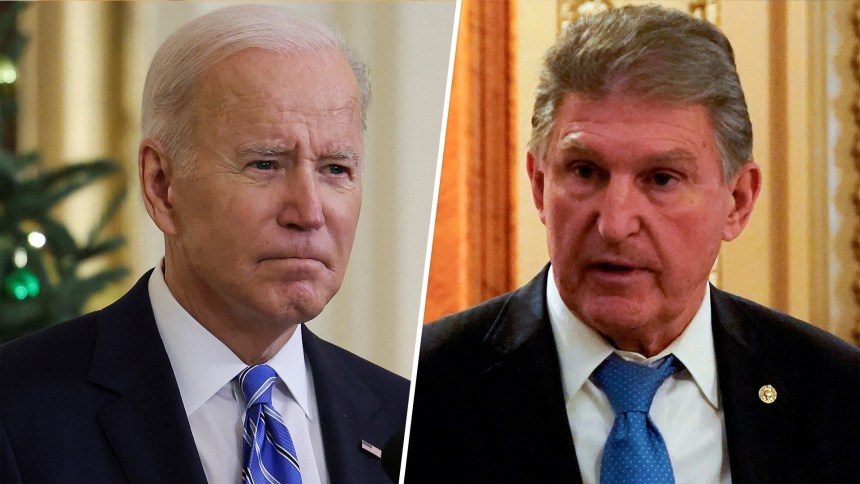
By now, we have heard the news that the plan looks doomed because one man, Joe Manchin, the Democratic senator from West Virginia, has said he can’t support it. Except that is not the full story. The full story is one of partisan divisions so deep they almost defy hyperbolic characterization, of American institutions so antiquated they allow a few, or even one, to thwart the desire of the many, and of a country doing little to address systemic gender inequality.
There is not just a small separation between Democrats and Republicans on the Build Back Better plan. There is a fault line no senator appears ready to cross. Well, except Manchin. If one Republican senator voted in favor of the plan, Manchin’s vote wouldn’t be needed. But none will.
This partisan division in the Senate largely mirrors what happened in the House of Representatives when that legislative body passed the Build Back Better plan. Every Democrat but one voted in favor of it; every Republican voted against it.
Manchin reportedly told his colleagues that he thought poor parents would use their child tax credit payments on drugs, not their children.
And yet, here we are. Democrats control the White House, the Senate and the House. The Build Back Better plan is supported by all but two Democrats who are federally elected representatives. And that is not enough.
How can one Senate Democrat thwart the will of almost every other Democratic lawmaker? Because the Senate is, and was designed to be, a deeply anti-democratic institution. The Senate is evenly split between Democrats and Republicans, except that Democrats now represent more than 43 million more people than Republicans. The 1.8 million West Virginians represent approximately 0.5 percent of the American population of 333 million people.
All of this — the partisan divisions and the anti-democratic institutions — is maddening and points to deep structural problems in our society. But it shouldn’t cause us to ignore another structural problem in our country: gender inequality. It’s worth asking why the man who pulled the plug on the Build Back Better plan did so. Manchin reportedly told his colleagues that he thought poor parents would use their child tax credit payments for drugs, not for their children. The child tax credit, which will lapse if it is not continued, has cut childhood poverty by 30 percent. Research indicates that 90 percent of low-income families use money from the child tax credit for necessities and education. Manchin also apparently thought people would commit fraud and lie about being sick if a proposed sick leave policy were passed. It is at best paternalistic, and at worst misogynistic that Manchin thinks so little of his constituents that he is willing to torpedo expanding portions of the safety net that will disproportionately assist women in being full members of our society. We live in a society rife with inequalities. Our government had the opportunity to try to remedy some of them. This is not about giving women extra benefits, it is about remedying detriments. Many women, particularly poor women, start most races miles behind the starting line. The Build Back Better plan would have been part of an effort to help them begin the race at the same time and place as everyone else.
Jessica Levinson is a Loyola Law School professor and MS NOW columnist. 


