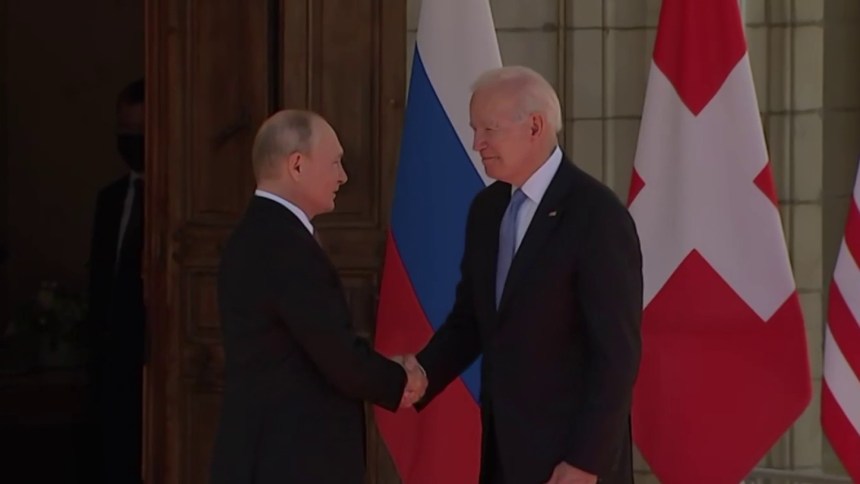
On Wednesday, in an 18th century Swiss villa overlooking Lake Geneva, Joe Biden will sit across from Russian President Vladimir Putin for the first time as president of the United States, in what has been described as “one of the most closely watched summits of the year.”
Every president has misjudged the dead-eyed former KGB colonel from the get-go.
Few of us can forget what happened at Putin’s first official summit with then-President Donald Trump in the ornate Gothic Hall in Helsinki in July 2018. Trump caused an outcry at the joint news conference that followed their private meeting, even within his own party back in the U.S., by suggesting that he had accepted the word of the Russian president over his own intelligence agencies’ conclusion that Moscow had interfered in the 2016 U.S. presidential election. “I have President Putin. He just said it’s not Russia,” declaimed Trump. “I will say this: I don’t see any reason why it would be.”
Some of us have longer memories, though. In fairness to Trump — and I hate typing out those words — every American president has heaped praise on Putin in their first meeting. Every president has misjudged the dead-eyed former KGB colonel from the get-go.

Putin has thrived for over two decades in power by, time and again, persuading American presidents to invest their trust in him while simultaneously sowing division and discord among the U.S. and its allies.
In June 2000, standing side by side with Putin in the Kremlin’s St. George’s Hall, Bill Clinton declared the new Russian president, who had been elected less than three months earlier, to be “fully capable of building a prosperous, strong Russia while preserving freedom and pluralism and the rule of law,” adding: “It’s a big challenge. I think he is fully capable of doing it.”
Speaking at a joint news conference with Putin in front of a mountain in Slovenia a year later, George W. Bush famously remarked that he had looked Putin “in the eye,” saying: “I found him to be very straightforward and trustworthy. … I was able to get a sense of his soul, a man deeply committed to his country and the best interests of his country.” Bush said he “wouldn’t have invited him to my ranch if I didn’t trust him.”
Putin in April signed a law amending the constitution and allowing him to stay in office … until 2036.
As late as the summer of 2009, when Putin was serving as prime minister between his two stints as president, the newly elected Barack Obama went to visit him at his forest residence outside Moscow. “I am aware of not only the extraordinary work that you’ve done on behalf of the Russian people in your previous role … as president, but in your current role as prime minister,” Obama declared before enjoying a breakfast of smoked beluga on the balcony.
Three years later, during the third presidential debate of the 2012 presidential campaign, Obama would famously mock his Republican rival, Mitt Romney, for his hawkish stance on Russia. “The 1980s are now calling to ask for their foreign policy back, because the Cold War’s been over for 20 years,” Obama quipped.

By the time the 2020 presidential election rolled around, however, the roles had been reversed: It was the Democratic challenger who took a hawkish line on Putin, while the Republican incumbent defended his Russian counterpart.
Since coming to office, Biden has denounced Putin as a “killer” and expelled Russian diplomats. He also announced new sanctions against Moscow after the poisoning and imprisonment of Russian opposition figure Alexei Navalny. Biden has emphasized the importance of the “democracy versus autocracy” frame in his approach to Russia (and, for that matter, China).
Putin has thrived for over two decades in power by, time and again, persuading American presidents to invest their trust in him.
Writing in The Washington Post ahead of his departure from Washington this month, he said his foreign trip was “about realizing America’s renewed commitment to our allies and partners, and demonstrating the capacity of democracies to both meet the challenges and deter the threats of this new age.”
Referring to the meeting with Putin in Geneva this week, Biden pledged that he would “again underscore the commitment of the United States, Europe and like-minded democracies to stand up for human rights and dignity.”
Whatever your view of Biden or of U.S. foreign policy, this is a laudable goal. It is difficult to think of a world leader who better symbolizes the global rise of authoritarianism and nationalism than Putin, the longest-serving Kremlin leader since Joseph Stalin.
Inside Russia, Putin is a modern-day czar, having perfected his own brand of strongman politics. As Berkeley’s M. Steven Fish wrote in The Journal of Democracy in 2017, “Putin is not merely Russia’s best-known, most powerful politician; he is its only politician.” His main political opponents are either in jail (think Navalny, imprisoned since February) or dead (think Boris Nemtsov, assassinated on a bridge near the Kremlin in 2015).
Last month, The Associated Press reported, a Moscow court “outlawed the organizations founded by Russian opposition leader Alexei Navalny by labeling them extremist, the latest move in a campaign to silence dissent and bar Kremlin critics from running for parliament in September.” Putin in April signed a law amending the constitution and allowing him to stay in office … until 2036. Outside Russia, Putin has been accused of launching assassinations on foreign soil and interfering in democratic elections from the U.S. to France. He is also believed to have sponsored and backed far-right nationalist movements across Europe, from Marine Le Pen’s National Rally to Matteo Salvini’s Northern League. And, of course, Russia, under Putin, invaded and annexed Crimea in 2014, and it has since backed violent separatist forces in eastern Ukraine. Here, of course, Joe Biden has the distinct advantage of simply not being Donald Trump. To be clear, there is no military solution to the crisis in Ukraine — even Biden’s deputy national security adviser, Jon Finer, agreed with me in an interview last week. Nor does the U.S. have any particular economic or diplomatic leverage to wield against Moscow in demanding the release of Navalny or other political prisoners. Wednesday’s meeting is unlikely to result in any significant change in behavior from Putin in the short run. In the long run, however, Biden can do at least three things to bolster global democracy and address Putin’s international power and influence. First, lead by example. Believe it or not, countries around the world still look to the U.S. for leadership and, yes, guidance. The archaic Senate filibuster is an issue of global geopolitical importance. Biden needs to work with Democrats in Congress to reform or end the filibuster and get voting rights legislation passed in the Senate as soon as possible to protect free and fair elections in America from the Republican Party’s state-level antics. The U.S. cannot lecture others about safeguarding democracy abroad if it cannot safeguard it at home. Second, America under Biden cannot pretend to be concerned about the future of democracy and the rise of authoritarianism among adversaries like Russia and China while coddling friendly dictators like Mohammed bin Salman in Saudi Arabia and Abdel Fattah el-Sisi in Egypt. Third, Biden has to win friends and influence people across Europe and the wider world. He has to rally democracies to the cause of democracy. Here, of course, Biden has the distinct advantage of simply not being Donald Trump, not being a president who needlessly antagonizes America’s allies while making a belligerent fool of himself at international summits. But will it be enough to build and sustain an anti-Putin coalition when some European democracies aren’t as keen to stand up to Russia as others? So far, Biden has demonstrated that, while he is willing to work with his Russian counterpart on issues of shared importance, like arms control and climate change, he has no intention of being seduced by him, as his four predecessors were. There will be no joint news conference, for example, in Geneva. Now, Biden also has to demonstrate the truth of his own words that “democratic alliances and institutions” can stand up to “modern-day threats and adversaries” like Putin’s Russia. It won’t be easy. But it may well be one of the defining challenges of his presidency.
Mehdi Hasan
Mehdi Hasan is host of "The Mehdi Hasan Show" on Peacock and an MSNBC political analyst. He is a former senior columnist for The Intercept, for which he launched the "Deconstructed" podcast. He was also the presenter of "UpFront" and "Head to Head" on Al Jazeera English. He is the author of two books and the winner of the Society of Professional Journalists' 2018 Sigma Delta Chi Award for Online Column Writing.