A retired Israeli general made headlines by sharing with the world what he said has been a closely guarded secret. According to 87-year-old professor Haim Eshed, there really is life among the stars — and it thinks most of humanity isn’t ready to meet it yet. And, quite frankly, I can’t say that I blame it, whatever “it” is, for being skeptical of us right now.
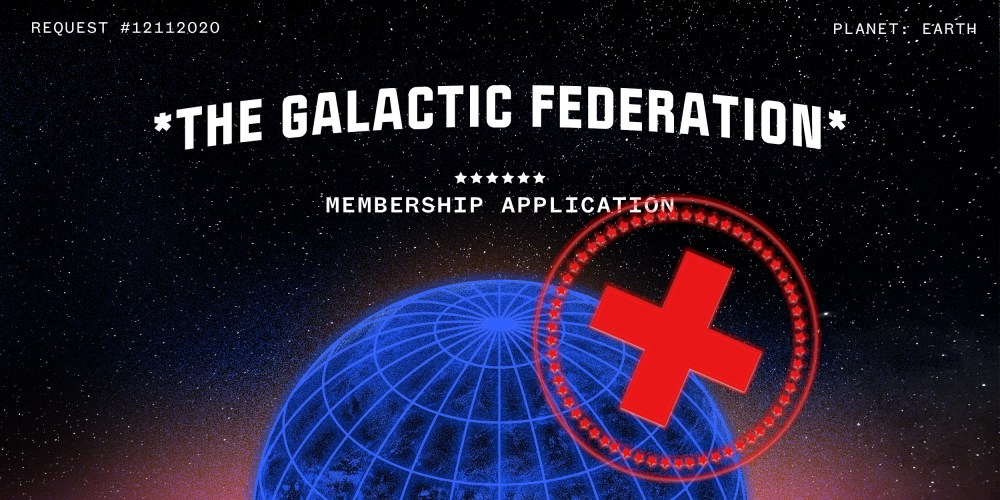
Eshed isn’t just some random crank. He’s the former head of the Israeli Defense Ministry’s space directorate, which means he knows his way around a nebula. So when Eshed told the Israeli newspaper Yediot Aharonot that a “Galactic Federation” has secretly made contact with Earth, it’s no wonder the story caught our attention in a tractor beam. (Especially his claim that President Donald Trump had to be talked out of blabbing about the aliens too soon.) The story went viral soon after The Jerusalem Post published clips from the interview in English.

Broadly speaking, there’s a chance Eshed is correct. Not about the part where he claims that we’ve apparently set up a joint Terran-alien exploration base on Mars. But possibly about the part where, as the famous Drake Equation shows, the odds are good that there’s some kind of extraterrestrial life out there. Humans are definitely on the lookout: China has spent more than $180 million on the world’s first radio observatory with a core mission of looking for signs of alien life.
As it stands, though, I’m very glad that nobody else in the galaxy has to deal with humanity. Not yet, anyway. Because, my friends, I have to say it — we are a mess.
Eshed’s “Galactic Federation” quickly drew the obvious comparisons to “Star Trek’s” United Federation of Planets. The first contact between the people of Earth and an alien race in the “Star Trek” canon was depicted in the aptly named movie “Star Trek: First Contact.” In the film, because humans had already gone through our apocalypse — a series of nuclear wars near the start of the 21st century — humanity was finally open to putting aside its problems for something better.
I’m very glad that nobody else in the galaxy has to deal with humanity. Not yet, anyway.
It’s a nice sentiment, baked in from the beginning of the franchise. One day, “Star Trek” creator Gene Roddenberry promises in his vision, there will be no need for money and no poverty, and peace will be the default political status. My favorite of the successor series, “Star Trek: Deep Space Nine,” actively questioned whether that sort of utopia could exist and whether humanity could ever evolve to that point.
The show went deep on that exploration in its two-part episode “Past Tense,” which first aired in 1995. Thanks to a classic bit of time-travel mumbo jumbo, the season-three episode was mostly set in the characters’ pasts. It was a little distressing to realize on a recent rewatch that the crew had traveled back to 2024 — a nearer future than I was expecting when I’d pressed play.
And while the U.S. may not have implemented the “sanctuary zones” the show depicts, cordoning off major cities’ homeless and unemployed populations to keep them out of sight, Earth’s problems haven’t exactly improved since the series’ original airdate.
It’s one of the most overtly political episodes of “Star Trek,” and it avoids some of the clunky heavy-handedness of earlier series’ attempts to weave in political allegories. Dr. Julian Bashir, played by Alexander Siddig, acts as the audience surrogate, venting his outrage at the conditions he finds 21st-century Americans living in. Bashir’s ignorance of the time mirrors the privilege that the writers could rightly assume many viewers had, having never faced down some of the stigmas and despair depicted on-screen. Bashir finds himself unable to process why mental health issues he’s spotted among the degenerate, which could be treated with medicine available at the time, are not addressed.
“It’s not that they don’t give a damn,” Bashir’s commanding officer, Cmdr. Benjamin Sisko (played by Avery Brooks), tells him. “They’ve just given up. The social problems they face seem too enormous to deal with.”
Viewers grappled with it at the time, too, with some rejecting the idea that things could really be as bad as depicted. “People are still even writing that we only presented ‘one side’ in ‘Past Tense’ and that we should have presented ‘both sides’ and not just the ‘liberal’ point of view — and I’m still trying to think what that means,” episode co-writer Ira Steven Behr told Star Trek Monthly magazine in 1996. When they finally make it back to the 24th century, Bashir asks Sisko, “How could they have let things get so bad?” Sisko responds: “That’s a good question. I wish I had an answer.” Four years from when the episode would take place, here in 2020, I find myself asking the same question. The world is in the middle of a pandemic that has spread unchecked in the United States because of government inaction. More than 8 million people are newly impoverished thanks to federal aid’s drying up. Food insecurity and chronic hunger are spiking, as is the rate of people shoplifting basic foods like bread and pasta, The Washington Post reported Thursday. Meanwhile, Eshed said, the aliens were waiting for us to “develop and reach a stage where we will understand, in general, what space and spaceships are” before making themselves known. As it turns out, two of the richest men on Earth, Jeff Bezos and Elon Musk, are in the middle of a race to privatize space. And in the process, they will reportedly avoid paying taxes on the millions of dollars spent on their projects, using a tax break meant to help poor communities. The Galactic Federation probably doesn’t exist. But if it did, I somehow doubt it would want us as members just yet.
Hayes Brown is a writer and editor for MS NOW Daily.