








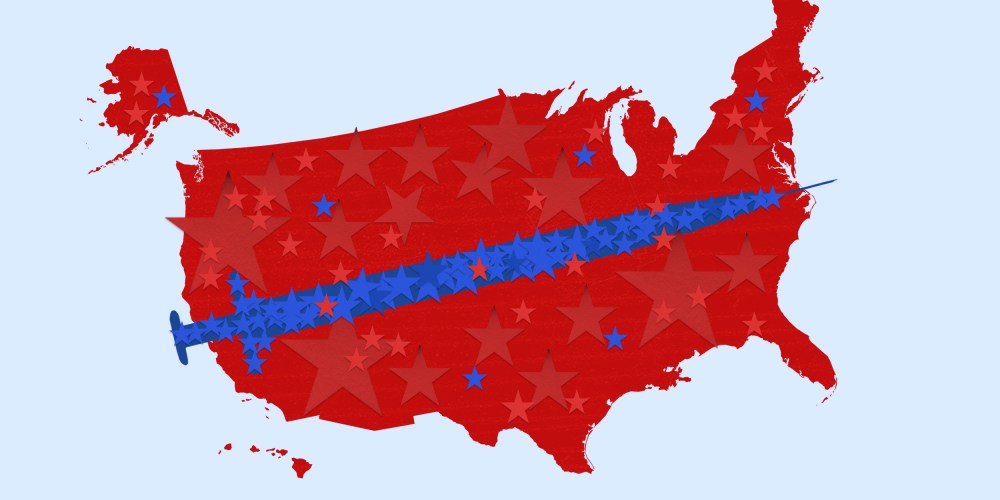
As the nation celebrate its 245th birthday, it is increasingly and depressingly clear that America is becoming two very different countries: a blue one and a red one, with little in shared identity and vastly different health and economic outcomes.
Polarization is not just transforming American society — it’s literally killing people.
The cleavages in American society have become so extreme that where one lives and how one votes increasingly has life and death consequences. And no recent issue better exemplifies this phenomenon than the growing red state/blue state divide over Covod-19 vaccinations. The vaccine fight, rather than an outgrowth of Trump’s divisive presidency, is just another example of how polarization is not just transforming American society — it’s literally killing people.
In June, the White House announced that the U.S. will not hit President Joe Biden’s goal of getting 70 percent of American adults to receive at least one shot of a Covid-19 vaccine before July 4th.
So far, only 18 states, as well as the District of Columbia and Puerto Rico, have surpassed the 70 percent marker for vaccinations. They all have one thing in common: Every one of them supported Biden in the 2020 presidential election.
In the states that former President Donald Trump won, it’s a very different story. Across the South, which voted overwhelmingly for Trump, vaccination rates hover around 50 percent with two states (Mississippi and Louisiana) below that mark and three others (Alabama, Tennessee, and Arkansas) barely above it. There are similarly low rates in the far west, with Idaho and Wyoming lagging behind the rest of the country.

Data assembled by Seth Masket of the Center on American Politics at the University of Denver show that the correlation between how states voted in the last election and the percentage of their citizens who are vaccinated is nearly exact.
According to Masket, “Vaccinations are a better predictor of state voting patterns in 2020 than education, racial composition, or almost any other demographic factor.”
With the highly contagious and deadly Delta variant spreading across the country, red-state America may be looking at yet another wave of Covid-19 cases this summer and fall.
This disconnect is yet another example of America’s increasingly fractured politics.
This disconnect is yet another example of America’s increasingly fractured politics. Voters are not only choosing candidates based solely on whether they have a “D” or an “R” next to their name, they are making health decisions using the same criteria.
Decades ago, most American states saw similar improvements in life expectancy; all boats tended to rise as one. Today, residents of northeastern and western states (which generally vote Democratic) are living longer and healthier lives while in the GOP-voting South and Appalachia life expectancies have stagnated.
In 2017, the gap between Hawaii, the state with the highest life expectancy and Mississippi (which has the lowest) was a whopping seven years. White men in large metropolitan areas have seen some of the biggest gains in life expectancy, while white men in non-metro areas have had far smaller gains.

These disparate results are directly correlated to the attention and resources that red and blue states devote to the health of their citizens. Blue state Americans have far greater access to health care. Their political leaders invest more in education, day care, and other safety net programs. They strictly regulate handguns, which means fewer of their residents die from gun violence. Medicaid benefits are generous and are not tied to punitive regulations like work requirements.
Today, more than a decade after Obamacare became law, there are still 12 states that have refused to accept federal money to expand Medicaid, which was a key aspect of the health care law. This is happening even though the federal government is picking up 90 percent of the tab for the expansion and the recently enacted American Rescue Plan increased the total another 5 percent. Not surprisingly, all 12 states have Republican-controlled state legislatures and the rationale for not accepting the federal government’s largesse is grounded in political polarization: They want to have nothing to do with a federal program associated with Barack Obama. That means nearly 4 million people are being deprived of access to health insurance for literally no good reason. In the GOP-voting South and Appalachia life expectancies have stagnated. In fall 2020, Missouri voters tried to take matters into their own hands by passing a ballot initiative requiring the state to expand Medicaid. But in April, the Republican-dominated state legislature balked at allocating any money for the plan, in effect killing it. “Owning the libs” by contributing to the early deaths of your state’s citizens is unimaginably cruel. But in Missouri and 11 other states, it’s a reality — and one that Republican voters continue to endorse at the ballot box, election after election. Now Missouri is currently experiencing an increase in Covid-19 cases, with the second highest number of cases per 100,000 residents in the country. Not surprisingly, of the three counties in the state that voted for Biden in 2020, two of them have the highest rates of vaccination, while the ones where Trump won are lagging behind. The divides so evident in Missouri are more than just an outgrowth of Trump’s presidency — they are a reflection of the growing chasm between red and blue America. Republicans and Democrats are today far more likely to view those members of the other party not as competitors, but as enemies, holding overwhelmingly unfavorable views of each other. In Washington, partisanship and dysfunction have paralyzed Congress and the federal government. On the anniversary of our independence, America is less a country united and far more a house divided.
Michael Cohen is an MSNBC columnist. He is also the publisher of the newsletter Truth and Consequences and hosts the weekly podcast That ‘70s Movie Podcast. 

