








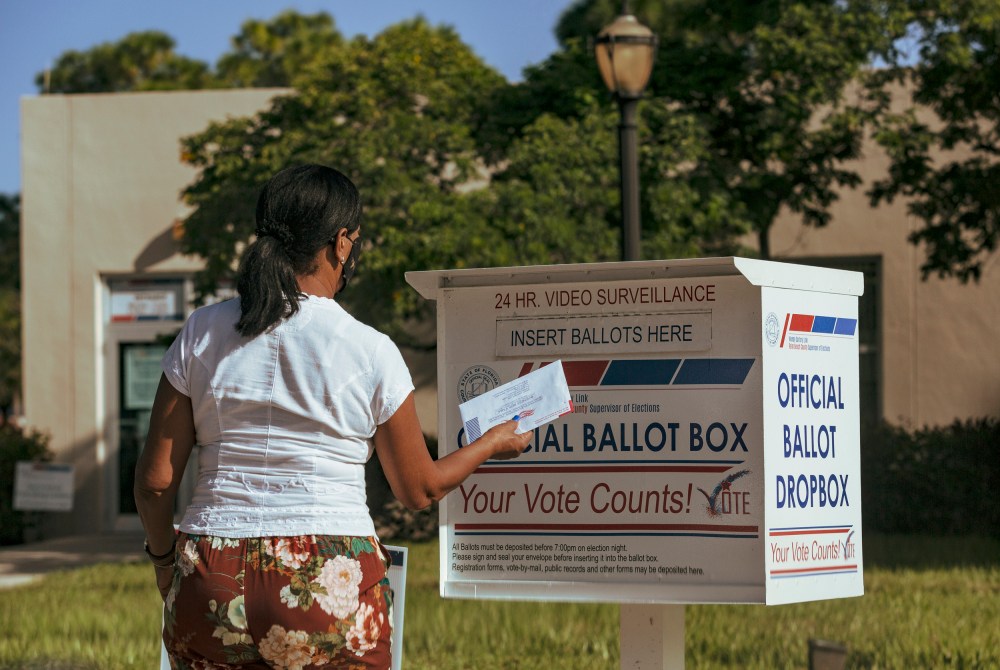
Florida has earned the distinction of becoming the first state in the nation won by former President Donald Trump in the 2020 election to implement restrictive voting measures. Of course, Florida’s new law is not a one-off; it follows a trend set by Georgia, which previously passed a suppressive law. Texas is on the verge of passing a similarly restrictive law. And many other state bills are waiting in the wings.
The people who support Florida’s law cannot seriously claim to support a representative democracy.
There is a two-fold solution that federal lawmakers can enact to prevent further erosion of our voting rights. First, we need federal voting rights protections, and we need them now. Second, we should use a little known, but Constitutional, mechanism to strip the Supreme Court of jurisdiction to weigh in on that federal law.
While stripping the court of jurisdiction is not an action that should be taken lightly — or even often — we are in desperate need of a federal law that protects voters against suppression and discrimination. Let’s call these laws what they are: anti-democratic.
While it is not a fait accompli that broader federal voting rights protections would be dismantled by our current Supreme Court, it is more than a remote possibility. Article III of the U.S. Constitution specifically authorizes Congress to make “exceptions” and “regulations” to the ability of the Supreme Court to hear certain cases. Hence, per Congress’ authority under Article III, it should strip the Supreme Court of the power to review that piece of legislation.

Perhaps the main problem with jurisdiction stripping is that it can be used to insulate both “good” and “bad” laws from Supreme Court review. Let’s imagine that Congress passes a law which purports to outlaw voting my mail, is upheld by the lower federal courts, and includes a jurisdiction stripping provision. This may be exactly the moment when we need the highest court in the land to step in as the last stop against the tyranny of the majority, and overturn such a law. In addition, we have to be mindful of the separations of power issues raised by jurisdiction stripping.
Florida’s law would, among other things, place limits on drop boxes, require voters to more regularly request vote by mail ballots, and limit the people who can drop off ballots for a voter.
Trump won Florida, so what are Republicans worried about anyway?
Florida’s voting law, like so many of these restrictive voting laws seem to be, is cloaked as a solution to voter fraud, but is actually a solution to Republican anxiety about losing elections. Florida’s own election supervisors apparently found no widespread fraud over the last four years. Second, Trump won Florida, so what are Republicans worried about anyway? The likely answer is shifting demographics and voting trends. In the 2020 election, unlike the 2016 and 2018 elections, more Democrats than Republicans voted by mail. This could be in part because due to unfounded allegations spread by Trump and his supporters, the vote by mail system was not deemed trustworthy. But it does not seem to be a coincidence that just as Democrats start voting by mail more often than Republicans, one of the things Florida’s law will do will be to create more barriers to voting my mail.
Yes, some parts of these laws may be declared unconstitutional under the First and 14th Amendments to the U.S. Constitutional and parts may be suspect even under what remains of our federal voting rights act. But these protections are not enough.

The time to enact a floor of federal voting rights protections is not now; it was frankly years ago. But we do still have time to act before another election cycle passes us by. Just a few months ago, the House of Representatives again passed a bill that would expand voting rights protections. The bill will now languish thanks to the use of the filibuster and the fact that most laws now need 60 votes in the Senate to pass.
But let’s imagine for a moment that that key hurdle is passed and real voting rights protections once again become the law of the land. That all-important law may meet its demise before it is ever implemented in our current Supreme Court. The current court is more conservative, and likely, more hostile to a federal voting rights law than the court that overturned half of the Voting Rights Act in 2013 in Shelby County v. Holder. That was a five-to-four decision and four members of majority are still on the court. The time to enact a floor of federal voting rights protections is not now; it was frankly years ago. Now-retired Justice Anthony Kennedy was replaced by his former clerk, Justice Brett Kavanaugh. And one of the members of the minority in that 2013 case, Justice Ruth Bader Ginsburg, who passed away in September 2020, was replaced by Justice Amy Coney Barret. Voting rights advocates may be rationally concerned about whether Kavanaugh or Barrett would uphold another piece of federal voting rights legislation which puts demands and constraints on states with respect to how they run elections. Federal voting rights protection is not just any law. In so many ways, it is the foundation of other laws, and in fact of maintaining our system of government. If access to the ballot box is restricted because those in power want to keep power, it becomes damn near impossible to hold elected officials accountable and create a government which truly represents the electorate. Put another way, restrictive voting laws not only protect lawmakers from change and possible ouster, they harm voters and degrade our government by stymieing voters’ ability to make changes and elect the candidates of their choosing. And so, only in this limited circumstance, when the legislation itself deals with the ability of our government to function and our voters to have a voice, jurisdiction stripping is an appropriate remedy to what ails America. I don’t use words like “suppressive” or “anti-democratic” lightly, but they apply here. The people who support Florida’s law cannot seriously claim to support a representative democracy. Winning by making it harder for certain people to vote is not a victory. Success at the ballot box which comes only from closing the gates to the polling places is a defeat for our country.
Jessica Levinson is a Loyola Law School professor and MS NOW columnist. 

