








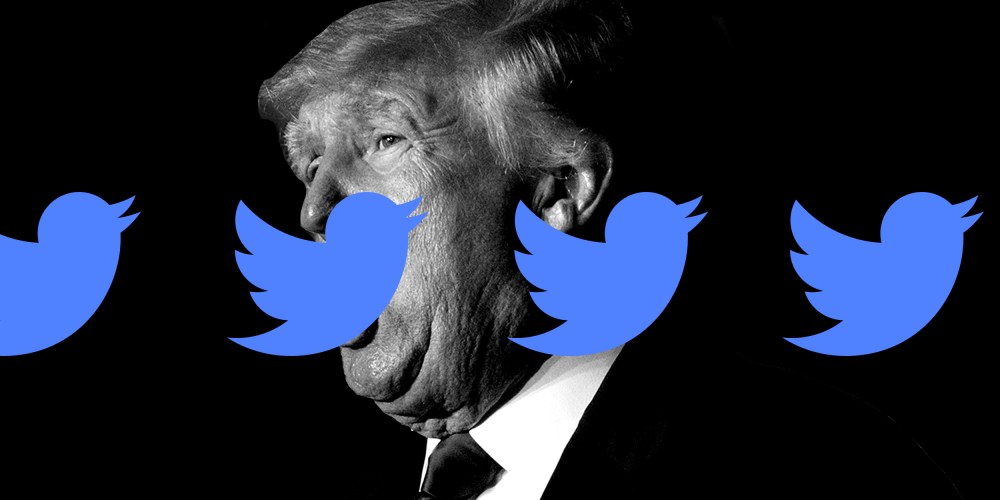
Our former president has had enough of his permanent Twitter timeout. Donald Trump wants back on the social media platform that allowed him to efficiently amplify his often-hateful messages, including those encouraging the insurrection at the U.S. Capitol on Jan. 6. Indeed, two days after a violent mob of Trump’s supporters attempted to overturn a valid election at his behest, Twitter banned Trump.
Trump’s legal arguments are real stinkers, perhaps rivaled only by the absurd strategy to have him declared the winner of the 2020 election.
Trump asked a federal judge to force Twitter to allow him to get back on its platform for a variety of (to use a legal phrase) utterly bogus reasons. Trump’s legal arguments are real stinkers, perhaps rivaled only by the absurd and unsuccessful post-election litigation strategy to have him declared the winner of the 2020 election. The demand to be let back on Twitter, of course, is an implicit acknowledgment that Trump’s attempt to communicate with his supporters via his website was a failure. If Trump could effectively reach a wide audience through other means, he would.
Trump’s legal argument is a bit like looking in a funhouse mirror. Once you open your eyes, everything is upside down and distorted.
Trump’s first assertion is that Twitter is violating his First Amendment rights by censoring him. Perhaps one of the most common misconceptions regarding the First Amendment is that it protects our right to say whatever we want without limits. This is grossly incorrect. The First Amendment protects us against government censorship. A private individual or group can absolutely tell you to shut the hell up, and in this case, to get off its platform.

The first thing law students learn about the First Amendment is that it applies only to government actions; Trump’s attorneys understand that. Instead, they have essentially argued that because Twitter is so big and powerful, benefits from a federal law, allegedly acts in agreement with government officials, that it is the government. The problem of course, is that it is not. For a whole host of reasons. Many private individuals, groups and corporations are hugely powerful and even have complex business dealings with the government. That doesn’t mean a magic cloaking device is thrown around them the moment they surpass a certain level of power and, voilà, they become the government. Here is where the topsy-turvy part of Trump’s legal arguments really kicks in. If Trump could force a federal judge, undoubtedly a member of the government, to compel Twitter, a private company, to put him back on its platform, that would be the only real First Amendment violation at issue here. Under the First Amendment, there is a doctrine called “compelled speech,” basically the flip side of censorship. Under the First Amendment, the government can neither force you to stop nor start speaking.
If Trump won his argument and a judge ordered a private company to put him back on its platform, that action could amount to unconstitutional compelled speech. If forced or compelled speech were allowed, here are a few things that could happen: A state could force kids to stand and salute the flag; put a motto, with which you disagree, on your license plate, or prohibit you from distributing anonymous campaign material. You get the picture. If Trump won his argument, that action could amount to unconstitutional compelled speech. Like so many of his, often doomed, legal arguments, Trump may know this suit has as much chance as encountering a unicorn on the way to work. So what is really going on here? In part, Trump’s go-to response when he is upset is to file a suit. Lawsuits tend to scare people and perhaps deter their actions, even when they are not doing anything wrong. Just as the rest of us reflexively duck or swat when a ball is thrown at us, Trump, just as reflexively, files a lawsuit when he is angry. But Twitter is not a small mom-and-pop startup, and it is unlikely to be scared off by paying legal fees to defend against this meritless suit. So another part of what is going on is likely that by filing the suit, Trump can try to convince his supporters that Twitter is doing something illegal. He’s long argued that Twitter is in cahoots with the Democrats and is treating Trump unfairly, but making that argument through a legal filing gives it a whiff of legitimacy. The primary reason Trump wants to get back on Twitter is money, the same thing it so often seems to be about with him. He has used previous lawsuits against social media companies to fundraise. Heading into the 2022 midterm elections and perhaps another presidential run in 2024, his ability to fundraise will be an important predictor of the role he will continue to play in the Republican Party. Trump’s desire to get back on Twitter is not about freedom of speech but, rather, all about the power of money to speak in campaigns.
Jessica Levinson is a Loyola Law School professor and MS NOW columnist. 

