








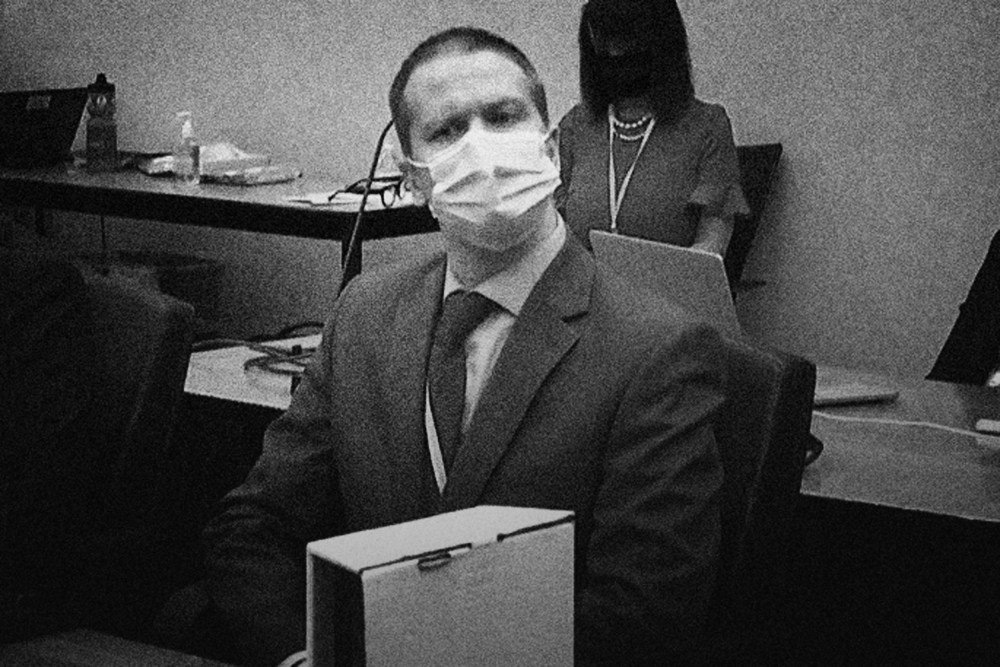
On Monday, 10 months after George Floyd’s death, the trial of former Minneapolis police Officer Derek Chauvin began in Minnesota. Chauvin faces second-degree unintentional murder, third-degree murder and second-degree manslaughter charges in Floyd’s shocking death, which was captured on bystander video and viewed around the world.
The prosecution told jurors to “believe your eyes” when they watch and hear about Floyd’s death.
The prosecution told jurors to “believe your eyes” when they watch and hear about Floyd’s final minutes. And video of the incident may make folks think this is an easy case for prosecutors. But the forensic pathology piece suggests otherwise. (Disclaimer: There is so much that could be written, discussed, argued and debated on the forensic pathology front, but I will touch on only some of the highlights here. As a warning, some readers may find the analysis and details below upsetting.)
The Hennepin County medical examiner who performed the autopsy, Dr. Andrew Baker, ruled that the cause of death was “cardiopulmonary arrest complicating law enforcement subdual, restraint, and neck compression.”

“Cardiopulmonary arrest,” in layman’s terms, means “the heart stopped.” Of course, it stopped while police officers were applying “restraint and neck compression.” This is what makes this case a “homicide” — which simply means “death at the hands of another.” Importantly, the word “homicide” does not connote criminality. If I kill someone in a lawful exercise of self-defense, I have committed a homicide but have done nothing criminal.
Having absorbed the Floyd autopsy report and consulted with my friends in the forensic pathology community, I have a layman’s explanation for Baker’s findings: The pressure being applied to Floyd’s neck and the pressure being applied to his torso, in combination, impeded his oxygenated blood flow, which resulted in his heart stopping. More specifically, it takes only about a few pounds of pressure on the veins in one’s neck (arteries are a bit deeper) to significantly disrupt blood flow. Regarding the torso, if pressure is being applied, it can make it difficult to draw enough oxygen into the lungs to allow for the oxygenation of the blood in the first instance. Therefore, the combination of these applications of force and restraint caused Floyd’s heart to stop.
However, a number of forensic findings will give the defense some room to maneuver. Importantly, Baker found no clear injuries to Floyd’s neck, either internally or externally. This tells us something (though not everything) about the amount of force Chauvin was applying to Floyd’s neck. You can bet the defense will argue that the pressure was minimal. In my experience with manual strangulation cases, there are almost always injuries to the structures of the neck (a broken or fractured hyoid bone, for example, or fractured thyroid cartilage, etc.).
It’s worth mentioning that, in a manual strangulation incident, the victim can lose consciousness within 10 seconds and die in 3 to 5 minutes. Though this may sound counterintuitive, I suspect we will see the defense “embrace” the fact that Chauvin knelt on Floyd for 9 minutes and 29 seconds — not the infamous 8 minutes and 46 seconds, by the way — as evidence suggesting that Chauvin was not putting significant enough pressure on Floyd’s neck to kill him via asphyxiation.
Though this may sound counterintuitive, I suspect we will see the defense “embrace” the fact that Chauvin knelt on Floyd for 9 minutes and 29 seconds.
Another important finding: Baker noted “no facial, oral mucosal, or conjunctival petechiae.” In deaths involving manual strangulation/asphyxiation, there generally are petechial hemorrhages in the whites of the eyes and often in the gums and elsewhere. The absence of such hemorrhages suggests that there was not a sustained, acute cutting off of Floyd’s airway. I can envision the defense arguing that these findings refute (at least in part) any suggestion that this was an asphyxial death (as Dr. Michael Baden, the forensic pathologist hired by the Floyd family, opined).
But it’s important to note again that you can have an asphyxial death without injuries to the neck and without petechial hemorrhages.
The prosecution has several forensic pathologists it may call to the stand. The defense says it may call as many as eight medical experts of its own; key among them is likely to be Dr. David Fowler, the former chief medical examiner for Maryland. I know Fowler well, as I hired him and put him on the stand as the prosecution’s independent expert witness (when I had a murder case with a specialized need beyond the expertise of the forensic pathologist who performed the autopsy in a given case).
Indeed, I turned to Fowler in some of the most complicated cause-and-manner-of-death cases we dealt with in Washington, D.C. Fowler is a very accomplished forensic pathologist and a strong trial witness. Incidentally, he is also steeped in the controversial field of “excited delirium,” which may or may not make a showing at the Chauvin trial. (The syndrome, which is not recognized by either the American Medical Association or the American Psychiatric Association, has been used by dozens of police offices to explain how suspects died suddenly in custody, often when drugs are involved. I worked with Fowler in an excited delirium case that was a bit infamous — the “D.C. 9 case.”) We have already seen some of this defense strategy play out in opening statements. Chauvin’s lead defense attorney, Eric Nelson, said Floyd displayed “none of the telltale signs of asphyxiation.” There was “no evidence that Mr. Floyd’s airflow was restricted,” he claimed. I expect that the defense will continue to argue this point throughout the trial, contending that the findings during autopsy suggest that Chauvin was not placing any significant pressure on Floyd’s neck and was not impeding his ability to breathe. Of course, given that the other defendants have been severed from the trial, Chauvin is also likely to argue that if any pressure was being applied to Floyd’s torso by other officers (which could create a suggestion of asphyxia), they may be culpable even if he is not. To be clear, I am not suggesting this is a winning defense, but it is, at a minimum, a defense that will find at least some support in the autopsy findings.
Glenn Kirschner
Glenn Kirschner, a former assistant U.S. attorney for Washington, D.C., is an NBC News and MSNBC legal analyst. 


