








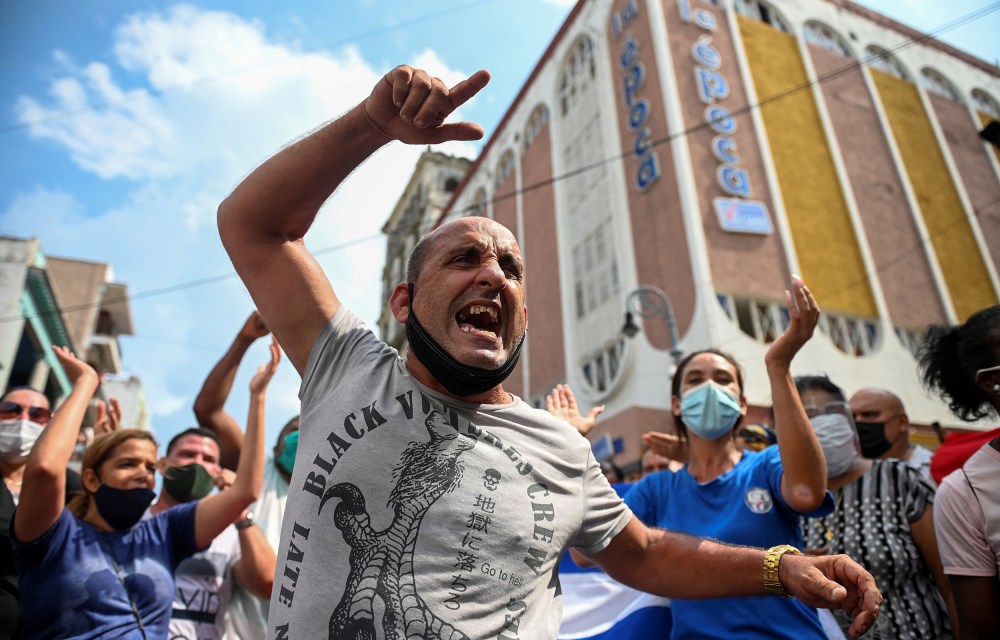
This weekend, thousands of Cubans poured into the streets in the largest display of anti-government sentiment since 1994. We’re only aware of what’s happening in Cuba thanks to a handful of videos that slipped out before the government closed off communications with the outside world and publicly threatened to crush the protests by force.
Rolling, hourslong blackouts outside of the country’s cities has upended Cuba’s governable consensus.
But we saw enough: Demonstrators chanting slogans like “we want freedom” and flying the American flag.The accounts of this event in mainstream American media venues are mechanically nuanced. The Cuban economy has been decimated by the pandemic-related tourism drought. Shortages of food, medicine and doctors have created intolerable conditions. Rolling, hourslong blackouts outside of the country’s cities has upended Cuba’s governable consensus.
But the Cubans demonstrating in the streets chanting “anti-government slogans” of “Freedom!” in this Communist island “known for repressive crackdowns on dissent,” as The New York Times damningly observed, are demanding something more from Havana than functioning public utilities and basic social welfare.

In his second inaugural address, George W. Bush committed his administration to a “freedom agenda.” Both to preserve America’s national security from rogue regimes and the malefactors they incubate and to promote the flourishing of the human condition around the world, Bush pledged to pursue policies with the lofty “ultimate goal of ending tyranny in our world.”
Bush’s opponents dismissed the notion as naïve and unworldly. The president’s supporters regarded it as purely aspirational. Voters came to see it as a veiled commitment to more military adventurism around the world, and they rejected it unmistakably in both 2006 and 2008.
America has not had anything close to a “freedom agenda” since. But the oppressed peoples of the world have not abandoned their desire to breathe free, even if our support for their ambitions is now only rhetorical.
Bush pledged to pursue policies with the lofty “ultimate goal of ending tyranny in our world.”
In Cuba’s case, all the usual proximate causes that can be rationalized away as something other than a demand for essential liberties are on full display in the mainstream press. But there are always proximate causes behind the upheavals that result in the destruction of an oppressive schema. And that schema is never far from the forefront of oppressed minds.
Poland’s Solidarity movement owed its existence to the rising price of food. The unrest in the Baltic republics that culminated in the dissolution of the Soviet Union arose in response to Moscow’s plan for a strip mine in Estonia. The self-immolation of a Tunisian fruit vendor that produced one of the most responsive and democratic governments in the Muslim world occurred in response to high unemployment and inflation.
Seismic geopolitical events begin with banalities, but they are also almost always a symptom of the maladies associated with autocratic illiberalism. And eventually, an autocracy’s restive public will begin to treat the disease over its symptoms.

Rather commendably, President Joe Biden welcomed the protests as a “clarion call for freedom” — an outpouring against what the president deemed the “repression” meted out by “Cuba’s authoritarian regime.” This is due to a rejection of the “proximate causes” theory of unrest in oppressive states, but the Biden administration did not initially speak with one clear voice on the subject.
“We are deeply concerned by ‘calls to combat’ in #Cuba,” acting assistant secretary for the State Department’s Bureau of Western Hemisphere Affairs, July Chang, tweeted in what The Washington Post accurately characterized as a rebuke of Sen. Marco Rubio, R-Fla., who called on the Cuban military to “defend the people, not the Communist Party.”
“We stand by the Cuban people’s right for peaceful assembly,” Chang said. “We call for calm and condemn any violence.”
But Biden’s national security adviser, Jake Sullivan, quickly clarified the administration’s position: “The U.S. supports freedom of expression and assembly across Cuba, and would strongly condemn any violence or targeting of peaceful protesters who are exercising their universal rights.” There’s a subtle distinction here — one that speaks to the traditional American orientation toward the support of even revolutionary struggles against tyranny, particularly those that target unfree governments hostile to American national ambitions.
Eventually, an autocracy’s restive public will begin to treat the disease over its symptoms.
And why shouldn’t that be the case? We’ve seen what the laissez-faire approach produces, and no one should be satisfied with the results.
When the Venezuelan people rose up against their oppressive and regionally destabilizing government in 2014, President Barack Obama let Congress take the lead. The president signed a bill imposing sanctions on Venezuelan officials into law only after at least 43 demonstrators had been killed and the movement that threatened to topple the regime in Caracas had been all but quelled.
Obama was just as reluctant to provide any meaningful support for the demonstrators who made up Iran’s “Green Revolution” in 2009. For fear of jeopardizing the prospects for diplomacy with Tehran or inflaming an already tense situation, Obama downplayed the prospects for revolutionary social change in Iran. Indeed, he hoped to avoid making the U.S. “the issue inside of Iran,” and could not be moved to even question the results of what few observers concluded was a free and fair election. Obama’s Republican successor was similarly if not equally inclined against providing any meaningful support for anti-authoritarian dissidents. Donald Trump got a second bite at the apple of Iranian democracy in late 2019 and early 2020 when violent protests erupted, ostensibly over rising gas prices (more proximate causes). And while Trump was more willing than his predecessor to express support for anti-regime demonstrators’ goals, he stopped short of advancing them himself. “U.S. officials say the administration needs to avoid any overtures that could draw accusations of foreign meddling — like direct financing,” Reuters reported, “and increase the chances of a violent crackdown on the people it wants to support.” That caution seemed to inform the Trump administration’s handling of the outpouring of anti-Beijing sentiment in the streets of Hong Kong in 2019. Akin to Obama’s administration of the crisis in Venezuela, Trump let Congress lead the way. And while the Trump White House was rhetorically supportive of the pro-democracy protesters, the president’s pronouncements surely confused the Chinese. He described the anti-Beijing protests as “riots,” which advanced a narrative preferred by the Chinese Communist Party. Trump coupled the issue of democracy in Hong Kong with ongoing trade negotiations, which his advisers insisted were entirely unrelated. And ultimately, he sought to avoid the very circumstances Obama feared: allowing the demonstrations to be affiliated with the United States — something that did not similarly concern the thousands of protesters who waved American flags and sang the American national anthem. And what has our stance gotten us? In Venezuela, our refusal to capitalize on the momentum of the moment allowed it to fizzle, leaving Washington to support a parallel government only belatedly and without many prospects for success. In Iran, it has led to the sacrifice of every opportunity to be rid of a medieval cabal that seems determined to one day present the world with a nuclear crisis that may only be resolvable through war or the extirpation of this regime. In China, democracy in Hong Kong is all but crushed. The regime in Beijing is now so emboldened by its success that it is intimating in every possible way that retaking Taiwan by force is no longer a hypothetical but a potentially imminent threat. So, what can Biden do for the persecuted Cuban people beyond speaking the truth about their persecutors? The White House can and should pressure countries and businesses operating inside Cuba to help the Cuban people evade the government’s efforts to limit their access to communications networks. Washington should do what it can to boost the shortwave radio signals carrying Miami-based Radio Martí. The Biden administration should threaten Cuban leaders with sanctions as well as travel and visa restrictions if they carry out Cuban President Miguel Díaz-Canel’s threat to violently suppress the protests. And if these demonstrations are put down, the U.S. should reduce its diplomatic presence in Cuba and restrict the movements of Cuban operatives inside the United States. Yes, the usual suspects will wring their hands over Washington taking tacit ownership of the protesters and their cause. So what? A more active defense of the world’s unfulfilled aspirations for freedom at least has the potential to change the course of history for the better. We know that doing nothing begets nothing. At the least, we should be honest with ourselves. We must admit that advancing the mutually compatible goals of seeking a freer world that is more stable and, therefore, more amenable to American geopolitical objectives is just a happy story we tell ourselves. If that’s not a palatable option, maybe it’s time to take a second look at the “freedom agenda.”
Noah Rothman
Noah Rothman is the associate editor of Commentary Magazine. 


