








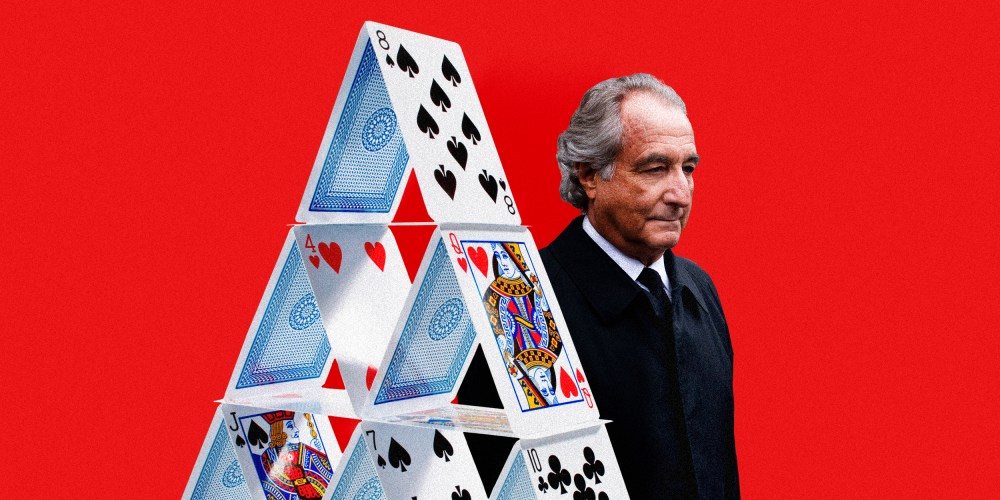
Bernie Madoff, who died Wednesday, will be justly remembered as one of the biggest scam artists in the history of capitalism. His massive, decadeslong Ponzi scheme ended up costing investors tens of billions of dollars and, in the process, wrecked many lives. But these days, Madoff also looks like something else: a man whose moneymaking scheme was an odd forerunner of the hottest, and strangest, investment crazes of the moment.
These days, Madoff also looks like something else: a man whose moneymaking scheme was an odd forerunner of the hottest, and strangest, investment crazes of the moment.
Madoff was a classic Ponzi artist. He raised money by promising his clients that he had a special proprietary investment strategy, one that allowed him to make money consistently, in any kind of market. But the strategy was an illusion, as were the investment gains. Instead, Madoff paid off his old investors with the money he raised from newer ones (while skimming something off the top for himself). This is a hard thing to keep going for a long period of time. But Madoff was smart — instead of promising his clients massive gains, he promised reasonable but stable returns. And he worked assiduously with investment managers who could keep bringing him new clients and new money. It wasn’t until the global financial crisis hit, and his clients demanded en masse to pull their money out of his investment funds, that the house of cards Madoff had built collapsed.
At its core, then, Madoff’s scheme depended on a simple idea: As long as you can keep new investors coming in and old ones from cashing out, you can make an illusion seem real. And that, as it turns out, is the same idea that has animated a host of speculative frenzies in the past year. The booms in so-called meme stocks, nonfungible tokens, or NFTs, and cryptocurrencies like Dogecoin are, in some sense, legal Ponzi schemes writ large, in which the value of the underlying assets is little more than a wager that new money will keep coming into the market.

Take the cryptocurrency Dogecoin. It was created back in 2013 as, literally, a joke, a satire on cryptocurrencies like Bitcoin. (It got its name from Doge, a popular meme that’s the image of a Shiba Inu dog looking sideways at the camera.) For years, people would trade it back and forth, mainly just for the hell of it. But over the past few months, thanks in large part to tweets by Tesla CEO Elon Musk, speculators started buying Dogecoin. As its price rose, more people started to pay attention, and the price kept rising. Last week, it rose by more than 400 percent, putting it up by a mere 5,000 percent this year. Friday afternoon, the total value of Dogecoins topped $50 billion.
Why? There is no good answer to that question, other than to say Dogecoins have gotten dramatically more valuable because people have decided to act as if they’re more valuable. But the important point is that the only way that value can be sustained, let alone continue to rise, is if the people who hold it don’t all rush to sell and if new money keeps flooding in. Just as with Madoff, if the people who think they’ve gotten rich owning Dogecoin try to cash out en masse, the whole thing will come tumbling down.
The same is true, in many ways, of the sudden craze for NFTs, which you might think of as digital certificates for things like digital art, digital sports trading cards and limited-series musical albums. Like Dogecoin, NFTs have been around for years. But beginning in late 2020, the value of NFTs exploded. From October to early April, the average selling price of NFTs rose roughly tenfold, culminating in the sale of a 10-second piece of digital art for $69 million. Suddenly everyone and their cousin is rushing to cash in on the frenzy, issuing NFTs not just of digital art, but also of magazine covers, toilet paper ads and, most notoriously, an audio clip of a year of someone’s farts.
Needless to say, what’s driving this frenzy isn’t the intrinsic value of fart clips or even NBA highlights (which you can watch free on YouTube or NBA.com without buying an NFT). Instead, NFT speculators are betting that people in the future will be willing to pay more for their NFT than they did originally because those people will think that someone else in the future will, in turn, be willing to pay more for the NFT than they did. It’s a market that depends entirely on the prospect of new money continuing to flow in.
Now, you might ask, “Isn’t this just the way all markets work — prices rise because new investors come in?” But this misses a fundamental difference between things like stocks and bonds and assets like Dogecoin or NFTs. When you buy a stock, you’re purchasing a share of an actual business and its future profits. Stock prices can get out of whack, of course, soaring far above the true value of a company’s business. But because there is a business underlying the stock price, even an inflated stock has an intrinsic value that Dogecoin doesn’t. The same is even more obviously true of bonds, in which you get regular interest payments and the guarantee that the company or the government that issued the bonds will eventually buy them back. It’s a market that depends entirely on the prospect of new money continuing to flow in. In today’s speculative booms, by contrast, value is understood as something that can, in effect, be created out of whole cloth: As long as people agree that something is valuable, they can make it valuable. And as long as you can hold down the number of people who want to cash out, you can keep it valuable for a surprisingly long time. To be clear, there is an important difference between what Bernie Madoff did and what you might call Ponzi markets. Madoff’s investors, for the most part, had no idea they were part of a Ponzi scheme, while lots of the people buying these newfangled assets are, to some extent, doing it with their eyes open. They’re speculators who are well aware that they’re playing a game. But what isn’t any different is that this game can continue only as long as people are willing to play. When they aren’t willing to do that — because people decide to cash out or panic or just get bored — the game will end, just like Madoff’s scheme did. We may already be seeing that in the market for NFTs — in March, daily sales of art NFTs were down by roughly 85 percent, according to Nonfungible.com. And at that point the people with bad luck or bad timing, inevitably, will lose. It’s like Wile E. Coyote running off a cliff. He can keep going until the moment he realizes there’s no ground beneath him. When he does, he falls. And it’s a long, long way down.
James Surowiecki
James Surowiecki is the author of "The Wisdom of Crowds." His work has appeared in The New Yorker, The New York Times, Wired and Fortune, among others. 

