








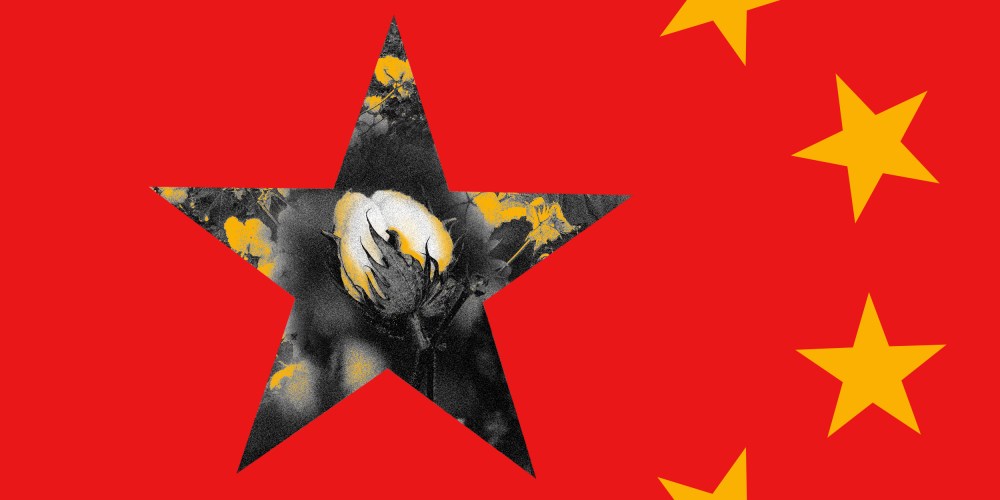
There’s something about cotton. The backbreaking crop that powered the antebellum South is etched in the psyche of every Black American. And centuries later, it remains one of the clearest symbols of the horror of the enslaved experience.
According to Chinese government documents and media reports, over 500,000 Uighurs have been mobilized to labor in the cotton fields, fueling China’s textile industry.
That racial memory is why a new report from the BBC published Monday stopped me cold when it crossed my Twitter feed. It turns out that halfway around the world, there are still minorities being forced to spend their days harvesting cotton — and it is part of a program based in racist denigration, an attempt to “better” a people whom their overseers have deemed backwards.
About 20 percent of the world’s cotton comes from the Xinjiang region of China. It’s the homeland of the Uighurs, a mostly Muslim ethnic group that for the last decade has been subjected to brutal repression and a concerted effort directed from Beijing to erase their culture and bring the northwestern province entirely to heel. And according to Chinese government documents and media reports, over 500,000 Uighurs have been mobilized to labor in the cotton fields, fueling China’s textile industry.
Previous reports have showed evidence of forced labor in Xinjiang’s textile factories — these newly reported documents show that the oppression goes all the way to the cotton fields. Taken together, they’re the clearest evidence yet that more than 150 years after the end of the U.S. Civil War, the cotton market is once again a center of human rights abuses.
It’s a case where Beijing’s economic and political goals appear to have intertwined. President Xi Jinping has made erasing poverty in China a key strategic goal. Among the more controversial tactics local officials have taken to hit that goal include relocating people from rural areas to urban centers, sometimes leaving them stranded in new cities, and forcing citizens to download an app that strongly encourages donations to the impoverished.

Those efforts are at the heart of most of the documents the BBC cites, which trumpet efforts to get the Uighurs working for wages instead of traditional sustenance farming or raising families. In the process, hundreds of thousands of Uighurs have been recruited to be shipped away from home for up to three months at a time during the harvest season. But the Xinjiang cotton scheme goes beyond just relieving poverty. A policy document from the Aksu prefecture, dated October 2020, notes that groups of cotton-pickers are accompanied by officials who “eat, live, study and work with them, actively implementing thought education during cotton picking.”
The re-education efforts the documents mention mirror those seen inside the much more infamous detention centers that Beijing has secretly constructed around Xinjiang. While China has said that the camps are merely vocational training centers, the few former detainees who have emerged and agreed to speak out say the true goal is the sublimation of Uighur culture and religion, through a program of abuse, deprivation and force-fed propaganda. We don’t know for sure how many Uighurs have been funneled through the camps, or how many remain, but estimates tend to put the number at over 1 million.
It seems like the detention centers are separate from this particular forced labor scheme. But the same security state apparatus that provides targets to send to the camps also powers the surveillance apparatus that has deployed 1 million government officials to live in Uighur homes to monitor the population. And the government seems unwilling to accept any refusals to perform the difficult work offered under it’s “labor export” scheme. A report from Jiashi county notes that in a village where after a door-to-door recruiting program locals were “unwilling to go out to work,” officials went back to their homes to “eliminate the villagers’ ideological concerns.” Twenty people were shipped out afterwards, the report declares, with another 60 due to be transferred in the near future.
Baked within this program are a series of assumptions about Uighurs that are downright racist.
Baked within this program are a series of assumptions about Uighurs that are downright racist. China is dominated by the majority Han ethnic group and in Xi’s time in office, the Chinese Communist Party has overseen a deepening of Han nationalism. China scholar James Millward detailed this suppression of minority cultures in 2019, noting that “rather than celebrating the uniqueness of individual cultures, the C.C.P. increasingly promotes a unitary category called ‘zhonghua,’ a kind of pan-Chinese identity. Though supposedly all-inclusive, the customs and characteristics of ‘zhonghua’ are practically identical to those of the Han.”
The increase in local Uighur workers has coincided with a reduced need to import Han Chinese laborers to the region. In freeing Han from this menial work, the government simultaneously sees itself as breaking the Uighurs of the “old-fashioned, unenlightened, and lazy thoughts” that plague them. The heavy-handed recruitment to pick cotton is necessary in communities where “the idea of laziness is deeply rooted,” one report claims. The idea that only through hard work can an indolent, backwards people modernize and become valued members of society is a familiar refrain to my Black ears. Supposed testimonials from Uighurs happy to have been put to work drip with the same honeyed poison as Jim Crow minstrel caricatures. One man is quoted in local state-run media as saying: “In the past, my lazy thoughts of ‘waiting, relying, and asking’ were serious. I only knew how to ask for things from the party and the government.” But with the support of the party, he now knows that the best thing in life “is to use the money I earn with my hard-working hands and my sweat.” I can almost see the dead-eyed look on his face as he mouths the words he knows his oppressors want to hear. The documents which form the basis of the BBC’s reporting were obtained and compiled by Dr. Adrian Zenz. Zenz, a senior fellow at the Victims of Communism Memorial Foundation, a Washington-based nonprofit that I, in all honestly, normally wouldn’t cite. And the report he compiled, from which many of the translated quotes in this essay are sourced, is thorough — but was first published at a tiny, recently established think-tank based in a small for-profit college in Virginia. Nonetheless, the documents he draws from are credible and track with what news outlets have reported about the conditions in Xinjiang. It’s disappointing, but not surprising — since when have businesses let a little thing like human suffering get in the way of their profits? Earlier this year, activists began organizing to get clothing brands end the use of Xinjiang cotton in their garments. The U.S. government meanwhile has begun restricting imports on certain products from Xinjiang, citing alleged forced labor concerns. And on Dec. 2, the U.S. banned cotton imports from the Xinjiang Production and Construction Corps, a state-owned paramilitary group that functions as Beijing’s arm in Xinjiang. But that still leaves two-thirds of Xinjiang’s cotton free to enter the American market. That could change though in the near future: A bill that would ban imports from Xinjiang produced with forced labor is currently waiting in the Senate after passing the House overwhelmingly in September. Several major companies and business groups are reportedly trying to water down the provisions of the bill to keep their supply chains steady. It’s disappointing, but not surprising — since when have businesses let a little thing like human suffering get in the way of their profits? I can only hope that the senators of today have a different view on the supremacy of King Cotton and other business interests than their predecessors once held.
Hayes Brown is a writer and editor for MS NOW Daily. 


