








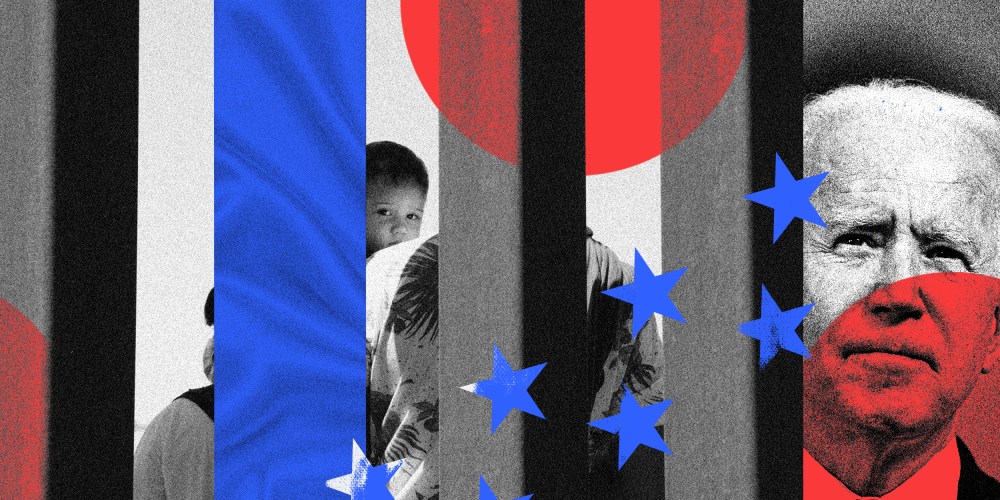
As new NBC News polling finds President Joe Biden enjoying a 53 percent approval rating, at least one issue stands out where polling shows a majority of Americans are dissatisfied with the president: immigration.
The first few weeks of the Biden administration brought a flurry of executive actions.
Yes, the low marks mean in part that Republicans have succeeded in turning a humanitarian crisis into an opportunity to fearmonger and score political points. (The Wi-Fi password at this week’s Republican House retreat was “Biden Border Crisis.”) But that low rating also reflects the frustration of many Americans who actually want to see Biden do more for immigrants, and do it faster.
Assessing the Biden administration’s approach to immigration in its first 100 days requires acknowledging the issues at hand are so complex, and many of the systems in play so deeply neglected, that delivering transformative change will require much longer than a few months.
The Biden administration knows this and has acknowledged the root causes of migration — climate change, government corruption, violence — necessitate a regional framework and long-term sustained investment.

The president is expected to address this problem area in his Wednesday speech commemorating his first 100 days in office. But even when analyzing what is possible within something as brief (and arbitrary) as a 100-day window, the results on immigration are strikingly uneven.
The first few weeks of the Biden administration brought a flurry of executive actions. Biden established a task force to reunite families separated by the Trump administration, moved to safeguard the Deferred Action for Childhood Arrivals program, issued a 100-day moratorium on deportations and rescinded the Muslim ban. The administration also suspended the Migrant Protection Protocols, the so-called remain in Mexico program, rescinded the Trump public charge rule and the previous administration’s changes to the naturalization test and eliminated the U.S. Citizenship and Immigration Services’ “blank space” policy; reinstated Deferred Enforced Departure for Liberians; extended Temporary Protected Status (TPS) to Burmese, Syrians and Venezuelans; and restarted the Central American Minors Program. In addition, the legislative framework the administration put forward to reform immigration was largely celebrated by activists.
That initial deluge set an expectation on the pace of progress that has since proved hard to maintain.
That initial deluge set an expectation on the pace of progress that has since proved hard to maintain. Several of the president’s efforts, including the moratorium and stopping border wall construction, ran into legal obstacles. The administration has frustrated and disappointed immigration advocates by maintaining the President Donald Trump-era policy known as Title 42, which uses the coronavirus pandemic as a pretext to limit asylum.

As my colleague Julia Ainsley has reported, there are five major immigration promises that Biden has yet to deliver on. Those include actually reuniting migrant families separated by the Trump administration’s zero-tolerance policy (the reunification task force has committed to bring deported parents back to the United States to be reunited with their children, but to date, none of those parents have actually been returned); holding the administration accountable for the abuses endured under that policy; ending the detention of migrant families by U.S. Immigration and Customs Enforcement; and ending construction on the border wall (a judge two weeks ago agreed to give the government land in Texas for the purpose of wall construction).
Most recently, the administration’s reversal on a commitment to raise the refugee cap from the Trump administration’s historic low has sparked outrage among advocates and congressional Democrats alike. The administration later said it would increase the cap, but the unforced error heightened concern that the administration was beginning to soften its initial resolve on expanding immigration pathways. The big question is whether the administration has the fortitude to continue to act boldly in the face of the political attacks it is facing on immigration. With many of these issues, there are two common threads. Looking backward, there is a seeming underestimation by the Biden administration of the bureaucratic and legal obstacles it would need to maneuver around and on the processes it would need to put in place expeditiously to deliver on said promises. Looking forward, the big question is whether the administration has the fortitude to continue to act boldly in the face of the political attacks it is facing on immigration. That will come into sharp focus as advocates call on the president to take action to create a pathway to citizenship for undocumented immigrants. “Promises are not enough,” said Lorella Praeli, president of advocacy group Community Change Action. “We need to pass legislation this year. The White House must start working with Democrats to make sure that citizenship for essential workers, undocumented youth, TPS holders and farmworkers are included in the infrastructure package.” With the first 100 days almost behind us, the next 100 days will tell us not just whether the Biden administration will stand firm in its commitments to undo the atrocities committed by the previous administration but whether it will actively reshape America’s immigration system to be fair, welcoming and humane.
Alicia Menendez
Alicia Menendez is a co-host of "The Weeknight," which airs Monday through Friday at 7 p.m. ET on MSNBC. She is also the host of the “Latina to Latina” podcast and the author of “The Likeability Trap: How to Break Free and Succeed As You Are.” 

