








New York Times columnist Tom Friedman is pretty sure he’s found the cure for America’s rampant polarization. We need only take our cue from Israeli politics and put a Democrat and Republican together on the same ticket in 2024. Unfortunately, this has been tried before — and it wound up being a mess that led to the country’s first presidential impeachment.
After multiple Israeli elections failed to produce a stable government, Friedman explained, an unlikely coalition came together to form a four-year unity government:
It’s the most diverse national unity government in Israel’s history, one that stretches from Jewish settlers on the right all the way to an Israeli-Arab Islamist party and super-liberals on the left. Most important, it’s holding together, getting stuff done and muting the hyperpolarization that was making Israel ungovernable. Is that what America needs in 2024 — a ticket of Joe Biden and Liz Cheney? Or Joe Biden and Lisa Murkowski, or Kamala Harris and Mitt Romney, or Stacey Abrams and Liz Cheney, or Amy Klobuchar and Liz Cheney? Or any other such combination.
Let’s for now leave aside the very real differences between Israel’s parliamentary, multiparty government system and our own two-party presidential way of doing things. History shows that Friedman’s idea is one that gets constantly recycled but never pans out.
History shows that Friedman’s idea is one that gets constantly recycled but never pans out.
Sen. John McCain, R-Ariz., in 2004 shot down overtures to serve as running mate to fellow Sen. John Kerry, D-Mass. Pundits floated the idea of McCain picking a Democrat as his vice president four years later, before he went with conservative Alaska Gov. Sarah Palin instead. Former Govs. John Kasich and John Hickenlooper — a Republican from Ohio and Democrat from Colorado, respectively — were pitched as a plausible unity ticket in 2020, despite seemingly zero demand from the electorate.
And in 2011, Friedman himself was trumpeting the work of Americans Elect, a group that wanted “to take a presidential nominating process now monopolized by the Republican and Democratic parties, which are beholden to their special interests, and blow it wide open.” (It did not.)
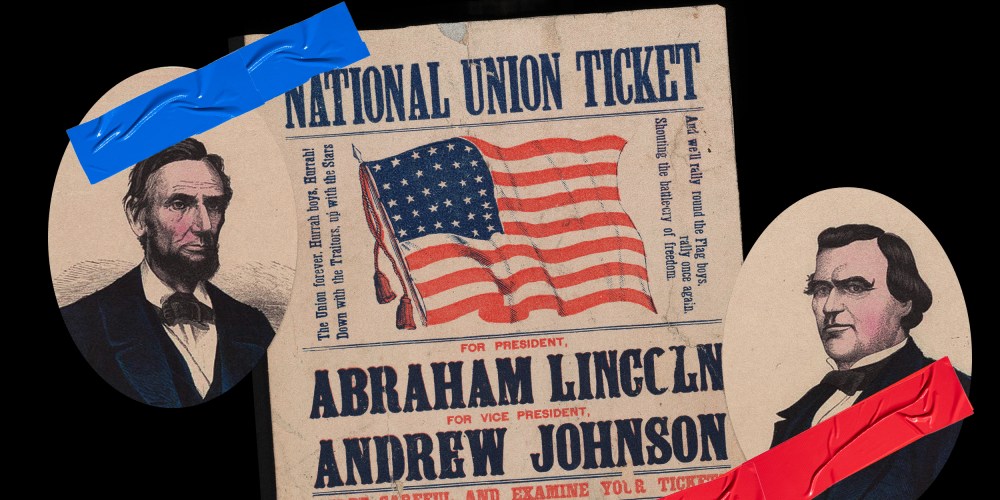
To Friedman’s credit, there is a precedent. There was a time when candidates from separate parties formed a single ticket. Abraham Lincoln, who became our first Republican president when he took office in 1861, won his second term as a candidate on the National Union Party ticket. In the process, he ditched his first vice president, Hannibal Hamlin, for Democrat Andrew Johnson of Tennessee.
Lincoln’s prospects for re-election in 1864 were not exactly great. The Civil War was dragging on, Union victories were few and far between and Lincoln faced an internal challenge from the left from the so-called Radical Republicans. Hamlin, a Maine Republican, was not super enthusiastic about serving again and was unlikely to have helped Lincoln in his bid to be the first second-term president since Andrew Jackson.
On the other hand, Johnson was a War Democrat, a firm believer in the preservation of the union. Hailing from eastern Tennessee, which was pro-Union, he was the only senator from a state that had joined the Confederacy to not resign his seat. When the Union Army occupied Tennessee, Lincoln had appointed him as military governor. He was also anti-slavery and, altogether, a potential boon politically for Lincoln.
While historians dispute whether Lincoln nudged the convention to pick Johnson, the outcome was clear: The pair won handily, both in the Electoral College and the popular vote. Political polling had yet to be developed, so it’s hard to know how much of a swing adding Johnson to the ticket provided. Historian Michael Burlingame argued, though, that having Johnson on the ballot meant “thousands of moderate Democrats in the border states moved into the Lincoln column.”
Friedman and others who’d propose someone like Rep. Liz Cheney, R-Wyo., as President Joe Biden’s 2024 running mate are hoping she’d do something similar: bring in moderate, suburban Republicans who swung away from former President Donald Trump 2020. (They don’t say, though, why they think those voters would swing back to Trump in 2024, but I digress.) In this way, the partisan divide Trump has inspired could be healed and the antidemocratic forces he’s marshaled turned back.
It’s a lovely bipartisan vision — but to see why that would be a mistake, look past the 1864 election and to what came next. While it’s taboo to discuss, the main job of the vice president is to act as a successor if the president is unable to fulfill the role. Johnson ascended to the presidency following Lincoln’s assassination, just one month after their term began. Johnson was left to manage the aftermath of the Civil War on his own terms.
It’s a lovely bipartisan vision — but to see why that would be a mistake, look past the 1864 election and to what came next. Republicans in Congress were not interested in bipartisanship, nor were they on the same page as Johnson regarding Reconstruction. Johnson envisioned a speedy reconciliation with the Southern states, forming a potential power base for his own re-election. Republicans, meanwhile, wanted protections for newly freed Black Americans, demanding that former Confederate states ratify the 14th Amendment before they were readmitted. The clash between the two branches over Reconstruction policy saw Congress (rightfully) overturn multiple vetoes from Johnson and Johnson dig in his heels against what he viewed as the weakening of white political power. While Congress’ impeachment of Johnson was over a relatively trivial law, failing by one vote to remove him from office, the political damage was done. He was not on the ballot in 1868, when former Union Gen. Ulysses S. Grant won the White House for Republicans. Over his two terms, Grant would continue to administer Congress’ vision of Reconstruction. The next election would be one of the most controversial ever, with Republican Rutherford B. Hayes prevailing only by promising to withdraw federal troops from the South, ending Reconstruction. That decision left Black Americans at the mercy of the restored white political class and set democracy back almost a century. Now, I’m not arguing that a Biden-Cheney ticket or any combo that Friedman proposed would meet the same fate as the Lincoln-Johnson administration. But there are real issues with her and Biden sharing a platform. While Johnson was a popular figure within his party, the same cannot be said of Cheney, Romney or any other Republican who might fit the bill. Even if — if! — a Biden-Cheney ticket won over some Republican voters, it may have a net negative effect on progressive voters. And it still wouldn’t change the Republican Party’s overall position. The remaining members of the party, much as in Johnson’s day, would have no sense of loyalty to the vice president or reason to change their policies or mute their obstructionism. As NBC News’ Alex Seitz-Wald put it on Twitter: “If the only bipartisanship you’re interested in is with apostates from the other party, then you’re not really interested in bipartisanism.” The idea that the Democratic Party would cede the top of the ballot to a third party in the same vein as the National Union Party or that Cheney would endorse the Democratic Party’s platform is also absurd. Johnson arguably delivered the border states to Lincoln, but I can’t see any states Biden lost in 2020 tipping towards him because of Cheney’s presence on the ticket. I can’t even see any state he won being locked in that way. I understand the desire to see the gap between the parties bridged. But it’s not going to happen just because a (D) and (R) appear together at the top of voters’ ballots. And, more to the point, it presumes that this pipe dream of a unity ticket ever makes it that far. It won’t.
Hayes Brown is a writer and editor for MS NOW Daily. 

