








As the omicron variant of the novel coronavirus spreads and adults and children are hospitalized in record numbers, the Centers for Disease Control and Prevention has shortened the recommended amount of time asymptomatic people who test positive for Covid-19 spend in quarantine. There is not a requirement that people test negative before ending that shorter isolation period, although Dr. Anthony Fauci, the White House’s top medical adviser, has said the CDC is considering it.
Though many schools have delayed their returns following winter break, Secretary of Education Miguel Cardona said this week, “Our expectation is for schools to be open full time for students for in-person learning.”
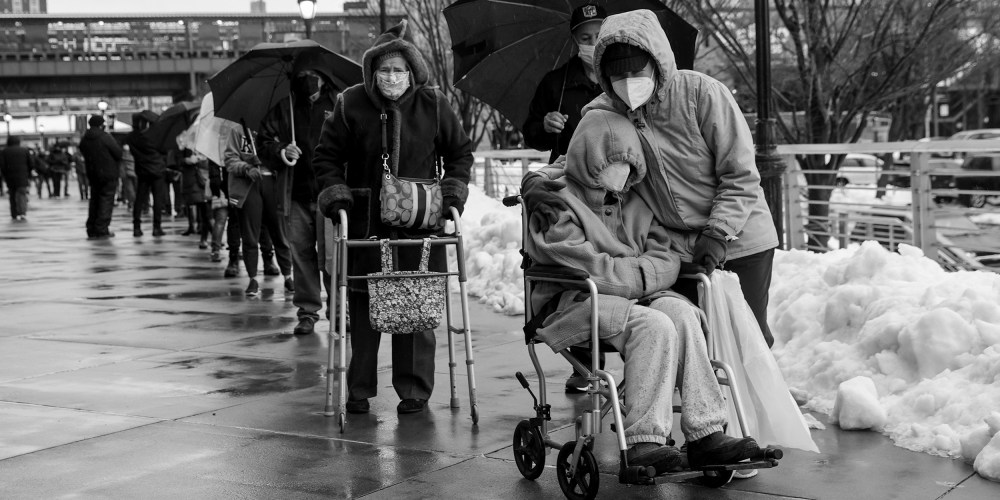
Assurances that the omicron variant is a “milder” variant of Covid-19 do little to comfort people with disabilities or people who are chronically ill.
“We are intent on not letting omicron disrupt work and school for the vaccinated,” Jeff Zients, President Joe Biden’s coronavirus response coordinator, said in December. “You’ve done the right thing, and we will get through this.”
Those policies and statements have left people with disabilities once again feeling abandoned and demoralized. Assurances that the omicron variant is a “milder” variant of Covid-19 do little to comfort people with disabilities or people who are chronically ill. Nor is it a comfort to hear the White House blame people who are unvaccinated for the pandemic’s latest surge, as Zients did when he said, “For the unvaccinated, you’re looking at a winter of severe illness and death for yourselves, your families and the hospitals you may soon overwhelm.”
Framing Covid-19 in a way that blames unvaccinated people ignores how sick people with chronic illnesses and people with disabilities can get even if they have been vaccinated. The White House seems to be waving these people off as a technicality.

Despite the administration’s vaccine-or-testing mandate, a legal challenge to which will be heard by the U.S. Supreme Court on Friday, there’s still a heavy focus from the administration on making vaccination and masking a matter of personal responsibility instead of taking more collective mitigation efforts such as requiring adequate ventilation of indoor spaces. Thus, U.S. policy has essentially made contracting Covid-19 a matter of morality.
Disabled and chronically ill people who run the risk of becoming seriously ill or dying may feel like the losers in this morality contest or feel that their infections are the “bumps in the road” Cardona was referring to when speaking of the complications of keeping schools open. There is a word associated with making health a morality play: eugenics.
Mentioning eugenics is sure to rankle some readers because it evokes the horrors of Nazi Germany and the Holocaust. But eugenics, which is rooted in the idea that the human gene pool can and should be improved, is often evoked during pandemics. During the Spanish flu pandemic of 1918, which has often been compared to our novel coronavirus pandemic, poor people, immigrants and racial minorities were disproportionately infected, and eugenicists argued that they fell ill more often because they were genetically inferior.
Disabled adults are more likely than nondisabled adults to endorse vaccination, but they are more likely to report difficulties in obtaining the vaccine.
That’s why hearing that omicron is milder or more benign doesn’t put at ease people who have disabilities or chronic illnesses or organ transplant recipients who often need immunosuppressant drugs so their bodies won’t reject their transplanted organs. Dr. Dorry Segev, a transplant surgeon at Johns Hopkins University, told The Boston Globe that he doesn’t think predictions that the omicron variant is more benign are “very hopeful.” He said, “If you’re immunocompromised, you’re the one for whom it’s not going to be benign.”
Earlier proclamations that Covid-19 does not affect young children often ignored immunocompromised children with pre-existing conditions who can become seriously ill if infected. This week, Texas Children’s Hospital reported a surge in hospitalizations, largely from the new variant, with more than double the number of kids with Covid-19 in the hospital compared to the week before. Yet, Texas is still largely resuming school despite these risks.
During 2020’s Democratic presidential primary, candidate Biden was mostly missing in action on disability policy before he finally released a robust plan that disability rights activists generally praised. However, Matthew Cortland, a disability rights activist and lawyer, said then that Biden’s “Covid-19 disability response plan is roughly equivalent to your car being on fire and your mechanic suggesting a plan to replace the brakes, rotate the tires, and change the oil.” Biden’s proposed Build Back Better plan would do little to expand Supplemental Security Income, a program for people with disabilities who are unable to work. (Although it would expand it to U.S. territories like Puerto Rico, Guam and the U.S. Virgin Islands.) And in an attempt to appease Sen. Joe Manchin, D-W.Va., Build Back Better now only includes a paltry $150 billion for home- and community-based care, down from the $400 billion originally proposed. Also, rather than expand services for people who will be disabled by long Covid, the administration and Democrats are offering scraps. According to ABC News, the CDC reported that disabled adults are more likely than nondisabled adults to endorse vaccination, but they are more likely to report difficulties in obtaining the vaccine. That limited access comes despite the reality summarized in a published comment in The Lancet: “People with disabilities have been differentially affected by COVID-19 because of three factors: the increased risk of poor outcomes from the disease itself, reduced access to routine health care and rehabilitation, and the adverse social impacts of efforts to mitigate the pandemic.” In this case, people with disabilities who are unvaccinated are not simply opposing vaccination; they clearly want it and are seeking it out. But they live in a country that has made their getting protected against Covid-19 next to impossible. It appears Washington is perfectly content to let people with disabilities languish without any kind of life raft, even if they enthusiastically want to get vaccinated. That’s why when people with disabilities hear politicians say it is “time to live with Covid,” as newly sworn-in New York City Mayor Eric Adams has said, it makes them wonder if they are included in either the “we” or the “live” and whether nondisabled people want to live with us.
Eric Garcia is an author and senior correspondent for The Independent. 


