








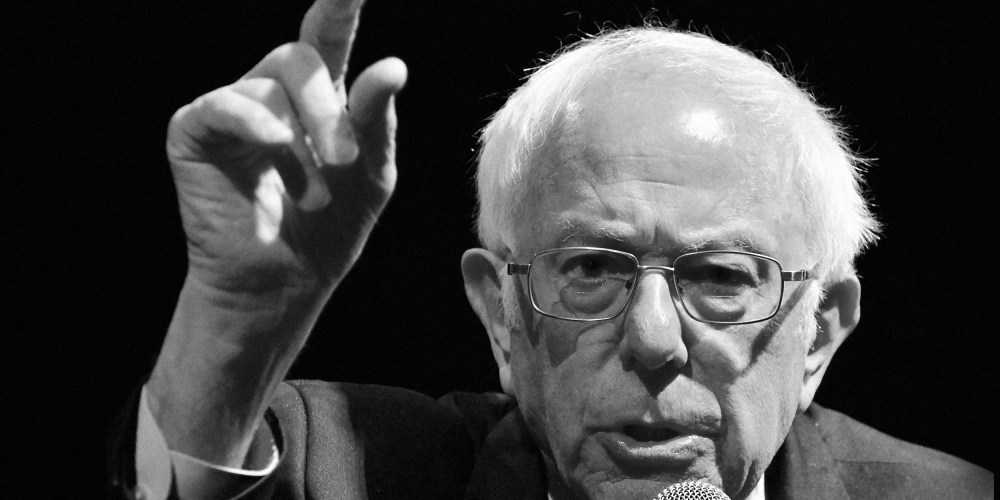
Sen. Bernie Sanders is fed up with the stalling of the Democrats’ legislative agenda in Congress — and he’s proposing an alternative plan for moving forward.
In an interview with The Guardian, Sanders took several shots at the party he caucuses with, lamenting that “the Democratic Party has turned its back on the working class” and expressed concerns about the party’s ability to win them. He argued that Democrats are in need of “a major course correction” as the daunting midterm elections approach.
Here’s what that course correction would look like, per the Guardian:
Sanders called on Joe Biden and the Senate majority leader, Chuck Schumer, to push to hold votes on individual bills that would be a boon to working families, citing extending the child tax credit, cutting prescription drug prices and raising the federal hourly minimum wage to $15. Such votes would be good policy and good politics, the Vermont senator insisted, saying they would show the Democrats battling for the working class while highlighting Republican opposition to hugely popular policies. … Sanders, chairman of the Senate budget committee and one of the nation’s most prominent progressive voices, said, “People can understand that you sometimes don’t have the votes. But they can’t understand why we haven’t brought up important legislation that 70 or 80% of the American people support.”
President Joe Biden has largely been successful in winning Sanders’ support for his policy agenda, so Sanders’ lashing out at the party over its handling of legislation is striking. The Vermont independent appears to be growing impatient, and is thinking about how Democrats are better off trying and failing to pass a bunch of popular and virtuous policies, regardless of how remote their chances of passing them are, to showcase who the Democrats and Republicans really are. While he “called for reviving a robust version of Build Back Better,” which could circumvent a filibuster, he also wants to try to get Democrats voting on individual components of the bill that progressives have tried to get into that legislation.
If Sanders’ strategy is well timed, it could help the Democratic Party prioritize and mobilize.
I reached out to a few political scientists and asked about whether this approach would work on a political level — or if it could backfire by embarrassing Democrats, who have a comfortable majority in the House but lack the power to overcome Republican filibusters in the Senate. The answer? It’s complicated. On one hand, voters are unlikely to punish Republicans for being obstructionists, as Sanders seems to hope they would. On the other hand, the noble failure strategy might help the Democratic Party and progressive activists get a clearer read on what the party stands for before the elections — and that in and of itself could be worthwhile. If Sanders’ strategy is well timed, it could help the Democratic Party prioritize and mobilize.
The experts I spoke to generally believed that the Democrats’ forcing Republicans to stonewall progressive legislation would not taint the GOP as spoilers in the eyes of the electorate. “There’s not a lot of evidence that parties pay a big price for obstruction,” David Hopkins, a political scientist at Boston College told me. “Even understanding that obstruction is occurring requires an attentiveness to the day-to-day details of the political system that the average voter does not exhibit.”
Consider, for example, the Republican Party’s tremendous growth in Congress over the course of the Obama era as Republican leaders made it clear that their highest priority wasn’t getting things done or making Dems more moderate, but making Obama “a one-term president” by blocking him at every possible turn.

The fact that the filibuster has created a de facto 60-vote threshold for most legislation in the Senate might make it feel like Republicans have a grip on Congress in the eyes of some, but Democrats control the White House and Congress, and media narratives and large swaths of the public are contemplating what they can get done with that power.
What about the possibility of Sanders’ plan backfiring by making Democrats look weak with failed votes? That isn’t necessarily a huge liability per se either, at least in the short term. Matt Grossman, a political scientist at Michigan State University, told me, “To the extent that we have evidence that votes in Congress tend to affect elections, it tends to be negative, and for things that passed.” That is to say, parties are more likely to be punished for productivity than for inactivity in the short term: Productive legislative periods, like, for example, Great Society reforms under Lyndon Johnson, or the Democrats’ passage of the Affordable Care Act under Barack Obama, were followed by huge midterm losses for Democrats. Legislative accomplishments likely inspire opponents of a party’s successful agenda to countermobilize more aggressively. As Hopkins has written, “In politics, grievance is a far more predictable response than gratitude.”
A series of failed votes won’t, on its own, deal a huge blow to the GOP or humiliate the Democrats when it comes to shaping voter perception. But there could be some other payoffs for Democrats — in the form of getting them more organized and fired up. “What may seem like an impossibly ambitious and unachievable set of objectives that in fact does not get enacted gives you a lot of talking points,” Ross Baker, a scholar of political science at Rutgers University, told me. “The idea is to mobilize the party base with good stirring oratory, and a lot of moral indignation — which Bernie Sanders is very good at.” Sanders’ idea for keeping the Democrats fired up faces a huge obstacle in Senate Majority Leader Chuck Schumer. Hopkins noted that while the average voter isn’t going to follow the clashes in Congress closely, activists will — and that could pay off in the longer term. Activists have disproportionate sway over voter mobilization, and their sense that the party is truly trying to deliver on their goals, even while failing at it, can keep them more invested in the future of the party. Hopkins also noted that votes on these smaller bills would constitute “collective decision-making within the party about what the party’s policy positions and priorities are.” The very bills that Democrats decide to try to vote on, and the votes counts on them, would allow the Democrats to put their beliefs on the record and form priorities for potential future bills or policy platforms. (This would not just be putting pressure on Republicans, but conservative Democrats like Sens. Joe Manchin and Kyrsten Sinema.) As Baker noted, Sanders’ idea for keeping the Democrats fired up faces a huge obstacle in Senate Majority Leader Chuck Schumer, who, “like all Senate party leaders is averse to bringing up bills he knows he can’t pass.” Schumer fears the price of Democrats looking splintered. He also likely is concerned about further rankling Manchin and Sinema, who are already bucking the party on major goals like Build Back Better and filibuster reform. Sanders’ agenda might have its merits, but it might be better to pursue it after other options to pull in Manchin and Sinema on big-ticket items are exhausted.
Zeeshan Aleem is a writer for MS NOW. Sign up for his newsletter. 

