








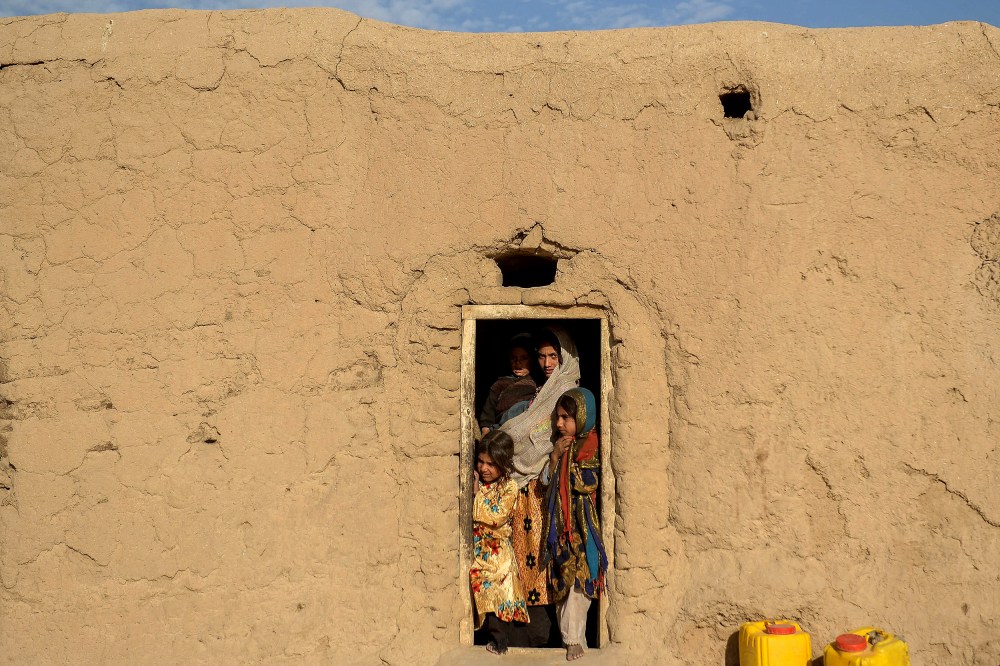
As winter approaches, humanitarian watchdogs are sounding the alarm over the increasingly likely possibility of mass starvation across Afghanistan, a deeply impoverished nation whose economy plunged into a tailspin after the United States’ withdrawal of troops in August. David Beasley, the executive director of the United Nations’ World Food Program, has deemed it “the worst humanitarian crisis on Earth.”
“Ninety-five percent of the people don’t have enough food, and now we’re looking at 23 million people marching toward starvation,” he recently told BBC News. “The next six months are going to be catastrophic. It is going to be hell on Earth.”
While as recently as September we saw wall-to-wall media coverage across the political spectrum hammering U.S. President Joe Biden for leaving Afghans vulnerable to Taliban persecution, the fact that more than half of Afghanistan’s population is now in acute need of food assistance has fallen outside the narrow scope of the Western gaze.
It’s looking like the U.S. will once again be involved in the disgraceful business of punishing ordinary Afghans for being born in the wrong place.
This pivot from fixating on how ending a war might harm Afghans to apathy about their postwar fate just weeks later is in and of itself worth noting and condemning. But what makes the turn worse is the fact that the U.S. has a direct role to play in Afghanistan’s potentially nightmarish economic crisis, and it has the choice to help mitigate it. If the U.S. doesn’t change course, it’s looking like it will once again be involved in the disgraceful business of punishing ordinary Afghans for being born in the wrong place.
Afghanistan is one of the poorest countries in the world, and its economic maladies predate the withdrawal. Much of them stem from Afghanistan’s status as an impoverished but geopolitically pivotal rentier state: It relies on funding from international sources for the overwhelming majority of its government revenue. And there are a number of factors at play in the Afghan economy’s current free fall, including the lingering effects of war, a swiftly emptied out civil service, a drop in international remittances, a terrible drought and an over-reliance on imports.
But as The New York Times pointed out in a recent explainer, “the crisis is, in large part, American-made, imposed by deliberate policy choices with results that were predicted months in advance.”
One major issue: The Afghan government has a stockpile of currency reserves that would cover about a year and a half’s worth of imports, according to the Times, in banks abroad. But the overwhelming majority of those reserves are held in the U.S. — and Washington has frozen them in its bid to isolate and pressure the Taliban. The U.S. also ended direct foreign aid meant to replenish those reserves.

Another problem is that that the U.S.’s designation of the Taliban as a terrorist organization means the afghan government is subject to a harsh sanctions regime. As the Times explained:
Now that the Taliban are Afghanistan’s government, this forbids most aid in the country, even if it is granted directly to Afghan civilians. The Treasury Department has opened some humanitarian exceptions to sanctions. But these are so narrow and vaguely defined that most international groups have concluded they have no choice but to stop all services in Afghanistan, according to a paper by the Center for Global Development. As a result, not only are aid groups unable to ameliorate the food shortages imperiling many civilians, they have had to pull back even from services they offered before the Taliban takeover.
Washington is hoping to use starvation of the Afghan economy as leverage to extract commitments from the Taliban on counterterrorism and human rights. But the way it’s doing so brutal, and in some ways echoes the logic of the U.S.’s failed war.
“We’re in a situation where the last 20 years of international policy that was imposed on Afghanistan created an aid-dependent state,” Adam Weinstein, a research fellow at the Quincy Institute, told me. “Now the international community has essentially decided, ‘Well if we couldn’t dictate outcomes in Afghanistan through the use of military force, let’s see if we can do it by suffocating the country by cutting it off essentially from money.’”
The U.S. recently announced $144 million in additional humanitarian aid to Afghanistan, which is not a trivial sum of money. But a number of experts point out that this aid, which involves distributing emergency provisions through independent humanitarian organizations, isn’t going to change the fundamentals of the country’s economic crisis. Weinstein likened it to using “a Band-Aid on a bullet wound” in light of Washington’s measures meant to slow the flow of desperately-needed money into Afghanistan.
And aid experts tell me that humanitarian aid is an inefficient and worryingly ad hoc way to deliver services in an emergency situation. “It’s possible for foreign aid to go through these other organizations that are functioning in the country like the the World Food Program to provide for immediate support, but the transaction costs for doing that each time … are so high,” a former State Department official who has worked with multilateral banks told me, speaking on the condition of anonymity because the person was not authorized to speak publicly in their current job. “The reality is that by working directly with governments, you can bring transaction costs way down and increase the scale of your ability to work in a country.” Analysts like Weinstein and Erica Gaston of the United Nations University Center for Policy Research argue the U.S. should loosen its grip on at least some of Afghanistan’s currency reserves temporarily to avert the oncoming humanitarian catastrophe. And Washington has the option to roll back some of its sanctions to allow some aid to resume. Just as disturbing as U.S. policy toward Afghanistan is our society’s apparent indifference to it. For now, though, the U.S. is seeing how far it can push the Taliban. In the meantime, millions of ordinary Afghans are at risk of starving during what’s shaping up to be a brutal winter. While some might defend the U.S. government’s position as playing hardball for a worthy cause, it’s a callous gamble — doubly so after what the Afghan people have put up with for decades at the whims of the U.S. Just as disturbing as U.S. policy toward Afghanistan is our society’s apparent indifference to it. The U.S. subjected Afghanistan to a war that took the lives of tens of thousands of civilians in the region and ruined the lives of many more. When Biden rightly decided to follow through on former President Donald Trump’s withdrawal plan, the media class, liberal interventionists and right-wing hawks slammed Biden, often without considering how the Taliban was always going to overrun Afghan security forces because of decades of U.S. policy failures. (This is not to say Biden’s execution of the withdrawal was above criticism — it certainly wasn’t — but rather to point out that outrage over Biden’s withdrawal was often blind to the extraordinary suffering and death caused by war itself and failed to contend with the immorality of the alternative of endless occupation.) But one must ask now, as millions of Afghan lives hang in the balance due to a crisis the U.S. is helping to fuel and has the power to avert: Where is that crowd? Why do Afghan lives not matter anymore? I’m not sure which is more bleak: that Afghans have already been forgotten, or that our society seems to only want to play hero using the barrel of a gun.
Zeeshan Aleem is a writer for MS NOW. Sign up for his newsletter. 

