








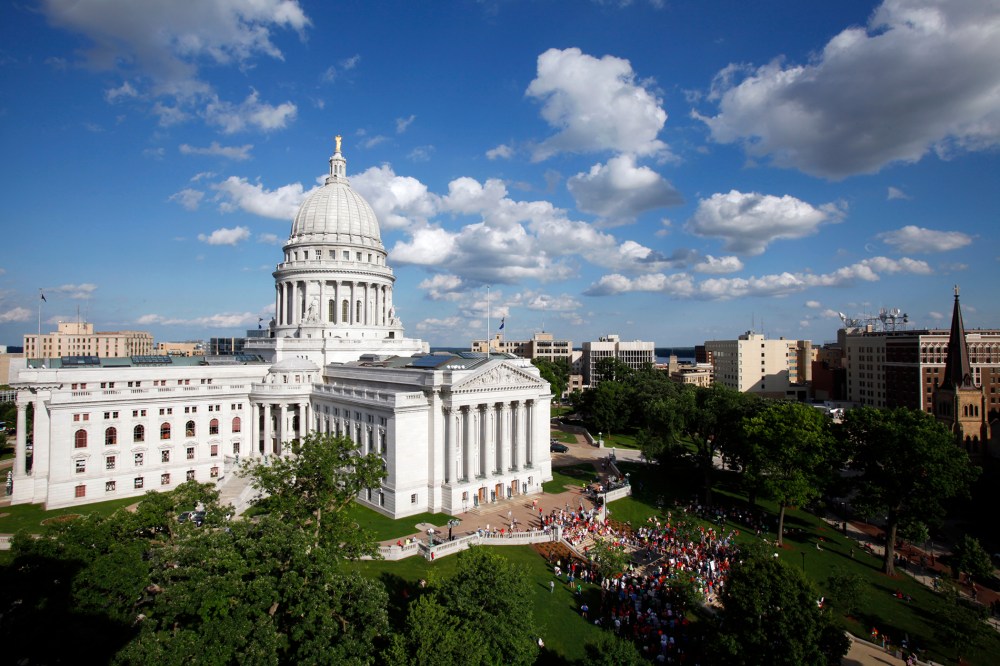
The most polarized state in the country isn’t Texas, where Governor Rick Perry once threatened to secede if Washington continued “to thumb their [sic] nose at the American People.” It’s not even California–where not one, but two state secession movements have cropped up in response to the state’s progressive reforms. No, the most divided state in the country is the cheese-making, beer drinking, Badger State of Wisconsin.
According to a Public Policy Poll last year, just 4 percent of Republicans in Wisconsin approve of President Obama, compared to 93 percent of Democrats. That is the biggest gap of any state. When it comes to the partisan approval gap for governors, no one comes anywhere close to Wisconsin Governor Scott Walker–who has an 85 percent higher approval rating from Republicans than he does from Democrats.
It may come as a surprise then that no one in Wisconsin has threatened to secede. After all, at least eight states have seen secession movements crop up during the Obama presidency. That is until now. The Milwaukee Journal-Sentinel reported that the Republican Party caucus of Wisconsin’s 6th Congressional District adopted a resolution stating, “Be it further resolved that we strongly insist our state representatives work to uphold Wisconsin’s 10th amendment rights, and our right to secede, passing legislation affirming this to the U.S. federal government.”
The Chairman of 6th District Republican Party, Dan Feyen, quickly distanced himself from the resolution, claiming that it did not deal with the “true opponent” Republicans face this election cycle, namely Democrats.
Wisconsin’s electorate is polarized partly because its leadership is extremely polarizing. In 2011, Wisconsin Governor Scott Walker pushed through a highly unpopular bill to limit collective bargaining for most public employees, along with cuts to pension and health benefits. As a result, organizers gained enough petitions to hold the first gubernatorial recall election in Wisconsin’s history. Walker eked out a victory, in part because he raised more than $25 million—the majority from out-of state—compared to the less than $1 million raised by his Democratic opponent, Tom Barrett.
But Wisconsin voters were polarized before Walker’s election. Recent research suggests that better educated, more engaged voters are often the most ideological. And Wisconsin is a case in point. The state’s high school graduation rates are higher than all but twelve states, according to data from the U.S. Census Bureau. As Political Scientist Alan Abramowitz tells the Sentinel-Journal, “In Wisconsin, a more educated, engaged electorate may also help explain the depth of division, since voters who follow politics more closely tend to be more partisan and more aware of the differences between the parties.”
Wisconsin’s polarization—and its burgeoning secession movement—offers a cautionary tale for the country. As Bill Bishop and Robert Cushing detail in The Big Sort, Americans are increasingly living among like-minded people, which in turn fuels partisan polarization. In 1976, less than a quarter of Americans lived in places where the presidential election was won in a landslide. By 2004, nearly half lived in landslide counties. And it’s not just presidential elections. Today, 80 percent of Congressional Districts are solidly Democratic or Republican. In state government, one party has control of the legislature and the governor’s mansion in 36 states, the most in over 60 years. The differences aren’t between red states and blue states so much as within them. Governor Walker lost his home county of Milwaukee by 27 percent in his recall fight. In neighboring Waukesha County—one of the most conservative counties in the state—he won by 35 percent, a 36 percent spread between the counties. In 2012, President Obama had almost the same results, in reverse. Polarization won’t reverse itself overnight. The roots of our divided electorate go back at least 40 years. But we can fix the institutions that reward polarization. Changing campaign spending laws—either through a constitutional amendment, or through a revamped public financing system (as Rep. John Sarbanes has proposed) would help. So would enacting stronger voter protection laws to expand the electorate. Mandatory voting and moving federal elections to weekends have all had bipartisan support in the past. Ultimately, even the solutions themselves fall prey to polarized politics. At a time when we should be expanding the electorate, Republican governors like Walker are trying to limit it. Even modest campaign finance reform bills are filibustered. In other words, we can expect to see a lot more states like Wisconsin invoking their “right to secede.”
Jeremy Slevin Recommended


