








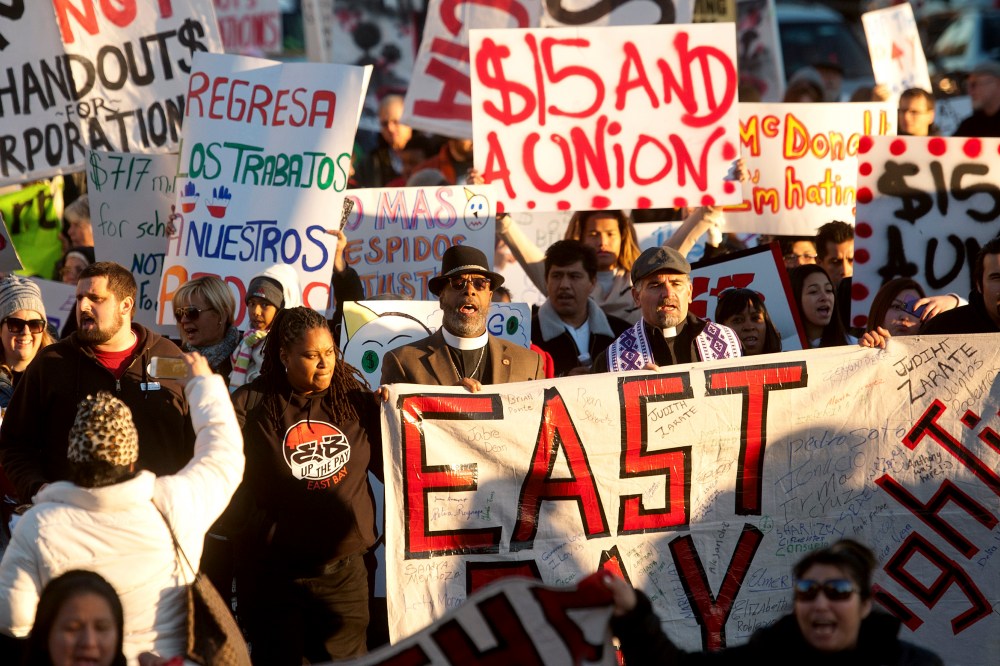
In November 2012, 200 fast food workers in New York City did something completely unheard of: they walked out. Workers from 60 restaurants throughout the boroughs held a one day strike to highlight the difficult conditions, low wages, and often nonexistent benefits of fast food work.
The movement quickly caught on. By August of last year, strikes had spread to 50 cities. And in May, workers in 150 cities across the U.S. were joined in solidarity by protesters in 30 countries.
But for all their success, many of these workers had yet to meet each other until this weekend. On Friday, 1,200 fast food workers travelling from across the country gathered in the Chicago suburb of Villa Park, Illinois–just four miles from the headquarters of McDonald’s corporation–to make two demands: a 15 dollar minimum wage and the right to form a union. They were joined by leaders ranging from “Moral Mondays” organizer, Reverend William Barber to Congressman Keith Ellison (D-MN).
The event highlighted the ironic effect Congressional inaction has had on the minimum wage movement. As their concerns are ignored at the federal level, organizers are using new—and often more ambitious—strategies to raise pay. For the past year, the Service Employees International Union (SEIU) has petitioned the National Labor Relations Board (NLRB) to allow workers at multiple McDonald’s franchises to form a single union. If the NLRB rules in favor of the SEIU, workers will be able to organize dozens or more McDonald’s stores at once.
And earlier this year, unions won a major victory when President Obama issued an executive order to gradually raise the minimum wage for all federal contractors to $10.10 an hour. The White House action was spurred by an organizing campaign involving the SEIU, the International Brotherhood of Teamsters, the United Food and Commercial Workers, and the United Farm Workers It’s not just unions who are filling the void left by Congress: This year alone, at least 34 states have considered raising their minimum wage; 10 of them (plus the District of Columbia) have already succeeded. In some cases, the state laws have exceeded any changes considered on the federal level. A Massachusetts law passed earlier this year will gradually raise the state’s hourly wage to $11.00. Seattle instituted the highest minimum wage law in the country last month—when the City Council passed an increase to $15.00 an hour. For Republicans, outright opposition to increasing the minimum wage is proving to be a double-edged sword.
Jeremy Slevin Recommended


