The Rachel Maddow Show WEEKNIGHTS 9PM ETMorning Joe WEEKDAYS 6AM ETDeadline: White House with Nicolle Wallace Weekdays 4PM ETThe Beat with Ari Melber Weeknights 6PM ETThe Weeknight Weeknights 7PM ETAll in with Chris Hayes TUESDAY-FRIDAY 8PM ETThe Briefing with Jen Psaki TUESDAYS – FRIDAYS 9PM ETThe Last Word with Lawrence O’Donnel Weeknights 10PM ETThe 11th Hour with Stephanie Ruhle Weeknights 11PM ET
‘American’s Creed’: The story of one of the most defining statements of U.S. national identity
William Tyler Page’s 100-word essay on what it means to be an American continues to inspire patriotism a century on.
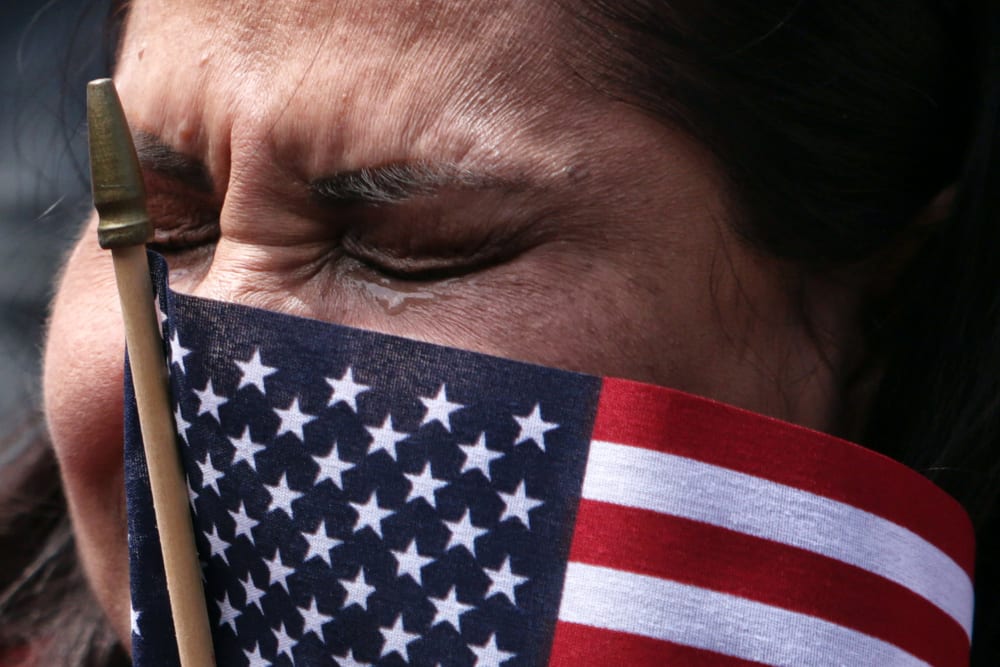
A woman tears up during a naturalization ceremony at Fisher Pavilion in Seattle on July 4, 2017.Genna Martin / San Francisco Chronicle via Getty Images
In 1916 the United States was on the precipice of entering World War I when the New York commissioner of education, Henry Sterling Chapin, decided to hold a nationwide writing competition to encourage patriotism among the American public.
The goal was to establish a national creed that would find “the best summary of the political faith of America.”
The winner of that competition, chosen from more than 3,000 entries, was William Tyler Page, a 49-year-old longtime congressional employee. The Maryland native had begun his career in public service as a page in the U.S. House of Representatives in 1881 at age 13.
American civil servant and Clerk of the House of Representatives William Tyler Page, right, and an unidentified man hold a poster of “The American’s Creed” in front of the Capitol in 1936.Library of Congress and Interim Archives / Getty Images
Page, a descendant of John Tyler, the 10th president of the United States, and Carter Braxton, a signer of the Declaration of Independence, looked to several documents and speeches from the country’s history for inspiration, including the preamble to the U.S. Constitution, Abraham Lincoln’s “Gettysburg Address,” George Washington’s “Farewell Address” and the national anthem.
His winning entry, which earned him a $1,000 prize, was described by the competition’s officials as “brief and simple but remarkably comprehensive of the best in American ideals, history and tradition as expressed by the founders of the Republic and its greatest statesmen and writers.”
I believe in the United States of America as a government of the people, by the people, for the people; whose just powers are derived from the consent of the governed, a democracy in a republic, a sovereign Nation of many sovereign States; a perfect union, one and inseparable; established upon those principles of freedom, equality, justice, and humanity for which American patriots sacrificed their lives and fortunes.
I therefore believe it is my duty to my country to love it, to support its Constitution, to obey its laws, to respect its flag, and to defend it against all enemies.
In 1918, “The American’s Creed” was adopted by the House, and a ceremony was held to honor Page. A bronze tablet bearing the essay was placed at the U.S. Capitol.
The next year, Page was elected clerk of the House, later serving as emeritus minority clerk until his death in 1942.
Page once described his 100-word essay as “a summary of the fundamental principles of American political faith as set forth in its greatest documents, its worthiest traditions and by its greatest leaders.”
More than a century later, “The American’s Creed” is still often recited at naturalization ceremonies and other government events.