








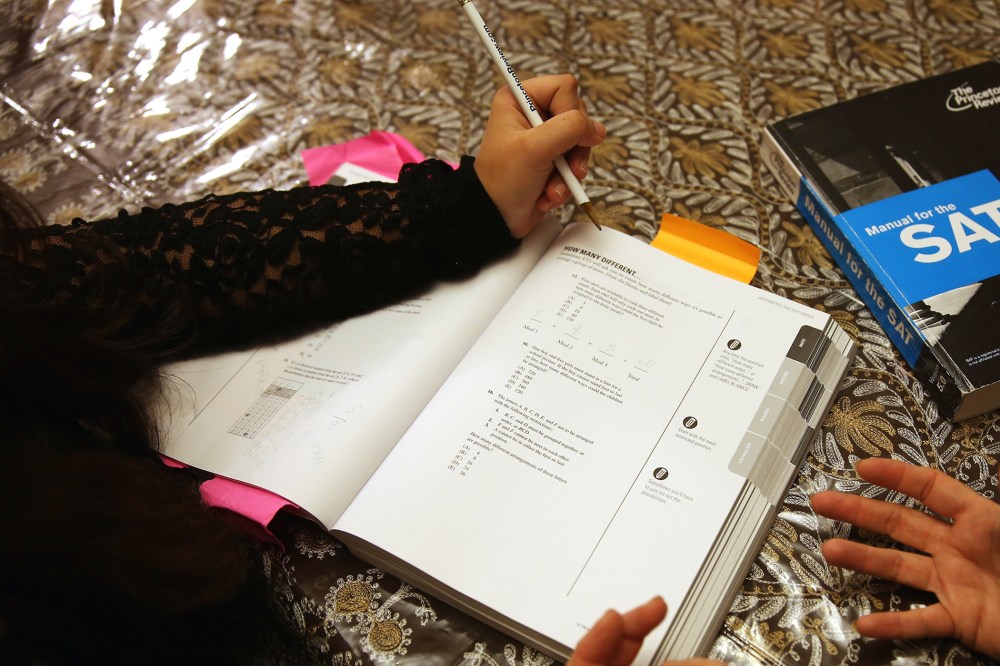
John Katzman founded the Princeton Review in 1981 after graduating from college. He spent years mastering the SAT, teaching American students to “beat it.” Over thirty years he has come to the conclusion that the assesment is useless, suggesting is it time for a complete rethinking of testing in the school system, “Curricula should drive the test, not the other way around—after all, the goal of college admissions tests should be to assess how a student will perform in college, as well as whether that student learned a subject meaningfully.”
Read more about John Katzman’s vision for a new testing system in his recent msnbc op-ed.
Katzman – now the founder and CEO of Noodle – took YOUR questions directly from msnbc.com and msnbc social media. Check out his responses:
Juan Martinez on msnbc.com: How can you help me help my students on the SAT in Detroit?
Katzman: First, consider having them switch to the ACT, which is a better test. Every college accepts either.For either test, have your students use practice tests and questions from the official guide; other practice materials generally contain poorly researched items and will not prepare your students adequately. As you work through the various types of questions, consult with a good guidebook for technique. For the math section, focus your prep on middle school skills like fractions, ratios, and one-equation algebra.
BmBm237 on msnbc.com: The thing that really frustrated me about the SAT is that I spent all this time studying for it but didn’t feel like I really learned anything of value…I just learned how to take this test. How can we have a test that actually reflects what students know?
Katzman: You’re right – the SAT doesn’t promote good, relevant learning, and it won’t until we replace the College Board with a better organization. The College Board has created an admissions process that’s expensive, stressful, and ineffective, and this has worked well for them (and, admittedly, for the test prep industry). But this isn’t good for the very people this system should be serving: students. Over 60% of students will not graduate from the college where they start. College admissions testing should promote meaningful learning, and it should drive students to find the colleges that are actually right for them. Maybe this means that students take tests in the subjects that are compelling to them, and focus their learning on what they are passionate about (the AP tests are a good example of this working well).
Kathryn Slocum on msnbc.com: You have said the Common Core has the same problems as the SAT. What do you mean by that?
Katzman: The Common Core makes many of the same assumptions as the SAT. The first is that every student should learn the same things as every other student, and they should learn them at the same time. The second is that we can measure a subset of those skills and concepts without students and educators narrowing their studies to just those things. Generally, the people creating these standards and tests are not, themselves, accountable for the overall performance of the process. Currently, college admissions testing organizations are not accountable for the performance of their testing systems, and there is no evidence that the SAT has help more students get to the right colleges or excel in the subject areas that matter most to them. Similarly, there is no true accountability built into the Common Core. Will students in the U.S. rise dramatically in international standings in the next five years? If not, who will give us our billions of dollars back? Holly Tidwell on Facebook: How is [the SAT] it culturally biased?
Katzman: These tests exist to predict college performance. This is not easy to do for each individual student, and the track record of these tests is accordingly weak. But it’s much easier to predict the performance of a large group. One glaring example of bias is the SAT’s under-prediction of the performance of women in college. Even though women overall have better high school and college grades, they have always scored lower than men on the SAT. The new SAT makes the essay portion optional, and because women generally do better on that section than men, the under-prediction will be even worse than it is today. When you realize that the SAT could easily be calibrated so that women scored better on the test than men, you realize how arbitrary the whole thing is. The SAT similarly under-predicts the performance of minority students.
@MrShimasaki on Twitter: If the SAT was mediocre why was it allowed to continue for so long? Now it seems as though they are playing catch up with the ACT. Katzman: The College Board was a monopoly, and has behaved as such throughout its life. Now that the competition has heated up, it’s moving to match some of the ACT’s improvements. We see this effort about once a decade, when the College Board announces important new changes to the test that will better align if with high school curricula and promote reading and writing. But none of these changes have ever made it a better test, and now the ACT is more popular among students and educators. You’re right that they’re playing catch-up; in fact, if you want to know what the new SAT will look like, just take the ACT. Frankly, though, we will get better tests, and a better admissions process, only when there is much more competition in the space. Alexis Garrett Stodghill on msnbc.com: This is all bringing back bad memories of preparing for this test. I had an excellent education, and excelled in college, but this test was like a hurdle that had to be overcome with a separate skill set that I was not taught in school. I am glad they are revising it, but will even these revisions be able to capture the full scope of a student’s abilities? Should colleges take the SAT so seriously compared to other variables? Katzman: Every 12 years of so, the College Board announces bold new changes to the SAT, but these changes have never made it a test that adequately reflects a student’s abilities. What a college really wants to know is how well a student will perform at that college. To do that, the college needs something that measures how a student does in the subjects he or she finds most compelling, not just on a test that measures performance on an arbitrary set of middle school skills. The new changes to the SAT will not enable it to capture the full scope of a student’s abilities; it will just make it look more like the ACT. Students need greater choice when it comes to demonstrating their strengths to colleges, and that means more tests from which to choose. lauren_evans13 on Instagram: The ACT is culpable of catering to certain kinds of thinking as well. Where are the changes to that test? Katzman: The ACT has always promised less. It’s simply a test of some of the content taught in most high schools. Unlike the SAT, the ACT is better aligned with an average high school curriculum, and it has never misrepresented itself as an IQ test. It’s not a great test—and I don’t think any one test could be right for everyone—but it’s generally competent and honest. The overarching problem here is that both the SAT and the ACT start with the idea that all students should know some set of arbitrary things. That structure fails to treat students as individual learners with individualized needs, and makes it impossible for good teachers to meet those needs. What would a good testing system look like? Students would be able to decide which subjects they wanted to take, dedicate their energy to them, and excel in them. The Advanced Placement (AP) and International Baccalaureate (IB) programs are good models here; they offer a curriculum that comes packaged with a test, and students decide whether and how to participate. A college could look at two candidates who each took three different AP tests and get a good sense of their abilities. Students should have more freedom to take the tests that they think will best reflect their abilities, and that means they need more choices.
MS NOW staff Recommended


