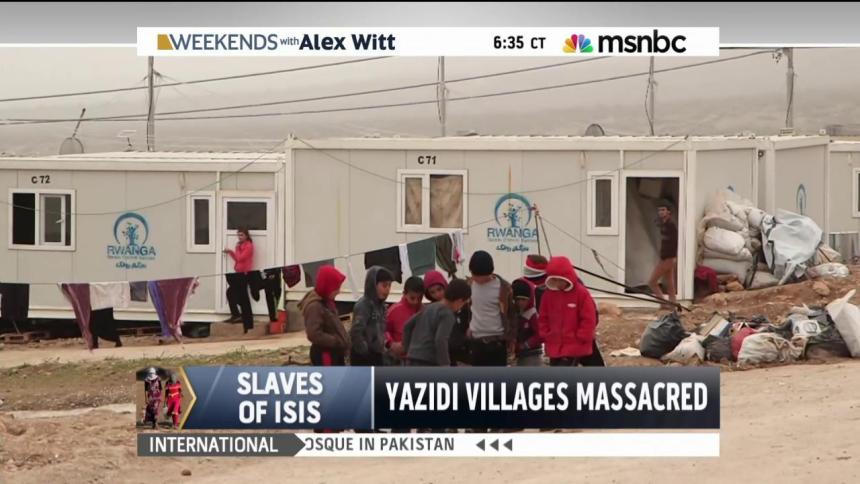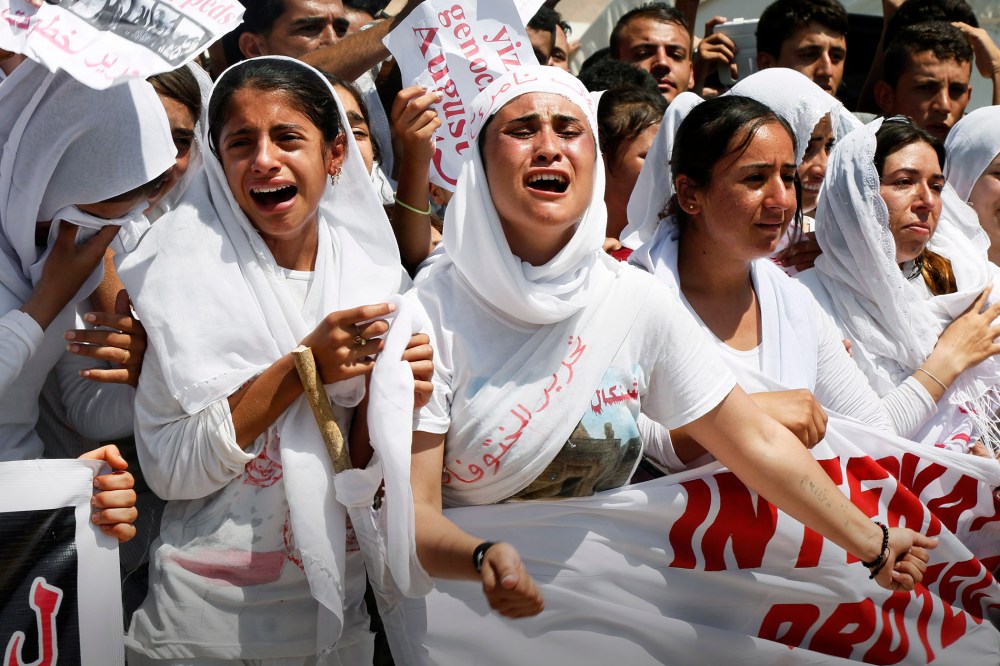
NEW YORK CITY — Islamic State militants stormed the woman’s village in northern Iraq in August last year. Coldly methodical, the fighters set to work.
Men and older women were led away and shot, the woman said, including her parents. Then she and other young women were hauled off and passed through a series of slave markets in Iraq and neighboring Syria, where they were bought and forced into sexual slavery.
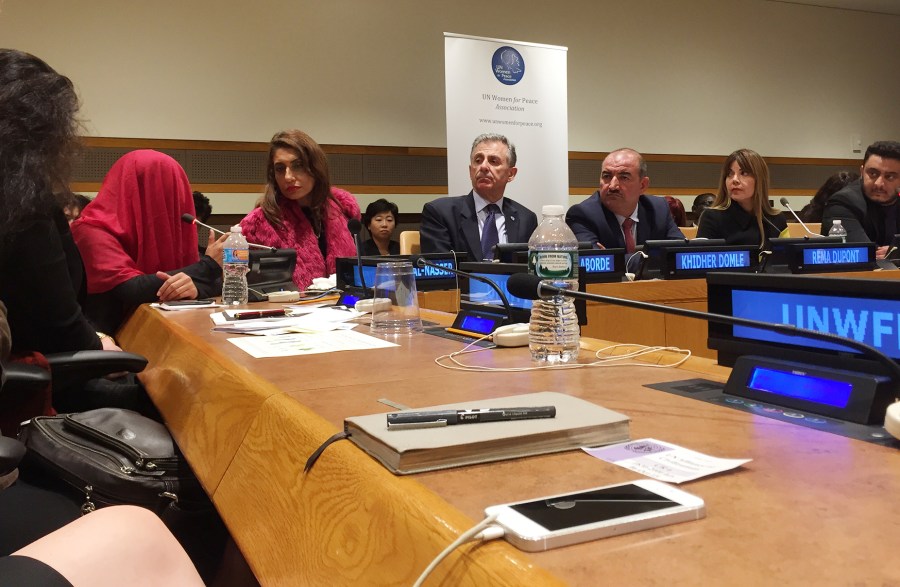
The woman, who calls herself Bazi, is a member of Iraq’s Yazidi religious minority. She gave her emotional testimony Monday before a panel hosted by the UN Women for Peace Association, which seeks to end violence against women and girls, and the group’s board member, Rema DuPont and chair Muna Rihani Al-Nasser. The event also featured clips from an upcoming documentary by Hazem Farraj, a Palestinian American activist, about Yazidi human rights workers involved in Bazi’s case.
Bazi, who wore a red shawl to cover her face, has said she is 20 years old. Organizers said that Bazi is not the woman’s real name. Her visit to the United States was facilitated by the human rights group Hardwired, which says that it arranged meetings last week between Bazi and members of Congress and the FBI.
Bazi’s story may be of interest to US officials because of a particular detail in her account: she says the fighter who kept her for 45 days in northwest Syria told her he is American.
That detail was first reported by CNN, which interviewed the woman last month.
“He spoke a little bit of Arabic, and what he spoke was broken,” Bazi told the panel Monday, speaking in her native Kurdish. “And that was another reason for me to know he was not Arab — he was American.”
Bazi told the panel that she was first taken to the ISIS-held city of Tal Afar, inside Iraq. There, she said, the sexual violence began almost immediately, when fighters in their 30s and 40s visited the house where she and other women were held, and marched girls only 12 or 13 years old up to the second floor. During their time in that house, the women were fed rice with shards of broken glass, Bazi said, and made to drink water soaked with the soiled diapers of children.
Bazi said she was eventually taken to the city of Raqqa, the ISIS stronghold in central Syria. After some time there, she was bought by an ISIS fighter and moved along with nine other children to Aleppo, in northwest Syria. There, Bazi said, the man sold the other girls one by one, but he kept Bazi and her three-year-old nephew Ivan.
Bazi said that after a few weeks the fighter grew to trust her, and began confiding in her.
“He told me that he’s American, and he has two children,” Bazi said, telling the panel that the fighter was known as “Abu Abdullah Al Amriki” and that he showed her photographs of his family back home.
Bazi said the fighter told her he “sees his family every once in while,” but she did not offer further detail on that claim.
In a statement released on Sept. 29, Rep. Ed Royce, the chairman of the House Committee on Foreign Affairs, said the committee had met Bazi, though the California Republican did not say whether lawmakers discussed Bazi’s claim about her captor’s nationality.
“‘Bazi’ shared with the Committee the harrowing details of her capture, enslavement, and escape from ISIS,” the statement read. “Her story puts a human face on the campaign of terror and brutal violence ISIS has unleashed against minority communities, the Yezidis in particular.”
%E2%80%9CHe%20spoke%20a%20little%20bit%20of%20Arabic%2C%20and%20what%20he%20spoke%20was%20broken.%20And%20that%20was%20another%20reason%20for%20me%20to%20know%20he%20was%20not%20Arab%20–%20he%20was%20American.%E2%80%9D’
ISIS swept into Yazidi villages in August last year, trapping thousands on a mountain for days without food. The U.S. began its bombing campaign against ISIS that same month in order to stop the crisis.
But not everyone was saved. Thousands of Yazidi men were killed by ISIS firing squads. According to Yazidi leaders and accounts by survivors, as many as 5,000 others were taken captive by ISIS. The young women were forced into slavery.
ISIS itself acknowledged its enslavement of the Yazidis last year, publishing an article in its propaganda magazine that justified the practice, calling the Yazidis pagans. “The campaign against the Yazidis is pre-meditated,” said Will McCants, a director at the Brookings Institution in Washington, D.C., and the author of “The ISIS Apocalypse,” a new book examining the extremist group’s theology and strategy. “According to their own propaganda magazine, they deliberated with their scholars before they began their campaign against the Yazidis in Iraq to determine if their women could be enslaved,” McCants said. “And their scholars answered in the affirmative.” NBC News first told the story of Bazi’s village of Kocho last February. RELATED: ISIS terror: Yazidi woman recalls horrors of slave auction Reporting from Dohuk, in northern Iraq, NBC News Chief Foreign Correspondent Richard Engel interviewed two young women, 19 and 12 years old, who were taken from Kocho and held as sex slaves inside Syria before escaping to safety. Bazi says that she too managed to escape, in January, along with her nephew, Ivan. Once safely inside the Kurdish region of northern Iraq, where ISIS has so far been held at bay, Bazi found support from Khidher Domle, a Yazidi professor and journalist. Domle, who also appeared Monday in New York, has helped to organize escape routes for Yazidi women who reach out to him from captivity via cell phone and messaging services. “Every time I’m in my country my phone is non-stop 24-7,” Domle said Monday. Domle said that 2,000 Yazidi women and children have so far escaped ISIS. He said around a thousand remain captive, and those that managed to escape desperately need counseling. “It’s been months that I was back,” Bazi told the panel, “but I don’t feel that I am back and out of their hands.” Correction: This article originally misspelled the name of UN Women for Peace Association board member Rema DuPont.
Jamie Novogrod Recommended