








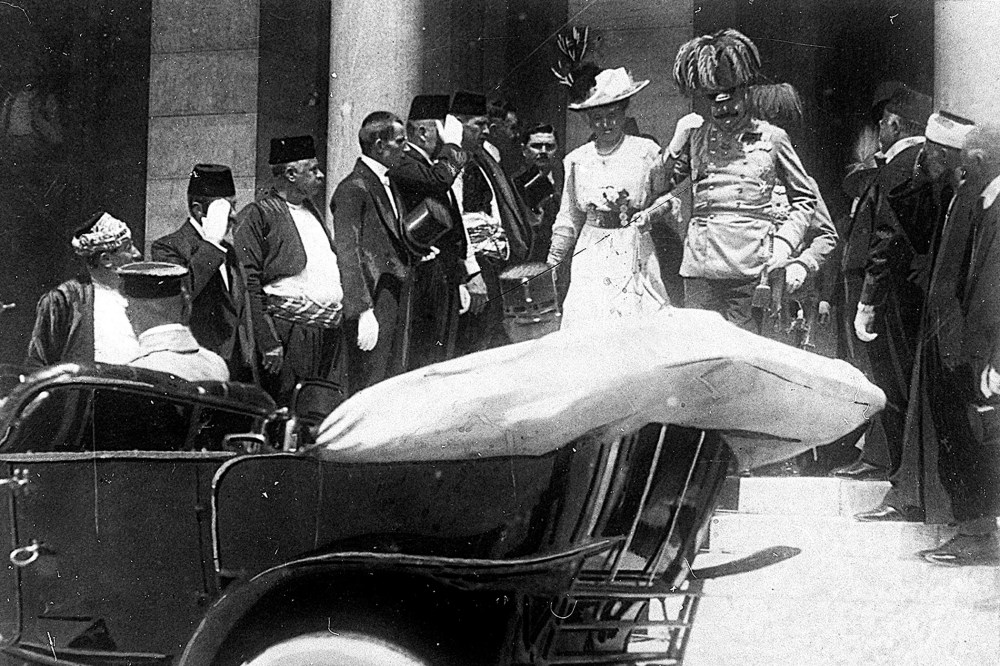
The world you inhabit today was created 100 years ago on June 28, 1914, in the capital of what is now the independent state of Bosnia-Herzegovina.
“THE STREET CORNER THAT STARTED THE 20TH CENTURY” blares a purple banner situated where the Austro-Hungarian Archduke Franz Ferdinand’s car took a wrong turn in Sarajevo (then part of Austria-Hungary) onto Franz Josef Street. While the Archduke’s driver halted and laboriously turned the car around, Gavrilo Princip, a 19-year-old Bosnian Serb, shot and killed the Archduke and his pregnant wife, Sophie.
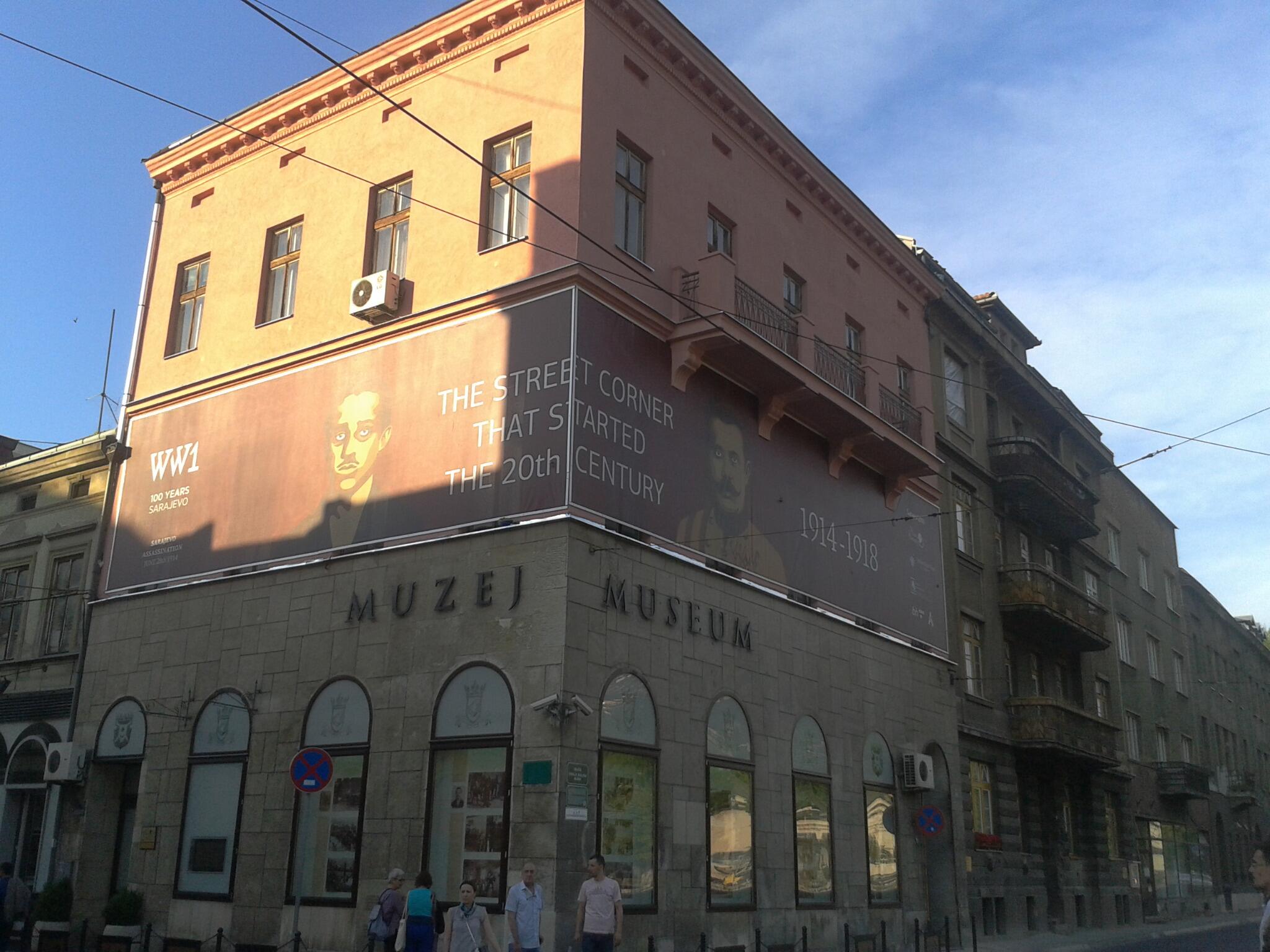
Franz Ferdinand was heir to the Austro-Hungarian throne. With what historian Barbara Tuchman scathingly described as “the bellicose frivolity of senile empires,” Austro-Hungarian Emperor Franz Josef, 83, presented Serbia with an ultimatum to which Serbia acceded in nearly all the particulars. But Franz-Josef declared war on Serbia anyway. That caused various dominoes to fall, leading to what we now remember as World War I.
Here’s the shortest possible description of what took place during WWI:
1. Serbia, which Austria-Hungary declared war on, was allied with Russia. Russia was allied with France. France was allied with Great Britain. Austria-Hungary was allied with Germany. Germany was bent on expansion, and had been building up its military forces for some time. It didn’t help that Germany’s leader, Kaiser Wilhelm II, was resentful, impulsive, and none too bright.
2. Germany invaded Belgium so it could get to France and defeat the French army before Russia mobilized.Meanwhile, France and Great Britain mobilized against Germany. The result was a deadly stalemate on the western front.
3. On the eastern front, Russian troops fared so poorly (76% sustained casualties) that the czar was overthrown in 1917. After the Bolsheviks took over they withdrew Russia from the alliance. The Turks, who were allied with Germany, did somewhat better, most notably at Gallipoli, but eventually they got pushed back by an Arab revolt aided by Britain (most famously in the person of T.E. Lawrence).
4. The Americans declared war on Germany in April 1917, citing German submarine attacks and a comic-opera German attempt to turn Mexico against the United States. This turned the tide and the Germans surrendered in November 1918.
5. What of Austria-Hungary, the country that started it? Barely worth mentioning. Serbia pushed its army back (though eventually it was occupied by Germany). Ninety percent of the Austro-Hungarian army sustained casualties in the war, a higher proportion than in any other country.
How did these events bequeath us modern life?
For starters, the “Great War” redrew the global map. Two centuries-old empires — the Ottoman (Turkish) and the Hapsburg (Austro-Hungarian) — were no more. The national boundaries of much of today’s Middle East — Lebanon, Iraq, Saudi Arabia — were drawn after WWI by British and French diplomats. Russia became the Soviet Union. The Irish Republic was born two months after the Armistice, thereby commencing a gradual unraveling through the next half-century of the British Empire (and an end to Western European colonialism generally). World War I was also the death knell for the European aristocracy. That the country-manor way of life faces extinction is a prominent theme in interwar European literature, echoed lately in the popular PBS series “Downton Abbey”. They weren’t imagining things. Thomas Piketty’s recent book “Capital in the 21st Century” shows that between 1914 and 1945 the combined public and private wealth in Germany, France, and Britain plummeted from about seven times national income to less than three times, with nearly all of that drop occurring between 1910 and 1920. You need only look at this photograph of the Archduke and his wife, the duchess of Hohenberg, taken shortly before they were killed, to recognize that these were figures from the 19th century, not the 20th. Another legacy of WWI was its modernist sensibility. The more high-flown ideals connected to honor and national destinies lost their force and were replaced by an interest in subjective experience, often influenced by Sigmund Freud’s pronouncements on psychoanalysis. James Joyce’s “Ulysses” was serialized during and after the war. Ernest Hemingway portrayed the war’s “lost generation” in “The Sun Also Rises” and the love affair of a disaffected deserter in “A Farewell To Arms”. A shell-shocked veteran of the Great War committed suicide in Virginia Woolf’s “Mrs. Dalloway”. In architecture and art, practicality and experimentation replaced classical forms, giving the world glass and steel skyscrapers and abstract paintings and sculptures. The Great War also prompted the Great Black Migration in the United States, bringing African-Americans north to industrial centers suddenly short on labor. They brought with them jazz, which defined American popular music for at least half a century. Every popular musical form that succeeded jazz is, in one way or another, its offspring. You can argue that much of this legacy is now reversing itself. The Soviet Union is once again Russia, and Iraq’s map may be in the process of redrawing itself. Capital’s long 20th century decline has reversed itself to the point that Piketty warns of a return to a world economy dominated by inherited wealth. Modernism has splintered into a thousand different movements, some of them moving back towards traditional modes of expression while others move into areas that might shock the early 20th century’s avant-garde. But even to the extent that the post-Sarajevo world is now in retreat, patrimonial capitalism and Russian oligarchs and postmodern pilasters and pediments aren’t what most of today’s adults grew up with. We grew up in the world that Gavrilo Princip and Kaiser Wilhelm II created with heedless violence in the immediate aftermath of June 28, 1914. It’s a world that the unhappy first half of the 20th century handed over to the more peaceful and prosperous second half, which is the only half most of us ever knew.
Timothy Noah Recommended



