








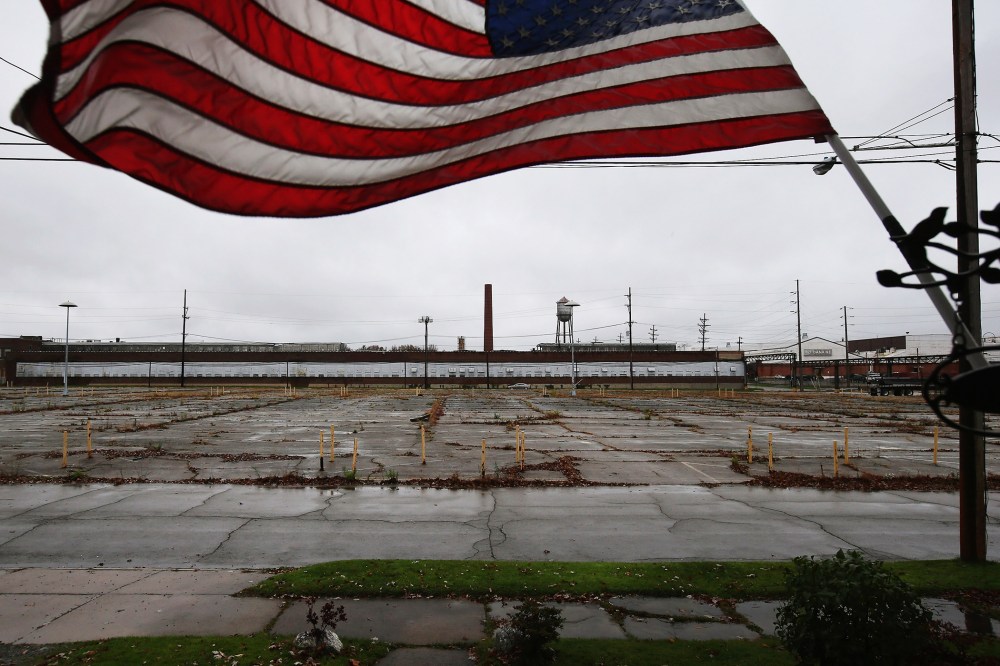
CLEVELAND, Ohio — Chuck Dennison sees whole cities destroyed in Ohio, and he blames free trade agreements.
“My job did not become obsolete. My job did not get overtaken by robots. My job still exists. It just does not exist in the United States of America,” he said.
Dennison grew up in a suburb of Dayton and became the fourth generation in his family to work at General Motors — before the company closed the plant and moved the line to Mexico after Bill Clinton signed the North American Free Trade Agreement in 1993.
“I don’t think the American people really grasp, when they hear free trade and jobs being sent overseas, what kind of ripple effect that has not only on the American workers, but also on the community they left behind,” Dennison said.
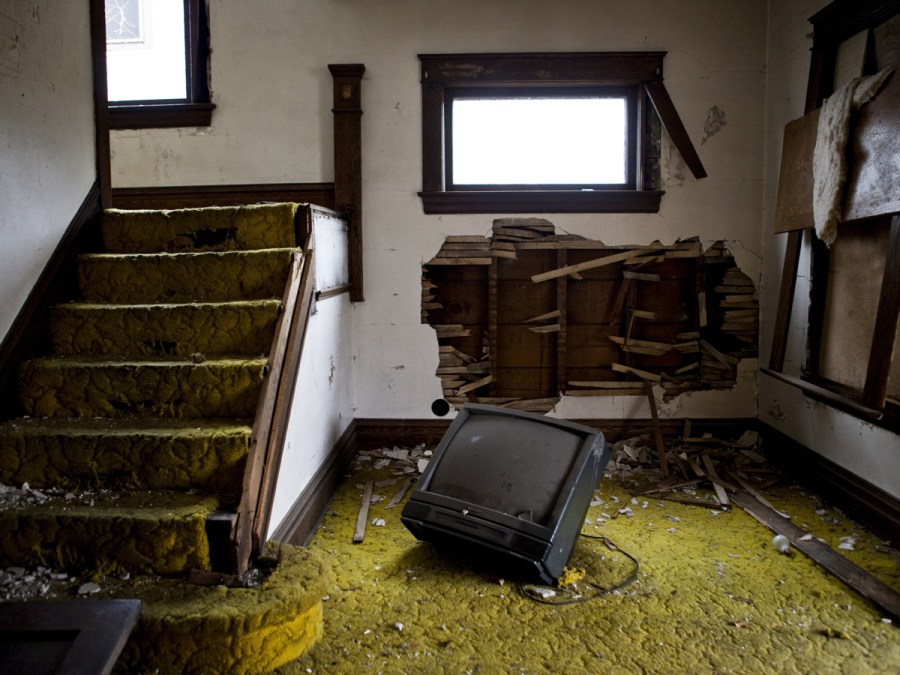
Deindustrialization defines the landscape here, from shuttered factories and steel mills to the dilapidated houses in neighborhoods that residents fled for greener economic pastures. Cleveland gave America its coffeemakers and vacuum cleaners, but now China and Mexico do. And deindustrialization defines the politics here, too.
Free trade agreements like NAFTA and the Trans-Pacific Partnership (TPP) — the massive new trade deal with a dozen Pacific countries currently pending approval — make it easier for countries to move goods and operations across state lines. But while many economists say such deals benefit the economy as a whole, they can have hugely disruptive effects on communities and workers.
Anger at trade is not new, but in the past, mainstream presidential candidates of both parties always adopted more tempered criticism.
Now, in a year defined by anti-establishment populism, outsiders Bernie Sanders and Donald Trump have made free trade a paramount symbol of how they say elites and on-the-take politicians sell out the middle class.
“Trade is a placeholder for economic anxiety,” said Andy Stern, the former president of the Service Employees International Union. “It matters, but what matters more is that it’s a placeholder for working families who think they’ve been taken advantage of by the economy and politicians.”
Both Trump and Sanders are running against the system that produced free trade. Hillary Clinton is running to continue the Obama status quo. On the Republican side, only Ohio Gov. John Kasich is running a similar message, explicitly defending free trade agreements.
RELATED: How Bernie Sanders hopes to pull a Michigan in Ohio
Whatever aggregate economic benefits trade produces, it’s deeply unpopular on the ground in places like Ohio, where manufacturing jobs have been lost. Paul Krugman, the liberal economist who supports free trade and has been friendly to Clinton in his columns, wrote Friday that “the elite case for ever-freer trade is largely a scam.”
Sanders scored an upset victory in Michigan earlier this week after spending hundreds of thousands of dollars on TV ads highlighting his long opposition to what he calls “disastrous” trade policy.
About six out of 10 voters said trade costs America more jobs than it creates, according to exit polls, and those who did favored Sanders by 15 points. Of the 30 percent who said trade creates jobs, most favored Clinton. The 37 percent of voters who said they were “very worried” about the economy broke strongly for Sanders, 58-40, while those only “somewhat” or “not too worried” went for Clinton.
“Voters’ rejection of bad trade deals like TPP is the resounding fact through the primary process. It crosses party lines, candidates, geography, age, race and gender,” said Richard Trumka, president of the AFL-CIO, which opposes most trade deals.
Now Sanders hopes he can repeat what he did in Michigan in Ohio, Illinois, Missouri and even North Carolina, where the textile and furniture industries have been hurt.
Ohio has lost 307,000 manufacturing jobs since 1994. Illinois has lost 290,822; Missouri, 105,798; and North Carolina, 359,794, according to Department of Labor data compiled by the anti-free trade group Public Citizen.
The focus on this issue puts Clinton in awkward position. On paper, Clinton and Sanders have more or less the same policy on trade: They oppose TPP and want to renegotiate NAFTA. As a New York senator, Clinton voted against the most meaningful trade agreement that came before her, the Central American Free Trade Agreement.
But Stern, who is not backing either candidate, notes it’s a tougher sell for Clinton, since her husband supported NAFTA and President Obama, her former boss, is pushing TPP. Clinton called TPP a “gold standard” trade deal when she was secretary of state.
On trade, “voters might believe Clinton, but they believe Bernie a lot more,” Stern said.
Democratic Rep. Tim Ryan represents Youngstown, Ohio, which has been particularly hard hit by the decline in manufacturing jobs, but he’s backing Clinton along with Ohio Sen. Sherrod Brown, perhaps the toughest critic of free trade in the Senate.
“NAFTA is like the logo for economic inequality, deindustrialization and lack of economic investment in the United States,” Ryan said in an interview.
But railing against against the agreement won’t actually solve the problem, Ryan said, and only Clinton is doing the hard, nuanced and admittedly less enthralling work of trying to put together complex public policy solutions to fix the economy. And trade is hardly the only or necessarily biggest driver of economic calamity, with technology playing an enormous role, as well.
“I’ve been here 14 years — I don’t really want to have another discussion about how bad NAFTA was,” Ryan said. “I want to have a discussion about how we grow our economy.”
Sanders has spent years building an overarching message that the political establishment elites have sold out working families. Clinton, as Sanders sees it, is emblematic of that establishment. It’s not just trade policy that separates the two Democratic rivals. Larry Cohen, the former president of the Communication Workers of America union who now does labor outreach for Sanders, said the Vermont senator’s relatively modest life puts him in closer touch with the concerns of average voters. “We have a candidate here that is much more authentic in terms of working-class life. He lives in a house like a teacher would live in in Burlington, Vermont. He doesn’t live in a mansion, and he doesn’t have a second mansion in Washington,” Cohen said. If Clinton authentically opposed TPP, Cohen argued, she could have stopped it by coming out against fast-track before Congress voted, which he’s convinced would have lead to its defeat. Clinton campaign manager Robby Mook rejected criticism of Clinton’s trade record in a conference call with reporters this week. But Mook acknowledged the campaign has to “work even harder” to amplify her economic arguments. Proponents of free trade note that it was none other than Franklin Delano Roosevelt, perhaps the Democratic Party’s most revered former president, who more or less invented the liberal trade regime as a guarantor of stability and prosperity after World War II. Bill Clinton, running in a very different political climate in 1992 than his wife faces today, embraced free trade in a controversial move. In October of that year, just weeks out from Election Day, and despite intense opposition from the left wing of the party and labor unions, Clinton decided to come out for NAFTA. The unenviable task of informing Michigan Democrats of Bill Clinton’s decision fell to his aides Simon Rosenberg and Stan Greenberg. On a conference call with dozens of elected officials and union leaders, the news dropped like a bomb. There was a long pause, and then things got heated. The opposition was fierce. “It was a rough and difficult call and the beginning of a very rough period,” Rosenberg recalled, “but we still won Michigan.” In 2008, Hillary Clinton and Obama were critical of NAFTA, but nowhere near as strident as Sanders is now. Trump has gone even farther than his Democratic populist counterpart, calling for ripping up trade deals and reintroducing tariffs while Sanders says he just wants to cut better deals. And from a national security point of view, Sanders and Trump haven’t explained what they would replace the global trade regime with as a symmetric soft power force for peace. In Michigan, trade may have tipped the balance for some. On Friday, the first layoffs will begin at a Dematic plant in Grand Rapids that is moving to Mexico. The plant makes conveyor belt systems for distribution centers. Scott Wahlfeldt, a welder and the president of the local chapter of the UAW, said the day before the election that he was undecided. Standing outside the plant, he said that while he blamed Bill Clinton for signing NAFTA, he also never made more money than under the former president. “Hilary’s been there, she’s walked the walk. She has the best chance,” he said. “My head says vote for Hillary, and my heart says vote for Bernie.” The next day, he texted to say his whole family ended up deciding to vote for Sanders. Kent County, which contains Grand Rapids and where the plant closing was covered in the local press, was one of Sanders strongest areas, favoring him 62-37 percent.
Alex Seitz-Wald Recommended


