








When Olympic champion and reality TV star Bruce Jenner came out as a transgender woman two weeks ago, it wasn’t the very public announcement or even the details of his transition that was most shocking.
As a worldwide celebrity, Jenner has attracted attention from millions in the last few years for his changing physical appearance, prompting widespread speculation about his gender identity long before he decided to make it public in a high-profile interview with ABC’s Diane Sawyer.
It was Jenner’s declaration of being a member of the GOP — a political identity often considered antithetical to the interests of the LGBT equality movement — along with the reactions from prominent conservatives that were hugely unexpected.
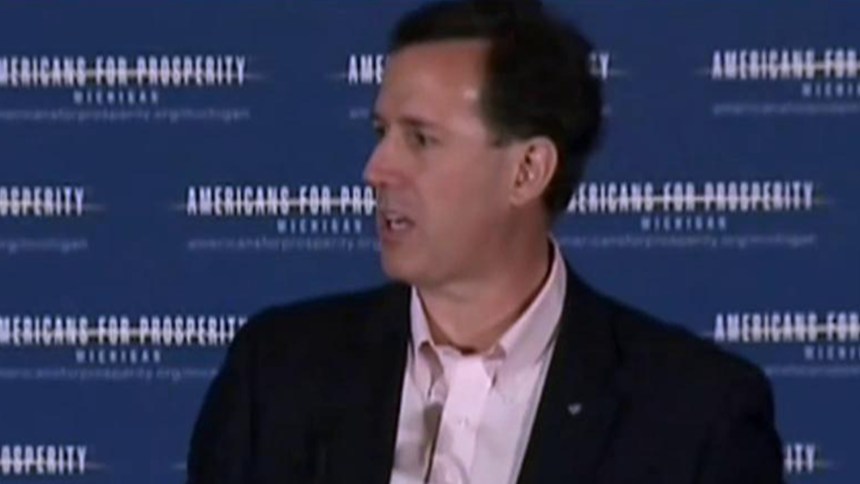
“He is a solid Reagan Republican. Good on taxes. Leave him alone,” tweeted Grover Norquist of Americans for Tax Reform. “He’s got to do what he’s got to do. I’m not going to sit around and judge him,” Utah Representative Jason Chaffetz told TMZ. And most surprising of all — “if he said he’s a woman, then he’s a woman,” former Pennsylvania Sen. Rick Santorum, who is expected to announce he’s running for president May 27, told BuzzFeed News last weekend.
Related: Santorum clarifies surprising remarks about Bruce Jenner
Santorum’s remarks, which he later clarified were “meant to express empathy not a change in public policy,” diverge considerably from past statements he’s made regarding LGBT rights, as well as his overall status as a Christian culture warrior. Just a few weeks earlier, Santorum told conservative radio talk show host Hugh Hewitt that he would not attend a same-sex wedding “as a person of faith,” positioning himself to the right of other Republican presidential hopefuls — like Louisiana Gov. Bobby Jindal, and Florida Sen. Marco Rubio — who said that they would.
Yet Santorum’s embrace of Jenner may also reflect a religious shift as much as a political one — a change that could prove invaluable in the national fight for transgender acceptance. If someone as devout as Santorum can accept that some people’s gender identities differ from those assigned to them at birth, after all, what’s to stop other conservative Christians, who account for the bulk of opposition to LGBT rights in the U.S., from doing the same?
%22There%20are%20a%20lot%20of%20evangelicals%20who%20turned%20around%20and%20started%20looking%20at%20gender%20very%20differently.%22′
Two words, many religious people will tell you: the Bible. In fact, a quick Google search of the terms “transgender” and “sin” produces multiple forums in which experts discuss why the two are one and the same, pointing to explicit Biblical passages that support their belief.
But there are some theologians who have a different read.
“There’s no getting around the fact that there are more expressions of gender diversity in Scripture than the standard binary, male-female,” Dr. H. Adam Ackley, a religious studies professor at the University of Redlands and a board member at SafetyNet, an LGBT advocacy organization for students at Christian colleges, told msnbc. “What I’ve tried to teach and what seems to be accepted by some is the idea that we’re all created in the image of God, and some of us are created with medical complexities of gender.”
The main argument that could potentially create a pathway for conservative Christians to accept transgender people is actually the same one often used to block that acceptance, Ackley explained — the idea that God makes no mistakes. Taken as a gospel truth, the precept could be understood as proof that someone’s gender identity is linked to that person’s God-given biology. No one can, therefore, be born with the “wrong body.”
But the same notion could apply to the idea that some people have God-given medical conditions causing their gender identities to clash with their physical bodies — conditions that they cannot be faulted for.
Televangelist Pat Robertson framed the issue in this way two years ago when he made the eyebrow-raising declaration that gender affirming surgery wasn’t sinful.
“I think there are men who are in a woman’s body,” Robertson, then 83 years old, said on an episode of the Christian Broadcasting Network’s “The 700 Club.” “It’s very rare, but it’s true. Or women that are in men’s bodies. And they want a sex change. And that is a very permanent thing, believe me, when you have certain body parts amputated, and you have shot up with various kinds of hormones, it’s a radical procedure. I don’t think there’s any sin associated with that — I don’t condemn somebody for doing that.”
“It’s not for you to decide, or to judge,” he added.
Related: 2016 gets real
Though Santorum didn’t fully explain his acceptance of Jenner, Ackley suspects the presidential hopeful was drawing on the same reasoning. “Those who can separate gender identity from sexual orientation and are able to frame it based on medical science are able to be a lot more open-minded,” said Ackley, who added that Robertson’s 2013 remarks were “very liberating” to him personally. Around the same time, Ackley himself decided to transition “from being a mentally ill woman to being a sane, transgendered man,” as he told Religion News Service in 2013. The decision led to his termination as a professor at California’s Azusa Pacific University. But it also drove him to find Scriptural evidence supporting his belief that Christianity can accommodate complex gender identities — passages he now teaches to families across the country and can rattle off with ease. In the Book of Genesis, for example, Ackley says the original Hebrew makes clear that ha’adam, the first human, is bi-gender and declared by God to be good. God does not create the two genders until later on, he explained. The Gospel of Matthew similarly speaks of eunuchs, which many have interpreted to mean people who are transgender or intersex, born “for the sake of the kingdom of heaven.” “This is a path that people like Santorum can take” in order to embrace the transgender community while staying true to their religious convictions, said Ackley, who’s seen hundreds of Christians go down that road already. Since his coming out, he said, “there are a lot of evangelicals who turned around and started looking at gender very differently — particularly younger evangelicals, who are extremely open-minded about gender.” But Ackley has run into roadblocks on issues viewed by Christians as behavioral choices — like sexual orientation, medical transitioning, and even public restroom use. “What I’ve had some evangelical pastors tell me is, ‘I can accept you feel one way, even though your body’s another way. But why can’t you just pray to accept this? Accept this as a cross and bear it without having any medical or legal changes made,’” said Ackley. Others have told him they would try to treat him humanely as he suffered with this condition. Ackley even sees potential for the evangelical world to warm up to the idea of same-sex marriage without disregarding what the Bible teaches. “If Christians can come along to realize that someone like Bruce Jenner is really a woman, that means he’s been married to a woman all this time,” said Ackley. “When you start framing gender differently, all of a sudden marriage looks different too.” Of course, in many ways, transgender Christians still face an uphill battle. In 2014, the Southern Baptist Convention — the second-largest Christian denomination in the U.S. after Catholicism — passed a resolution affirming “God’s good design that gender identity is determined by biological sex and not by one’s self-perception.” Pat Robertson, too, later backpedaled on his progressive remarks, by condemning transgender protection legislation in California and drawing a clumsy comparison between transgender people and his castrated horse. The ‘religious freedom’ movement is also now fast emerging as the main counterforce to the recent advancements for LGBT equality, as conservative lawmakers — many of whom also identify as conservative Christians — seek to pass measures that could invite broad discrimination on religious grounds. In light of those challenges, comments like Santorum’s become all the more groundbreaking. “This [evangelical] community is really the bulwark of opposition to transgender acceptance,” said Ackley. “And [Santorum’s] giving evangelicals in this specific Christian culture permission to say, ‘We can accept that science, medicine and Scripture all line up.’”
Emma Margolin
Emma Margolin is a reporter at MSNBC.com. Recommended


