








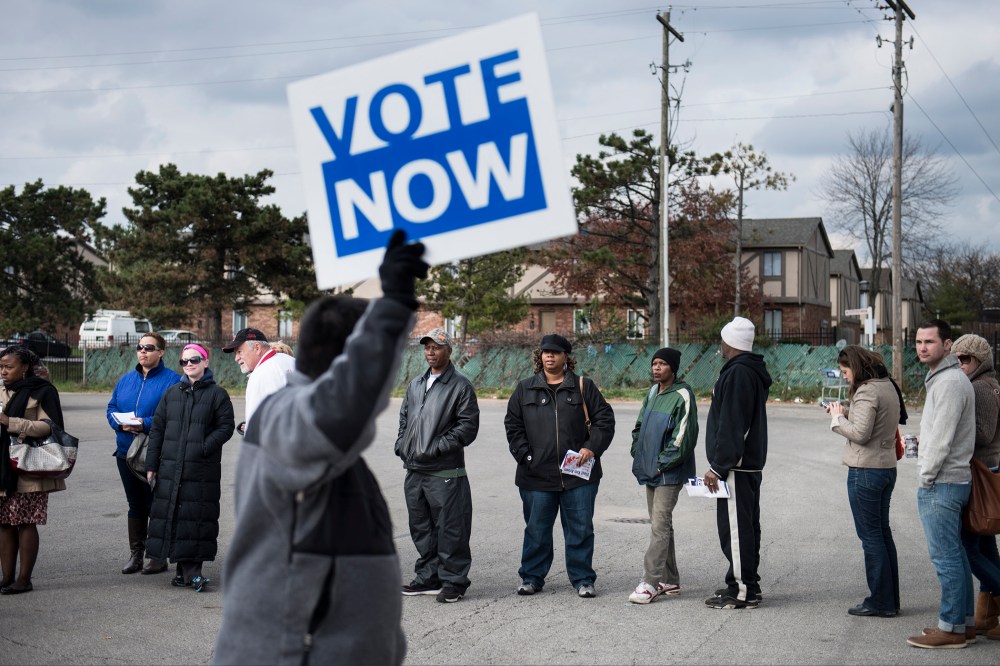
Voting restrictions imposed by Ohio Republicans earlier this year will make casting a ballot in the Buckeye State significantly harder, and will hurt African-Americans far more than whites, according to a new court filing which offers a wealth of data to back up its claims.
The brief, filed Monday by lawyers for the American Civil Liberties Union (ACLU), asks a federal judge for an injunction to block the restrictions—cuts to the early voting period, and the elimination of same-day voter registration—before this November’s election.
The ACLU filed suit earlier this year, alleging that the moves violate the Voting Rights Act’s ban on voting changes that have a racially discriminatory effect. But until Monday, it had not offered detailed information in support of its case.
In February, Ohio’s GOP-controlled legislature passed a law that cut the first six days from the state’s early voting period. The days that were eliminated were known as “Golden Week,” when Ohioans could register and vote on the same day. Less than a week later, Secretary of State John Husted followed that up by announcing a ban on Sunday and evening voting.
A federal judge recently required Husted to restore early voting on the weekend and Monday directly before the election—part of a case that went back to the lead-up to the 2012 election. But the other cuts remain in place. Ohio’s Republican governor, John Kasich, who signed the early voting cuts into law, will be on the ballot for reelection this fall.
To show that the cuts without question hit blacks harder than whites, the filing cites a wealth of data from various sources. The clearest is the Census Bureau’s survey on voting, which showed that in 2008, blacks in Ohio voted early at over twice the rate of whites—19.6% versus 8.9%. In 2012, the gap grew: 19.9% versus 6.1%.
To bolster that conclusion, the plaintiffs asked Daniel Smith, a University of Florida political scientist, to analyze state and county-level voter files, cross-referenced with Census data on race. Among other findings, Smith reported that the greater percentage of African-American voting-age population in a given census block, the greater was the share of early votes cast in that block—and even of early votes cast on the eliminated days themselves.
African-Americans rely on Sunday voting in particular, the filing argues. In recent years, in Ohio and other states, black churches have led “Souls to the Polls” drives, in which buses take people to vote en masse after Sunday services. In testimony, one black Columbus pastor explained why the tradition resonates in black many communities:
“Souls to the Polls” is important to the African Americans in my congregation and community. It is a way for family members across two and three generations to vote together. As we take bus rides to the polls, we share the stories of the sacrifices that people have made to give us the right to vote. We share with the younger generation of voters what Jim Crow was like. We sing freedom songs on the way to the polls. It is a sense of pride and honor that most of our young people don’t get to experience living here in America. Many of our young people are discouraged and won’t participate in the electoral process unless older generations encourage them.
But it’s the elimination of same-day registration that may do most to keep voters from the polls. In just the seven counties that track the number of people who use same-day registration, thousands of people registered and voted on the same day in 2012, according to the filing.
It’s harder to show that the scrapping of same-day registration affects blacks more than whites, because no direct data exists on the racial breakdown. Still, the plaintiffs make a good case: For obvious reasons, people who move frequently are more likely to use same-day registration. And in the last year, three times as many Ohioans making less than $25,000 a year moved, compared to Ohioans making more than $65,000 a year, according to a study cited in the brief. Of course, that low-income group, in Ohio as elsewhere, is disproportionately black.
It’s the same for the cuts to evening voting on weekdays. According to another study cited, Ohioans who voted in the evening in 2008 had between 11.7% and 15.0% less income than Ohioans who voted on Election Day or voted by mail. That’s hardly surprising: Working people have far less flexibility in their work hours and childcare arrangements, meaning they’re much more likely to rely on evening hours to vote. But to prove a violation of the Voting Rights Act (VRA), the challengers also need to show that blacks are disproportionately affected not just incidentally, but because of how the cuts interact with a history of racial discrimination. For instance, Wisconsin’s voter ID law was recently struck down under the VRA—in a case brought by the same team of ACLU lawyers—because a judge agreed that blacks are less likely than whites to have drivers’ licenses as a direct result of decades of social and economic marginalization. To bolster that claim in Ohio, the brief cites a series of racial appeals made by conservatives in Ohio around recent election campaigns. It notes that some attendees at rallies for Mitt Romney in 2012 wore t-shirts that said “Put the White Back in the White House.” And it points to an email sent by a Republican county election board member, explaining why he voted against allowing Sunday voting: “I guess I really actually feel we shouldn’t contort the voting process to accommodate the urban – read African-American – voter-turnout machine,” the official, Doug Priesse, wrote. The brief opens by cleverly making use of a recent pronouncement by Chief Justice John Roberts, not known as friend of minority voting rights. “There is no right more basic in our democracy than the right to participate in electing our political leaders,” Roberts wrote for the majority in McCutcheon v. FEC earlier this year. Of course, Roberts was arguing not for the need to protect citizens’ right to vote, but against most limits on money in politics.
Zachary Roth Recommended


