








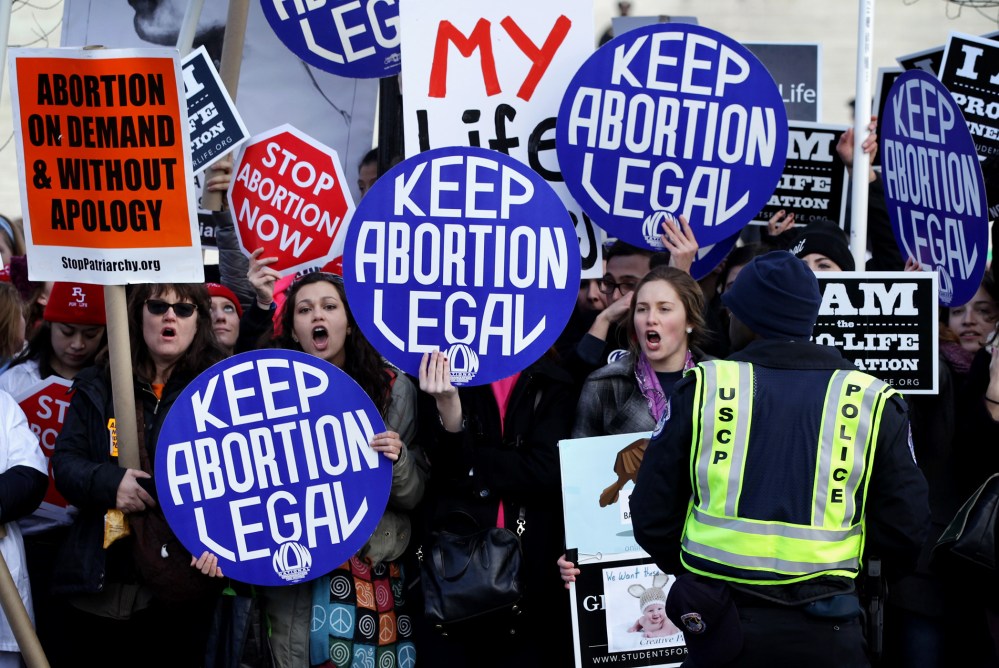
Forty-three years ago today, the Supreme Court ruled in Roe v. Wade that a woman has a constitutional right to an abortion. The vote in Roe was a solid majority: 7-2. But if you ask Americans how they feel about the abortion issue now, you can get a vast range of viewpoints. Much depends on how you pose the question.
You could ask, as Gallup has for 15 years, whether people consider themselves pro-life or pro-choice. Then you would learn that this year, 50 percent of Americans call themselves pro-choice, while 44 percent call themselves pro-life, after several years of basically being evenly divided.
You could also offer the choice of “both” and “neither” pro-life and pro-choice, which Gallup does not. Then you would learn, as Vox did, that 18 percent will say they are both and 21 percent will say they are neither. (Thirty-two percent identified as pro-choice and 26 percent as pro-life in the Vox survey.) You could use the words “women” and “safe” in the question, rather than abstractly asking about abortion legality, and the number of people supporting abortion rights will jump by 9 percentage points.
You could ask Americans if they want Roe v. Wade overturned, as the Pew Research Center did in 2013, and learn that 63 percent want to see it stand. Or you could ask Americans to choose between two vague statements, like the recent poll the Marist Institute for Public Opinion conducted for the Knights of Columbus, a group that opposes abortion. Asked to pick between “it is possible to have laws which protect both the health and well-being of a woman and the life of the unborn; or two, it is necessary for laws to choose to protect one and not the other,” 77 percent said it was possible to do everything. The policy implications of the first statement are unclear.
RELATED: Flashback: 1973 report on Roe v. Wade
Perhaps the Knights of Columbus poll was referring to the ever-shifting rationale behind the Texas abortion law the Supreme Court will consider this term in Whole Woman’s Health v. Cole. That law imposes requirements on clinics that have forced over half of them to close and threaten to close more. Texas claims the law protects women’s health, which is constitutionally allowable, but some of the lawmakers who support it have said they just want to make abortions harder to access, which is not permitted under the Constitution.
Asking about what the law should be, whether generally or specifically, is when it gets really messy. According to one pollster, the most popular question of all — asking people if they think abortion should be legal in all, most or certain circumstances — is the most problematic.
“I don’t even want to ask this dumb question anymore, because it doesn’t work,” says Tresa Undem. “It’s a bad polling measurement.” She conducted the Vox poll as well as a recent one for the National Institute for Reproductive Health, which supports abortion rights, and has written about the problem with polling on abortion.
Why? When Undem looked only at the 34 percent of people who said they thought abortion should be legal only in cases of rape, incest and health risk, she found contradictory views. For example, over half said they don’t want to overturn Roe, despite the fact that the decision allows abortion for any reason until fetal viability. The Knights of Columbus poll shows similar contradictions: Its poll found that a quarter of people who identify as “pro-choice” only support abortion in cases of “rape, incest or to save the life of the mother.” The group’s CEO, Carl Anderson, said that is proof that there is “consensus in this country in favor of significant abortion restrictions.”
But Undem says that internally conflicting views on abortion are par for the course. “On this topic, where people haven’t sorted through all their thoughts about it, you ask one question, the next you can get a reverse response.”
She also thinks that asking people whether abortion should be banned altogether is basically irrelevant, since the practical policy debate is currently about more incremental restrictions, like the new hurdles on clinics that the Supreme Court will soon vet.
But asking about that is even more challenging. “I can’t ask about restrictions, because people don’t know what restrictions are there in the first place,” Undem told MSNBC. “I can’t ask, ‘Do you think we should turn clinics into ambulatory surgical centers [as the Texas law requires]?’ because people don’t know if it’s safe or not.” RELATED: Strict TX abortion law to be heard by SCOTUS To try to understand what people know about restrictions on abortion, Undem conducted 34 focus groups for the National Institute for Reproductive Health in several states, including Texas, Ohio, Virginia and Georgia. The groups were made up only of people who had middle-of-the-road views on abortion, excluding the 15-20 percent of people who said abortion should always be illegal. “We gave them a timeline of laws in their state from 1973 to now. No messaging, very neutral language,” Undem says. “I’ve never in 15 years of doing focus groups seen a reaction like this. People were shocked and disgusted.” That’s not to say that some of those same restrictions don’t poll well on their own in other surveys. For example, the Knights of Columbus poll found that 61 percent of Americans support banning abortion after 20 weeks, and 68 percent oppose taxpayer funding of abortion. But even that can be malleable when more factors are added to the question. For example, a Hart Research survey commissioned by Planned Parenthood found that the same number of Americans would oppose a 20-week ban if a doctor determined the fetus isn’t viable, which happens several weeks later, or in cases of rape, incest or health issues. “Once voters consider the range of circumstances in which abortions would be made illegal under most 20-week abortion ban proposals, a majority of Americans oppose them,” pollsters Geoff Garin and Molly O’Rourke wrote. Given that when people are asked to consider specific circumstances from the point of view of the pregnant woman, they tend to be more pro-choice, it’s no surprise that a key factor is whether a person has talked to someone who had an abortion. “If you look at people who have talked to someone about the decision or the experience, they are much more supportive of the right to abortion and access and affordability,” says Undem. But that group has limits. “The people who are the least likely to have had the real life experience, actually talked to someone about it,” she says, “are the ones that call themselves pro-life and Republican men.”
Irin Carmon Recommended


