








Tuesday’s Supreme Court ruling on the Voting Rights Act looks like an echo of Monday’s ruling on affirmative action: a cautious, compromise approach that avoids drastic action and preserves part of a long-established legal regime.
Don’t be fooled. This opinion was a major blow to the court’s left—one from which the Voting Rights Act’s key provision, which technically survived, likely won’t recover.
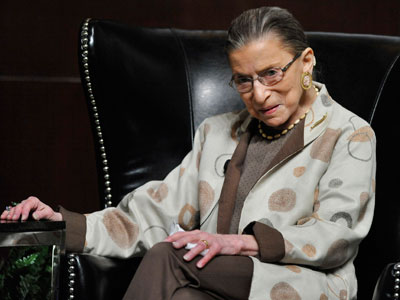
And Justice Ruth Bader Ginsburg, writing for the four liberal-leaning justices, didn’t take it lying down. She attacked Chief Justice Roberts’ majority opinion in unusually searing terms. She accused him of “hubris,” “disturbing lapses,” and total failure to engage with the facts of the case. “One would expect far more from an opinion striking at the heart of the Nation’s signal piece of civil rights legislation,” she wrote in an opinion fairly dripping with scorn.
Her harsh tone underscored that this was a very different sort of compromise than the one the court unveiled a day earlier.
In Fisher v. University of Texas, the court didn’t strike down affirmative action in higher education, as some observers had expected. Nor did it fully embrace the affirmative-action framework it had developed ten years earlier, as others had predicted.
Instead it split the difference. A seven-justice majority kept much of the affirmative-action framework intact, ruling that colleges can still “use race” as part of a broader set of admissions criteria. But the ruling made it harder for colleges to justify race-conscious policies.
To the shock of absolutely no one, Fisher was written by the court’s swing justice, Anthony Kennedy. And while we won’t know for sure for years, if ever—Supreme Court justices typically keep their papers private for decades—the opinion had all the hallmarks of an old-fashioned horse trade. Why did two of the court’s liberal justices join an opinion narrowing affirmative action? Why did its four core conservatives vote to keep affirmative action, even in watered-down form? The smart money: each side signed on to avoid losing the case altogether.
Today’s opinion, Shelby County v. Holder, is a horse of a different color. It too smells like a compromise—but this time, a compromise between the four core conservatives and Kennedy, with the court’s liberal wing left out in the cold.
Shelby County is about the Voting Rights Act of 1965. Reacting to decades of racist gamesmanship in the South—courts would strike down a law making it impossible for blacks to vote, and Southern localities would immediately think up another one—Congress enacted the statute to identify repeat offenders and block their shenanigans. Section 4 of the Act created a “coverage formula” that identified states with poor voting records. Section 5, in turn, forced these “covered jurisdictions” to get “preclearance”—that is, advance review—from the federal government before they made changes to their voting laws.
The Voting Rights Act was a dramatic piece of legislation—never before had the federal government given itself the power to review state voting rules this way. The Supreme Court nonetheless upheld it against repeated challenges, recognizing that a desperate situation in the mid-century South called for desperate measures.
That began to change in 2009. In an opinion also written by Roberts, the court suggested that it didn’t think Section 5 could be justified any longer; conditions had changed. So when the court agreed to hear another case on the same topic, the conventional wisdom was that Section 5 was doomed. Not so fast. In Tuesday’s opinion, the five-justice Shelby County majority led by Roberts left Section 5 technically intact. Instead, it struck down Section 4—the provision that created the “coverage formula”—as outdated. Again, there’s no way to know for sure, but that outcome looks like a compromise designed to bring Kennedy on board. By adopting the approach it did, the majority was able to claim what appeared to be more moderate, Kennedy-friendly ground. It took pains to note that it had issued “no holding on [Section] 5 itself.” And even Section 4 could be revived, the court explained: “Congress may draft another formula based on current conditions.” But does it much matter? Ginsburg clearly thinks not—she wrote that without Section 4, Section 5 is “immobilized”—and political realities suggest she’s right. Can a paralyzed Congress really be expect to develop a new “coverage formula” that subjects some states, but not others, to strict federal oversight? That seems unlikely from a body that often can’t even get its act together to pass a budget. That, no doubt, is why Ginsburg’s dissent in Shelby County reads like an obituary. “Thanks to the Voting Rights Act, progress once the subject of a dream has been achieved and continues to be made,” she wrote. “It was the judgment of Congress that 40 years has not been a sufficient amount of time to eliminate the vestiges of discrimination . . . In my judgment, the Court errs egregiously by overriding Congress’ decision.”
Dominic Perella Recommended


