








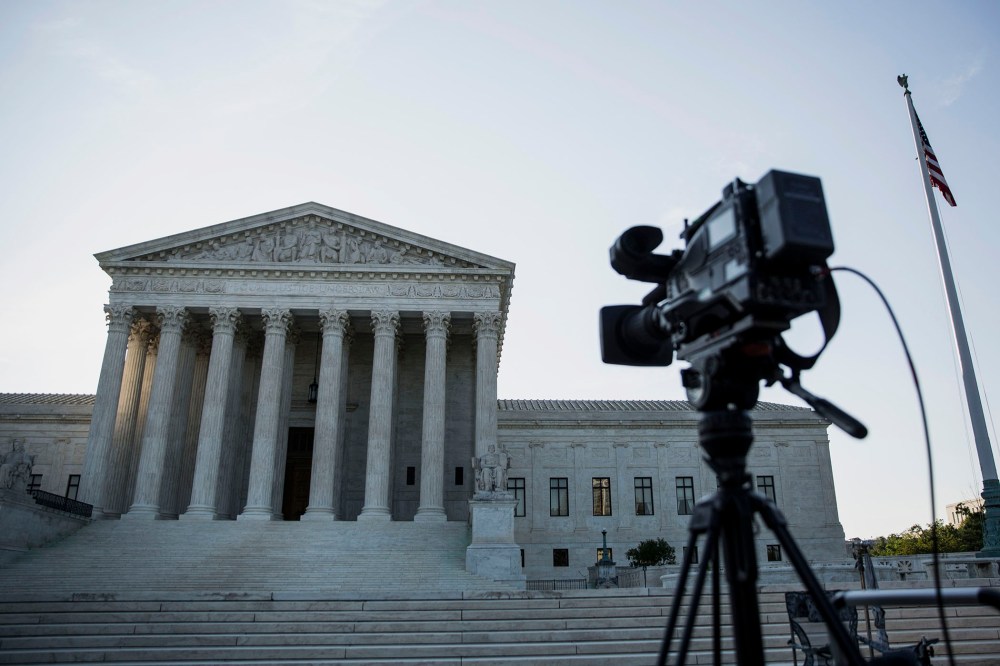
All nine justices of the U.S. Supreme Court have acknowledged at some point in their careers the value of televising court proceedings.
“I have no objection” to cameras, said Justice Clarence Thomas at his 1991 confirmation hearing. “It’s good for the American public to see what’s going on in there.”
“I don’t see any problem with it,” then-nominee Ruth Bader Ginsburg said two years later at her hearing. “It would be a terrific thing,” echoed Elena Kagan in 2010.
In the intervening years, each justice has changed his or her mind, much to the chagrin of an American public that overwhelmingly supports opening up our nation’s most powerful, least accountable institution.
RELATED: Is the Supreme Court broken?
Luckily this summer, while the justices themselves are on summer vacation, there’s a major milestone, and the opportunity for another, in the charge to convince our nation’s highest court to allow greater access to the media and average citizens.
First, the federal cameras-in-the-courtroom pilot program concluded this past week. The experiment began in 2011 and has allowed cameras in 14 federal district courts (two levels below the Supreme Court) across the country – from Alabama to California to Guam and many places in between.
The videos comprise hearings in civil cases, some of which, mirroring the Supreme Court docket, are fairly mundane, like evidentiary hearings in bankruptcy cases, while others are rather fascinating, such as a case in Iowa regarding when public officials are required to turn over e-mails to the press.
Most%20Americans%20believe%20that%20transparency%20should%20trump%20tradition.’
During the next few months, the judicial branch will study the results and offer guidance on the program’s successes and failures to the Judicial Conference of the United States, the federal judiciary’s policymaking body that comprises many of the nation’s top jurists who aren’t themselves on the high court. The conference may vote on expanding the use of cameras in federal courtrooms as soon as this winter.
Taking a step back, the arguments some judges and justices have been using against expanding media access to their proceedings are well-known: that a TV-free courtroom works and doesn’t need to be tinkered with; that cameras invite grandstanding; that the public won’t understand what’s going on; and that the broadcast media would take comments out of context.
But, increasingly, as the pilot program has shown, these arguments hold little water – as most Americans believe that transparency should trump tradition; that given the high stakes and abbreviated time, no advocate would dare play to the cameras; that the justices could explain the nature of a case at the start of a hearing; and that print reporters are already extracting snippets from hearings. They’re called “quotes.”
Right now, anyone – even Supreme Court justices, if they so desired – can watch many of the videotaped hearings online. What they’d find is that the cameras are about as obtrusive as wall-mounted clocks, doing nothing to add any drama or distraction to the proceedings.
Amid this backdrop, Congress has once again introduced a number of bills – five so far this session – that would allow cameras in the Supreme Court, hoping to force the justices’ hands if their colleagues on the Judicial Conference vote down what transparency advocates hope will be a positive review on the pilot program. RELATED: The nation’s highest court shouldn’t keep secrets These bills reflect the belief that if Congress can authorize the judiciary’s budget each year, it can write laws that mandate adherence to 21st century expectations of transparency. The sponsors and co-sponsors of these bills are bipartisan and geographically diverse and include committee chairmen, ranking members and even a presidential candidate and reflect the widely held belief that our nation’s highest court should broadcast its public exercises beyond its four walls. If%20the%20justices%20themselves%20aren%E2%80%99t%20willing%20to%20act%2C%20it%E2%80%99s%20up%20to%20those%20of%20us%20who%20care%20deeply%20about%20transparency%20to%20find%20other%20avenues.’ What’s unfortunate, though, is that, despite all this support, there has yet to be a hearing scheduled this year on the topic, with the last one having been held during a lame-duck session in 2014 by a congressman who has since retired. The second milestone during the justices’ three-month break, then, should be a hearing on at least one of the bills to coincide with the Judicial Conference’s next meeting, expected to be held the third week of September in the Washington, D.C., area. Since the end of the term two weeks ago, the justices have been traveling the world, trying to put what was a contentious June behind them. When they start the next term in October, there’s hope that a couple of the tasks needed to be done to open up the court – on the pilot program and on the bills before Congress – will have been completed in their absence. If the justices themselves aren’t willing to act, it’s up to those of us who care deeply about transparency to find other avenues through which we can build a more open and accountable Supreme Court. Gabe Roth is executive director of Fix the Court, a national, nonpartisan organization that advocates for a more open and accountable Supreme Court.
Gabe Roth Recommended


