








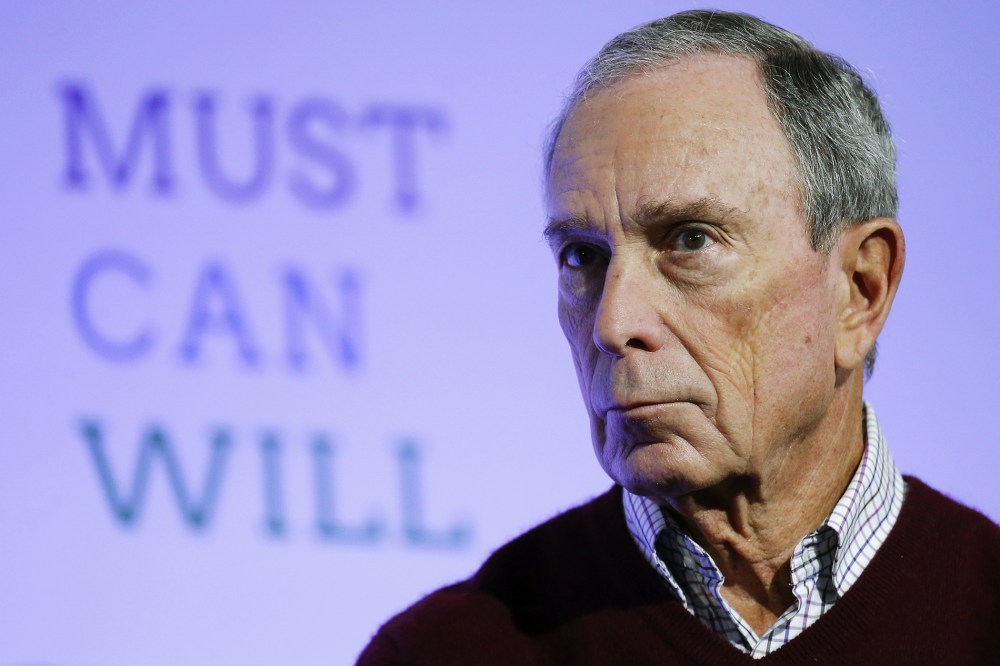
Tuesday’s New Hampshire contest could someday be known as “The Bloomberg Primary.”
The political world is still digesting the results from the Granite State, where self-described socialist Bernie Sanders and nativist Donald Trump each blew away rivals thanks to deep party support, but one consequence could be to coax former New York City Mayor Michael Bloomberg to come off the sidelines.
The thinking after New Hampshire, as described by a source familiar with the mayor’s plans, is that the results were anything but discouraging. The mayor sees a wider path if Trump or Senator Ted Cruz scores the GOP nomination, both of who appear well positioned after Tuesday. As for the Democrats, it’s not clear whether his thinking would be affected either way.
RELATED: The $39 billion question: Will Michael Bloomberg run for president?
Bloomberg, the billionaire founder of eponymous Bloomberg LP, suggested earlier this week that he might enter the arena on a centrist platform due to his disappointment with both parties’ front-runners. He explored a similar run in 2008 before ultimately deciding against it.
“I find the level of discourse and discussion distressingly banal and an outrage and an insult to the voters,” Bloomberg told the Financial Times shortly before Tuesday’s primary.
While the nominees are important, he doesn’t have the luxury of waiting for the process to play out. Bloomberg told the Financial times he’s targeted early March as a key deadline, at which point he’d need to mobilize his operation to start collecting signatures to get on the ballot before deadlines in key states like Texas.

Neither the Republican nor Democratic primary is likely to be resolved by then – the first big slate of contests is the SEC Primary on March 1, followed by another grouping on March 15. That means New Hampshire and upcoming early contests in South Carolina and Nevada could play a major role in swaying his thinking.
Bloomberg has kept a coterie of political advisers over the years who are now looking into the mechanics of a 2016 run. They include longtime strategist Kevin Sheekey, who enthusiastically encouraged Bloomberg’s last flirtation with a bid, former mayoral spokesmen Stu Loeser and Marc Lavorgna, former deputy mayor Howard Wolfson, and veteran Democratic pollster Doug Schoen.
While most have gone silent while Bloomberg makes up his mind, Schoen teased what a run might look like with an op-ed last month in The Daily News. In many ways, Schoen’s proposed messaging sounds like a bizarro version of Trump — “a political outsider who has never taken a dime of campaign contributions, but has taken on special interests and the Democratic and Republican establishments to do what is right and achieve real results.”
On policy and style, though, Trump and Bloomberg are almost perfect opposites.
When Bloomberg announced he would not run in 2008, he identified his top issues in the election as immigration reform, free trade, education, gun safety, and climate change. Since leaving office, he’s poured his time, prestige, and fortune into advocacy groups promoting each of these priorities. Trump, by contrast, is running on mass deportations, ripping up trade deals, ending gun-free zones in schools, and has claimed climate change is a hoax spread by the Chinese government.
RELATED: Could Bloomberg win as an Independent?
Bloomberg would run on a campaign of good governance based on data and empowering experts. Trump is running on tearing down the system and thumbing his nose at policy elites. It would make for a fascinating race.
It would be an extraordinarily difficult bank shot, though. Bloomberg is deeply unpopular with Republican voters over his positions on guns, climate, education, immigration, abortion, gay marriage, and public health regulations. Among Democrats, the nominee is likely to agree with him on many of the above issues, raising the question of how he would differentiate himself. This is an especially big hurdle, because his biggest break from the party is skepticism of liberal policies like taxing the rich and more tightly regulating Wall Street, both of which are popular among Democrats and independents alike. The issue that’s united both Sanders and Trump is a sense among voters in both parties that Wall Street and industry interests have too much power, and that global trade is balanced to favor corporate profit over American workers. It would be a strange election that empowered these candidates and then put Bloomberg, whose name is synonymous with the computer terminals that Wall Street runs on, in charge at the end of it. %E2%80%9CI%20find%20the%20level%20of%20discourse%20and%20discussion%20distressingly%20banal%20and%20an%20outrage%20and%20an%20insult%20to%20the%20voters.%E2%80%9D%20′ But Bloomberg is said to be wary of reading too much about the national mood from the primaries, which are often low-turnout races dominated by each side’s most strident members. The theory is that there’s another silent majority to match Trump’s that’s waiting for an anti-demagogue who promises quiet competence. Independent and third party candidates have never won and more often play a spoiler role for one of the major party nominees. Schoen seemed especially eager in his piece to rebut the notion he’d swing the race to the Republicans. Polling is too early and hypothetical to be of much value, but a Morning Consult Poll last month found Bloomberg getting 10-12 percent of the vote in various matchups, and drawing relatively evenly from both sides. Some of the biggest barriers to their success – lack of ballot access and institutional support – could be overcome to some degree by his vast fortune, estimated by Forbes at $39 billion. But the country is, if anything, more polarized along party lines than at any point in recent memory, making it difficult to peel off votes in either direction. His path might rest on Trump proving so spectacular a shock to the party system that the GOP essentially implodes. If Bloomberg could win just a handful of states, for example, he could deny either candidate a plurality of electoral votes and send the election to the House of Representatives. Republicans dominate the state delegations that would decide the race, but Bloomberg could try to forge a compromise between Democrats and moderate Republicans to swing their choice away from Trump. So far, however, GOP leaders sound much more willing to accommodate Trump than many expected several months ago. They’d face enormous pressure from their voters to fall in line behind whoever wins the nomination, making this scenario look far-fetched. In a year when politics has defied conventional wisdom at every turn, it would be foolish to rule out.
Benjy Sarlin Recommended


