This article has been updated since its original publication.
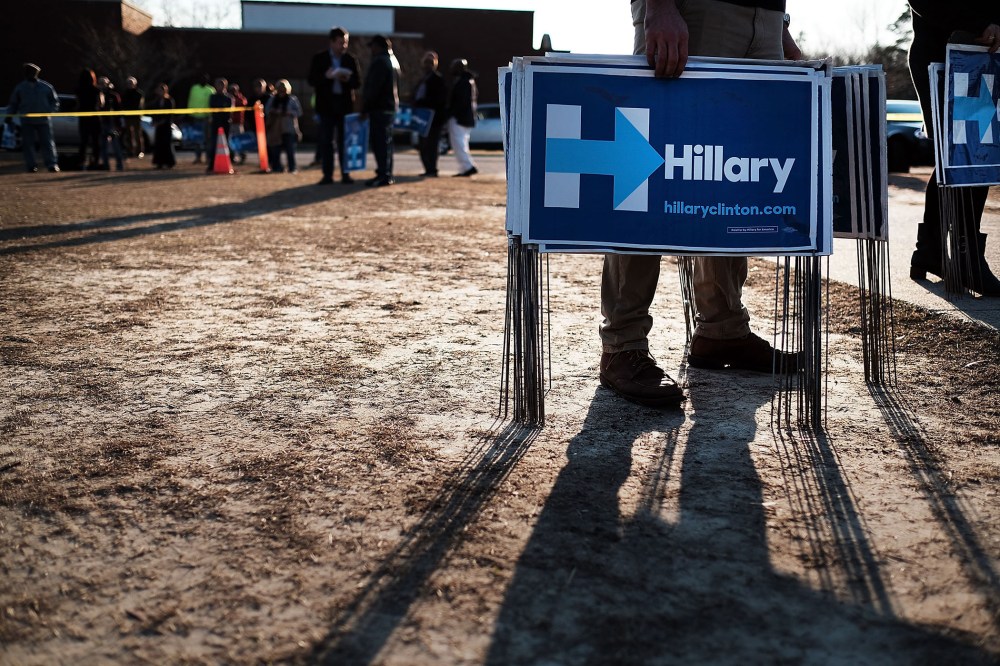
Even before Sen. Bernie Sanders began surging in early state and national polls, the Hillary Clinton campaign viewed South Carolina as her firewall, mainly due to her much higher standing and name recognition with black voters. But there are signs that the Clinton team may be falling behind the Sanders campaign, both in terms of organizing on the ground and exciting black voters, even as former Secretary Clinton maintains a large lead in the polls and prognosticators like FiveThirtyEight.com give her overwhelming odds of winning the state’s primary in two weeks.
As of last week, the Clinton campaign had only two campaign offices in South Carolina: one in Charleston and another in the capital, Columbia, with just 14 full-time staffers including state director Clay Middleton. The campaign also has nine “get out the vote” sites — smaller-scale sites devoted to turnout — across the state.
The Sanders campaign, meanwhile, had 240 staffers on the ground as of last week — 80 percent of them African-American — spread across 10 offices statewide.
“That’s real infrastructure,” said one veteran South Carolina political consultant who was involved in the 2008 effort to elect Barack Obama and who spoke on background. “[Donald] Trump lost Iowa because his campaign didn’t have infrastructure and Ted Cruz did. That’s what gets people to the polls. And Hillary is the very person who should know about infrastructure, because that’s how she lost to Obama in 2008 in the first place.”
The Sanders campaign is using both traditional and innovative strategies to reach voters, including “Bernie Bingo” for seniors who get a ride to the polls after enjoying the board game with the youthful canvassers. Voters in South Carolina have been able to vote early, absentee or in person since January 1, and the Sanders campaign is taking full advantage before the end of early voting for Democrats on February 26.
Primary voting days for Republicans and Democrats are February 20 and 27 respectively.
RELATED: Confusion over South Carolina ID law could keep voters away
“The Bernie people are doing the very thing that she should have been doing,” said the veteran campaigner. “At the end of the day, people want to be asked. Knock on my door.”
The Sanders campaign did just that on Thursday and saw some positive responses. LaFontant Williamson, 19, filled out a card committing to vote on February 27 and said he would be casting his first-time vote for Sanders. Jauris Shaw, 46, who like Williamson is African-American, prefers Sanders, too, and agreed to let the two young canvassers for the Sanders campaign place a yard sign in front of his home.
At legendary Story’s Barbershop in downtown Columbus, barber and manager Darrell Goodwin, 46, said he and his customers talk a lot of politics, just as they did when Barack Obama ran in 2008. And now, as then, he’s stumping for a candidate — this time pushing his customers to consider Sanders.
“He’s the only one speaking to the issues that we need to hear,” said Goodwin, who explained that as an Obama supporter, he wants to see even more change. “We got the Affordable Care Act,” said Goodwin, “and we appreciate it, but it’s not helping everybody. Bernie is talking about universal coverage, and that’s what we need.”
Goodwin said there is a generational divide between his older and younger clientele, with the older ones gravitating toward Clinton and the younger men siding with Sanders. But Goodwin hopes the former will change their minds. While he doubts a President Sanders could get all the things he wants, he likes that the candidate is “taking a stand for something” and reaching big, in the hope that even a compromise would produce a step forward from where things are now.
“Obama got us ‘here,’” he said, demonstrating a level with his hand, then raising it higher: “Bernie can take the next step and get us ‘here.’”
Through its South Carolina spokeswoman, Stephanie Formas, the Clinton campaign touted more than 1,900 grassroots events in the state and 16,000 hours knocking on doors, plus outreach to some 100,000 voters. On Friday, the candidate attended a town hall in Denmark, South Carolina, focusing on economic opportunity.
But on the ground in Columbia this week, there were few visible signs of excitement over the Clinton candidacy.
A case of overconfidence?
After losing in a 60-39 rout in Tuesday’s New Hampshire primary, Clinton campaign manager Robby Mook issued a memo emphasizing her strong ties to African-American voters in the more diverse states that follow the first-in-the-nation contests and the campaign’s superior data analytics. But veteran campaigners stress that analytics don’t win elections, ground games do. Some worry that the Clinton campaign took the wrong lessons from 2008, assuming that black voters will fall in line for Clinton the way they did for Obama, the way Democrats presume they will every time.

“The piece they adopted from [the 2008] Obama campaign was all this bullshit about analytics,” said the consultant, a South Carolina native. “The piece they didn’t adopt is what Democrats always forget: that without an actual, on-the-ground outreach strategy to get ‘Ray Ray’ and ‘Pookie’ to the polls, Obama would not have won.”
The Clinton campaign is betting that her vocal support for Obama and the backing of institutional players like the Congressional Black Caucus, whose political action committee endorsed her on Thursday, along with influential local black elected officials like State Sen. Marlon Kimson and church leaders will translate into turnout.
But conversations with elected officials and Democratic strategists in the state reveal little excitement over Clinton’s candidacy and a growing concern that not only are black voters not enthused, her campaign is being out-hustled by Team Sanders.
“They took [black voters] for granted and underestimated Bernie’s support,” said State Rep. Gilda Cobb-Hunter, who led the fight on the House side of the state legislature to remove the Confederate flag from the capitol grounds. “They’ve now discovered there are black folks ‘feeling the Bern.’”
Cobb-Hunter added that Sanders doesn’t even need to win the black vote outright to contest South Carolina.
“All he needs to do is carve off a piece of it,” she said, “because he’s got the working-class whites who don’t like Trump, he’s got the women, he’s got the young people.”
Sanders jumped from roughly 2 percent with black voters in South Carolina to around 20 percent in the polls between last summer and last month (there are no more recent statewide polls of Democrats in the state). Some veteran black politicians in the state think he could do better than that, Cobb-Hunter, who doesn’t endorse candidates as a rule, included.
Change in direction
After a tense confrontation with Black Lives Matter at Netroots Nation last year, the Sanders campaign staffed up with young, black political operatives who might not have gotten a second look in more traditional Democratic campaigns, but who are finding both opportunity and a passionate cause in the Sanders movement. They include his national spokeswoman, Symone Sanders, herself a veteran of the BLM movement, and national black outreach director Marcus Farrell, who is not yet 30 and has led an aggressive push to convert black voters nationwide. Aneesa McMillan, the campaign’s youthful South Carolina communications director, left the office of Alabama congresswoman Terri Sewell, who backs Clinton for president, to join the Sanders campaign.
The youth and energy inside the Sanders campaign is not just at the rallies, it’s also evident in his team. That energy and the call for revolutionary change has in turn attracted supporters for whom the new floor of expectation and possibility is the election of the first black president just eight years ago and whose center of organizational gravity is Black Lives Matter, not traditional and often clubbish Democratic politics.
The campaign has attracted a handful of important South Carolina players, like Clinton foe and 2008 Obama supporter Dick Harpootlian, a former chairman of the state Democratic Party, along with younger lawmakers like State Rep. Justin Bamberg, one of the attorneys for the family of police shooting victim Walter Scott, and a cadre of black iconoclasts who in many ways have been isolated from the centers of power, even in the Obama era.
Some of these could prove problematic for Sanders, including the president’s arch-nemesis, Dr. Cornel West, who has disparaged Obama as a “black mascot of Wall Street” and a “Rockefeller Republican in blackface,” among other slurs. His photo, along with quotes about Sanders, adorns the walls of the Sanders campaign office in Columbia, and McMillan insists he has been well received in appearances for Sanders on college campuses and even in the barbershops, despite the strong support for Obama in the state. Still, his history of lobbing vituperative and highly personal insults at the president could reverberate among black Obama supporters.
Other Sanders supporters could prove intriguing to black liberals old and young, including actors Danny Glover and Harry Belafonte, a confidant of the late Dr. Martin Luther King Jr. and an outspoken Black Lives Matter supporter; former Ohio State Sen. Nina Turner, who switched her support from Clinton to Sanders late last year; Ben Jealous, formerly the youngest president of the NAACP; and rapper Killer Mike. Most recently, respected Atlantic writer Ta-Nehesi Coates said he would be voting for Sanders, though he later wrote that his statement did not amount to an endorsement.
Clinton, meanwhile, has struggled to attract high-profile black surrogates who go beyond her traditional support base: Congressional Black Caucus members like longtime Clinton friend and ally John Lewis and the church and party leaders who supported her in 2008, as well. “I suppose they are influential in their home states,” Cobb-Hunter said of the CBC members who announced their endorsement Thursday. “But that’s not moving people here.” Clinton has attracted strong support from a majority of statewide elected officials and local religious leaders, including Rev. Anthony Thompson, whose wife Myra Thompson was among the nine parishioners killed inside Mother Emanuel Church last year. And Sanders and his supporters have provided openings for Clinton to press her claim for African-American support. The Clinton campaign is zeroing in on Sanders’ past and recent criticism of President Obama, whom Sanders said failed to lead on closing the divide between Congress and the American people in a recent interview with MSNBC’s Kasie Hunt. Sanders was among a group of liberals and liberal libertarians, including Dr. West and former independent presidential candidate Ralph Nader, who in 2011 said it would be a good thing for Obama to face a primary challenge in 2012, something Sanders told liberal radio host Thom Hartmann he was considering himself. And Rep. Lewis on Friday dismissed attempts by some Sanders supporters to inflate his civil rights activism, saying that as a leader of SNCC for six years during the 1960s, he never saw or met the future Vermont senator. This comes as questions have resurfaced about a photo on the Sanders website depicting what some University of Chicago alumni say is another man, not Sanders, leading a sit-in. The campaign previously confirmed that a photo being circulated by Sanders supporters of the 1965 march from Selma to Montgomery does not depict Sanders, who was a member of CORE while attending the University of Chicago in the early 1960s. Beyond Lewis, however, the most visible black celebrity supporter for Clinton is her longtime friend Star Jones. R&B singer Usher accompanied the candidate to a campaign rally at Clark Atlanta University last year but has not been seen on the campaign trail since. South Carolina Clinton supporters had expected a parade of stars to flood the state for Clinton ahead of the primary to help motivate voters. It hasn’t happened, and sources close to the campaign say it’s not for lack of outreach from the national campaign. The Clinton team is showing signs that it perhaps belatedly recognizes that it has a potential problem. The campaign hired veteran black ad firm Burrell Advertising late last year to do black radio ads in the state. And sources say the campaign is preparing to ramp up its presence, adding staff and hiring Rick Wade, who ran Obama’s successful 2008 campaign in the state, to try to turn things around. On Friday, the campaign announced that it has hired black feminist writer, political analyst and popular social media personality Zerlina Maxwell for its national digital outreach team. ‘Insurmountable’ lead over Sanders Not everyone agrees that the Clinton campaign is trouble in the Palmetto State. “Hillary’s lead in South Carolina is simply insurmountable, due specifically to the black vote, and this notion that he’s peeling away black voters from her is a myth,” said former Senate Democratic staffer Jimmy Williams, himself a native South Carolinian. “What black voters in South Carolina want is simple. They want someone who loves God, won’t lie to them, will protect America and will fight against racism. And the Clintons are literally family to black South Carolinians.” RELATED: Bill Clinton courts black voters on the trail in South Carolina State Sen. Ronnie Sabb, who has endorsed Clinton, also said there is more excitement on the ground than might be visible to reporters parachuting into the state for a few days. “You can feel the intensity revving up,” said Sabb. “The results from Iowa and New Hampshire have lit a fire under the campaign, as well as the voting public.” Rev. Nelson Rivers, who heads the National Action Network chapter in Charleston, said Clinton is likely to win the primary here, but he said that for many African-Americans, it’s more about concerns about Sanders’ electability than a rejection of his message. “There’s a double-mindedness” about Sanders among black voters, Rivers said. “People love his progressive politics and his ideas,” like single-payer health care and free college education for all. “But there’s a pragmatism there. They worry that he can’t be elected.” Even if he could somehow win a general election, Rivers said, black South Carolinians he talks to ask: “If the black president couldn’t do [these things], what can Bernie do?” Rivers notes that influential South Carolina congressman Jim Clyburn, whose political machine remains the most formidable of any black politician in the state and whose disdain over a series of inflammatory comments by the Clintons about Obama was the coup de grace for her campaign in the state, isn’t hurting Clinton this time around. And Rivers doubts that Clyburn, one of the 712 super delegates on the Democratic side, would side with Sanders over Clinton, even if he were not committed to neutrality until the primary. “He’s just too practical to do that,” Rivers said. But traveling around the state capital Thursday, it was difficult to find Clinton enthusiasts. African-Americans who spoke to MSNBC ranged from those who were “feeling the Bern” to voters like Rosemond Beacham, a grandmother who said she was leaning toward Hillary, but was now undecided after listening to her children and grandchildren advocate for Sanders, though she did point to his age as something that gives her pause. Beacham, who said education and whether her grandchildren will be able to afford to go to college are her top issues in the campaign, said she might wait to make up her mind until Election Day. Update: The Clinton campaign, through a spokesperson, points out that the 100,000 figure reflected the voter contacts in a single week and disputes the characterization of the number of staffers it had in South Carolina as of last week. The campaign would not disclose how many staffers they have in South Carolina.
Joy-Ann Reid
Joy-Ann Reid is host of “The ReidOut” at 7 p.m. ET on MSNBC. “The ReidOut” features one-on-one conversations with politicians and newsmakers while addressing provocative political issues both inside and outside of the beltway. Recommended