








Victoria Kidd was sitting on the couch next to her pregnant wife when she knew that something was wrong. Though 100% certain she had had a stroke, Kidd, a freelance writer and small business owner, didn’t want to call an ambulance for fear of burning a hole in her pocket. It was 2012, and neither the Commonwealth of Virginia, where she lived, nor the federal government recognized her marriage — a snub that prevented Kidd from obtaining coverage under the same health plan as her wife, Christy Berghoff, who received great insurance as an employee of the Department of Justice.
A few months later, when Berghoff gave birth to their daughter, Lydia, Kidd again faced discrimination — this time in the pediatric wing.
“She had a kind of, ‘Who are you?’ moment,” said Kidd of one of the nurses on duty. “When I explained that Christy was my wife, we got a raised eyebrow and not the most compassionate care. There are real, tangible ways that marriage equality impacts our families every day, but the ones that get under your skin are the intangible ways.”
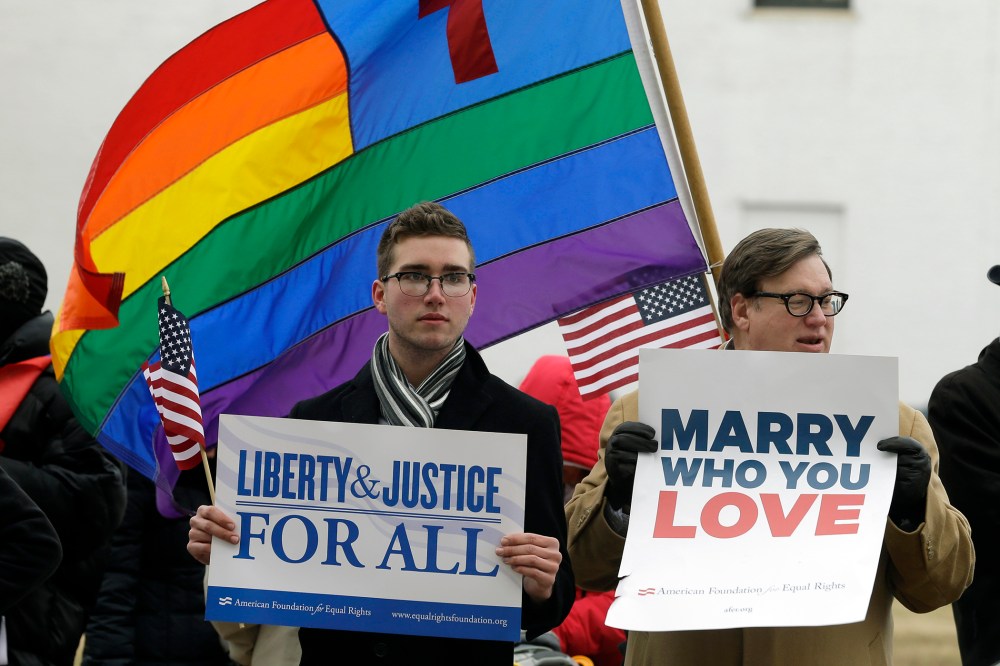
For the couple, both 34 years old, the two experiences capture what it’s like to be treated differently than their married, hetersexual counterparts, and what they’re hoping to eradicate by appearing Tuesday before the Fourth Circuit Court of Appeals as part of a federal challenge to Virginia’s same-sex marriage ban. In January, newly-elected Democratic Attorney General Mark Herring decided he would not defend the law, finding it to be “in violation of the U.S. Constitution.” A month later, U.S. District Judge Arenda L. Wright Allen – a President Obama appointee – agreed.
Tuesday’s hearing is the third marriage equality case to go in front of an appeals court this year, following oral arguments before the Tenth Circuit in lawsuits against similar bans in Utah and Oklahoma. All three cases (and six more that have so far reached the federal appellate level) stand a chance at drawing a broad ruling from the U.S. Supreme Court — one which eluded plaintiffs last June in the challenge to California’s ban, Proposition 8.
That lawsuit, argued by lawyers Theodore Olson and David Boies, successfully returned marriage rights to gay couples living in the nation’s most populous state. But it failed to do so for gay couples living everywhere else. Now, the duo behind Prop 8’s demise is back, hoping to accomplish in Virginia what they could not in California.
“David and I are not done with the battle,” said Olson at a press conference last September, alongside the plaintiffs in Bostic v. Rainer, Virginia’s marriage equality case. “Even though we were successful in California, we don’t feel — and we will not feel — that we’ve been successful until all Americans have the same rights, and the same privileges, and the same respect that other Americans do.”
Olson and Boies weren’t always on the same side. In 2000, the two argued against each other before the Supreme Court in Bush v. Gore, which cleared the way for Olson’s client, George W. Bush, to become the 43rd President of the United States.
But they’re not the only odd couple involved in the Virginia suit. The case also brings together the American Civil Liberties Union and Lambda Legal — two groups that had initially resisted the bold strategy to win marriage equality in one fell swoop — with Olson and Boies’ employer, the American Foundation for Equal Rights. After the ACLU issued a statement in 2009 opposing the Prop 8 case, Olson and Boies proceeded to block the group from joining their suit once it picked up steam.
This time, however, the Fourth Circuit allowed the ACLU and Lambda Legal to intervene, consolidating AFER’s federal challenge with a separate class action lawsuit. The case before the appeals court Tuesday now represents approximately 14,000 same-sex couples who wish either to marry or have their out-of-state marriage recognized in the commonwealth.
Despite their turbulent history, James Esseks, director of the ACLU Lesbian Gay Bisexual Transgender and AIDS Project, says there’s no bad blood between his group and AFER. Rather, he’s emboldened by having a massive legal team with representatives from every group responsible for the major gay rights victories of the last twenty years: Hollingsworth v. Perry (AFER), Romer v. Evans (Lambda and the ACLU), Lawrence v. Texas (Jenner & Block’s Paul Smith), and United States v. Windsor (ACLU).
“We’re bringing decades of experience to bear on this problem,” said Esseks of the Virginia suit. “To bring together all those people who helped make those cases happen and put them on one legal team … that is powerful.” Haunting Tuesday’s hearing is another landmark case, Loving v. Virginia, which led to the Supreme Court’s 1967 decision to invalidate laws prohibiting interracial marriage. As Esseks puts it, there’s a sort of “symmetry” about returning to the state “where the freedom to marry principles were first established.” Thirty-two states currently prohibit gay couples from marrying, though that number may go up to 33 should Arkansas’ Supreme Court suspend last week’s decision striking down the state’s same-sex marriage ban. Of this group, Virginia’s 2006 voter-approved amendment is particularly harsh, barring same-sex couples from marrying, having their marriages recognized, or entering into civil unions. Virginia also prevents gay couples from adopting each other’s children — a process known as “second-parent adoption.” “I had to go to court and essentially sue Christy to become a ‘co-custodian,’” said Kidd. “I’m not not her mother; I’m not her parent, even though I am the stay-at-home mother who takes care of her. I am the first person who held her. She is my everything.” The issue is particularly pressing for another plaintiff couple, Jessi Duff and Joanne Harris, who are raising their five-year-old son, Jabari, together. Harris, who is Jabari’s biological mother, suffers from epilepsy. “If there’s something wrong with Joanne, I wouldn’t be able to make my own son’s medical decisions,” said Duff. But the 33-year-old is also familiar with the less extreme — yet just as vexing — forms of discrimination, like a raised eyebrow at the hospital. “We just filled out the registration for kindergarten for Jabari,” said Duff. “I could fill out the paperwork, but I could not sign it. It’s something that they didn’t say anything to us about. I just knew that Joanne had to sign, and I couldn’t.”
Emma Margolin
Emma Margolin is a reporter at MSNBC.com. Recommended


