








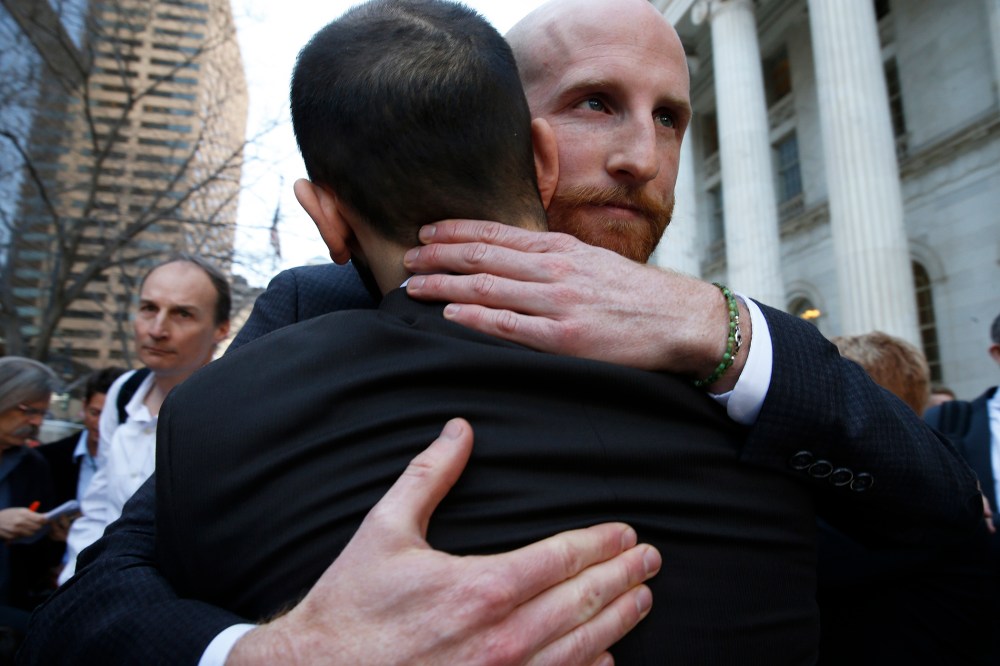
A three-judge panel of the Tenth Circuit Court of Appeals presented a divided front on Thursday as it heard oral arguments in Kitchen v. Herbert, a lawsuit seeking to overturn Utah’s constitutional definition of marriage as between one man and one woman.
Amendment 3, approved with 66% of the vote in 2004, is one of 29 constitutional bans on same-sex marriage in the United States. A further four states prohibit such unions by way of statutory provision. Should Kitchen v. Herbert make it to the U.S. Supreme Court, it stands a chance at drawing a broad ruling that strikes down all remaining state bans on same-sex marriage.
Since the nation’s justices took historic action on the rights of gay couples to wed last June, few days in court have drawn as much attention as this one — the first time a marriage equality case has reached the appellate level.
As with every other federal challenge to gay marriage bans over the country, round one in Utah’s fight went to the plaintiffs. U.S. District Judge Robert Shelby ruled in December that Amendment 3 violated the Constitution’s guarantee to equal protection under the law. Seven other federal judges have handed down similar victories for marriage equality since last June, when the nation’s highest court struck down a central provision of the Defense of Marriage Act — which prevented the U.S. government from recognizing same-sex nuptials — and allowed Proposition 8 — California’s version of Amendment 3 — to die.
But Thursday’s proceedings were different. As James Esseks, director of the ACLU Lesbian Gay Bisexual Transgender & AIDS Project, noted to msnbc, they offered the “first glimpse” at what this court — and what four other appellate courts on deck to hear marriage equality cases — may be thinking.
“The country, including judges, has been on a real journey over the last several years, specifically over this past year,” said Esseks ahead of oral arguments Thursday. “With the Supreme Court’s ruling in the DOMA case, we’ve seen a tipping point because every federal judge to rule on the freedom to marry since then has said that gay people are just like everybody else who has the freedom to marry in America. And today, we’re going to see whether that tipping point has reach the federal appeals court.”
The three judges appeared to be leaning in different directions during their questioning Thursday. Carlos Lucero, a 1995 President Clinton appointee, voiced strong concerns with Utah’s marriage law, even comparing the state’s argument to that of the defendant’s in the pre-Civil War Dred Scott decision, which denied citizenship to black slaves.
“To argue that public policy can trump a declared constitutional right would be a remarkable proposition,” said Lucero, as reported by the Associated Press.
On the other side of the bench, Judge Paul J Kelly, a 1991 George H.W. Bush appointee, appeared to be leaning toward the state.
“You are just taking the position they are wrong on this,” said Kelly, referring to Utah voters who approved Amendment 3.” We’ll just ignore what the people have decided and the Legislature has done?”
Legal experts agreed that Judge Jerome Holmes, a 2006 President Bush appointee, appeared to be the swing. Holmes already voted against Utah attorneys once on this issue, when he and two others on the Tenth Circuit denied the state’s request for a stay on Judge Shelby’s December ruling. More than 1,000 same-sex couples were able to wed in Utah because Shelby and the Tenth Circuit refused to delay the effects of the district court’s decision. The U.S. Supreme Court ended up granting the stay 17 days after Amendment 3 was struck down, halting further same-sex marriages from taking place while litigation continued.
Holmes peppered both sides with questions, at one point comparing Utah’s ban on same-sex marriage to now-defunct bans on interracial marriage, and at other times giving credence to the argument that voters should be allowed to define marriage as they wish.
The issue of child-rearing also came up, as the state argued that children in the long run benefit from marriages between a man and a woman. A federal judge in Michigan recently rejected the claim that gay couples make inferior parents to their heterosexual counterparts, so Utah attorneys were careful to tread lightly. In a last minute filing Wednesday, the state distanced itself from the findings of Professor Mark Regnerus, whose research on the negative effects of gay parenting was soundly dismissed by a Michigan judge as “entirely unbelievable and not worthy of serious consideration.” There is no clear timeline on when the judges will issue their decision, but Esseks believes they will continue to treat the case in an expedited manner. Next Thursday, the same panel on the Tenth Circuit is set to hear arguments in a lawsuit challenging Oklahoma’s ban on same-sex nuptials. “I would be surprised if we didn’t have a decision before the end of the summer,” said Esseks. Kitchen v. Herbert was filed last year on behalf of three same-sex couples in Utah. In a Facebook post Thursday, Moudi Sbeity — one of the plaintiffs — said he could “barely sleep” in anticipation of the hearing. “I’m anxious, nervous, excited, scared, happy, and everything in between,” he wrote. “And I can’t help but reflect on everything and everyone that led us to today, especially the man I love and committed myself to.” One thousands miles away from the Tenth Circuit Court in Denver, a federal judge in Evansville, Indiana, gave the marriage equality movement even more recognition. On Thursday, U.S. District Judge Richard Young granted a temporary restraining order on that state’s same-sex marriage ban, compelling Indiana to recognize the union between a lesbian couple before one of the women passes away from cancer. “We are so thankful that we can move forward and concentrate on being with each other,” said Niki Quasney, who has stage 4 ovarian cancer, in a statement. “Our time together and with our daughters is the most important thing in the world to me.”
Emma Margolin
Emma Margolin is a reporter at MSNBC.com. Recommended


