








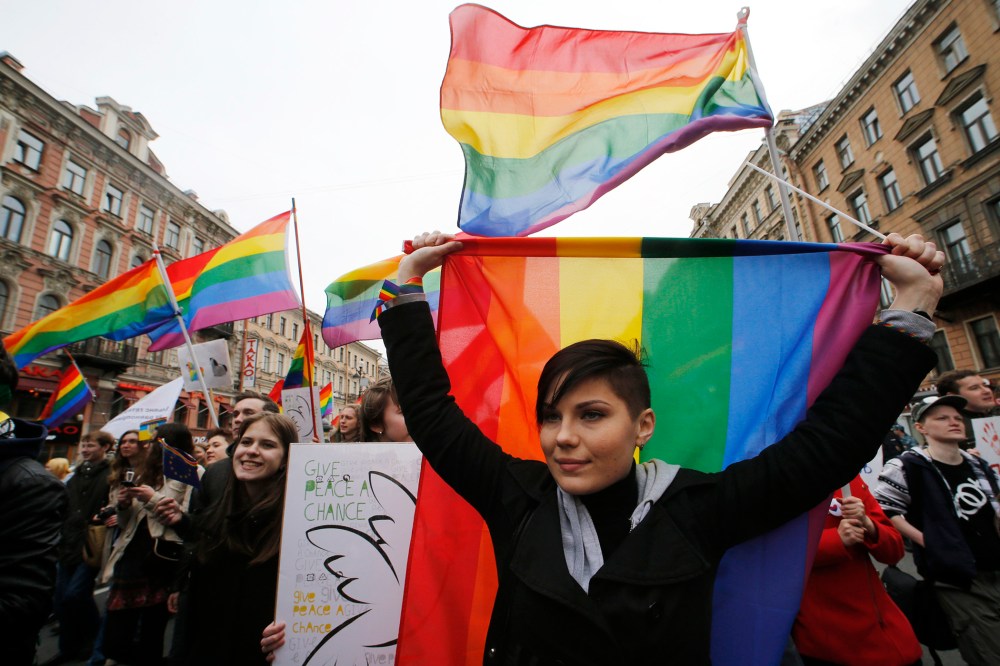
The United Nations Human Rights Council adopted a landmark resolution for LGBT rights during its 27th session on Friday, the second-ever motion of its kind. The resolution, which was heavily promoted by the U.S., was sponsored by Uruguay, Colombia, Brazil and Chile. Countries from every geographic region in the world joined as supporters.
The action, which passed by a 25-14 vote margin after more than an hour of debate, condemns violence and discrimination on the basis of sexual orientation or gender identity across the globe.
“We are pleased to see that today the international community is visibly and publicly upholding the rights of LGBT individuals, and thereby we demonstrate ourselves as a global community respecting the rights of all,” said Ambassador Keith Harper, who represents the U.S. on the U.N. Human Rights Council.
Still, since the resolution comes with no enforcement capability — it simply calls for a report from the U.N. high commissioner on LGBT rights abuses — it will likely largely be seen as a symbolic gesture, albeit it one that the U.N. has largely failed to make in the past. This resolution is only the second time the U.N. has referred to LGBT rights as “human rights.”
Not all of the reaction to the resolution was positive: Pakistan’s representative to the U.N. Human Rights Council called it a “divisive and controversial initiative.”
“We feel there is an attempt to impose uniculturality” that “runs counter to religious and cultural practices of some countries,” said Saudi Arabia’s representative during debate. “In my opinion, this [resolution] is a human rights violation.”
South Africa, considering their recent history of harsh anti-LGBT legislation, surprisingly backed the resolution. But Buzzfeed reports that insiders on the Human Rights Council say the African nation helped “water down” the resolution before lending its support.
A total of 21 countries either opposed or abstained from the resolution. Also — ironically in light of the sponsors of the resolution — Latin America accounts for almost 80% of the world’s reported murders of transgender people, with more than half of these deaths occurring in Brazil. “The Human Rights Council has taken a fundamental step forward by reaffirming one of the United Nations’ key principles — that everyone is equal in dignity and rights,” said Jessica Stern, executive director of the International Gay and Lesbian Human Rights Commission, after the vote. “This resolution puts the U.N. on a trajectory to address the discrimination and violence LGBT persons suffer daily across the world.” “The council is confirming that LGBT people have universal human rights,” she added. “We know, of course, that the struggle is long, and that we will need the Council to focus on the violations we suffer for many years to come. But for now, we celebrate that the majority of States stood with us to declare, unequivocally, that human rights are for everyone, everywhere.” While this resolution was passed on Friday, Russia’s Constitutional Court upheld their country’s anti-gay “propaganda” law. “This disappointing ruling legitimizes an unjust law created to target and oppress Russia’s LGBT community,” said Human Rights First’s Shawn Gaylord. “However the court makes it clear that the law’s application should be limited to cases involving minors.”
Adam Howard Recommended


