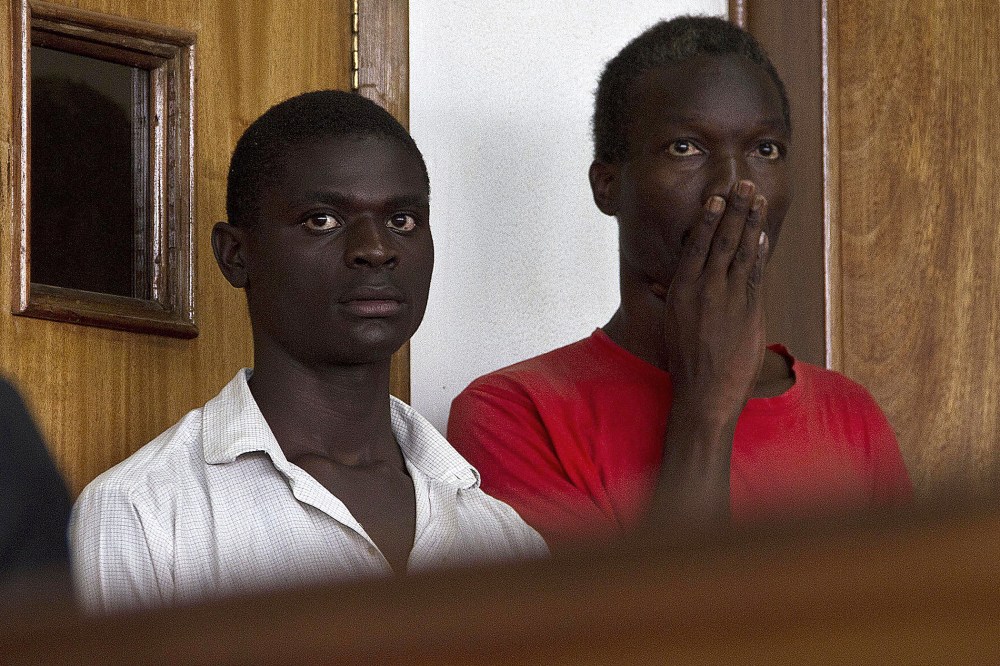
Two Ugandans set to face the first gay sex trial in the country’s history appeared before a magistrate’s court this week after spending almost five months in jail for engaging in acts “against the order of nature.”
Nineteen-year-old Jackson Mukasa and 24-year-old Kim Mukisa were arrested in January on charges of violating a colonial-era statute, known as the Penal Code Act, not the country’s more recent Anti-Homosexuality Act, which drew widespread condemnation from the international community upon its passage. The newer law is currently under appeal in Uganda’s Constitutional Court.
In previous cases, prosecutors have dropped the charges due to a lack of evidence. This time, however, they say they have enough to proceed. If convicted, the two could face life in prison.
Mukasa and Mukisa were able to secure bail on Wednesday, the group Human Rights Awareness and Promotion Forum (HRAPF) told BuzzFeed, and now await the start of their trial on June 12.
Even though the two Ugandans face charges under a decades-old law, human rights activists see their prosecution as a symptom of the country’s intensifying crackdown on its LGBT community. In the lead-up to the newer law’s passage and in its aftermath, anti-gay attitudes have spiked, often manifesting as violence toward LGBT or perceived-LGBT individuals. A similar slew of homophobic attacks took place in Russia when that country passed a series of anti-gay measures, one banning “propaganda of nontraditional sexual relations among minors.” Though Russia’s law carries administrative sanctions, not criminal penalties as in Uganda, both seem to have the same effect of fueling vigilante violence and anti-LGBT sentiment. In fact, when Mukisa and Mukasa were arrested, they were fleeing an angry mob, a local watchdog group told The Guardian.
It is precisely for this reason that John Abadallah Wambere, an openly gay activist from Uganda, requested asylum in the United States this week, just as Mukasa and Mukisa were preparing to appear in court nearly 7,000 miles away.
“This has been a very, very difficult decision for me,” Wambere said at a press conference with his legal team at the Gay and Lesbian Advocates and Defenders (GLAD) in Boston. “It gives me great pain not to be with my community, allies, and friends while they are under increasing attack.”
In February, Ugandan President Yoweri Museveni signed the Anti-Homosexuality Act — formerly (and informally) known as the “Kill the Gays bill” — which strengthened penalties for same-sex activity. Under the new law, a person faces life imprisonment for entering into a same-sex marriage or engaging in so-called “aggravated homosexuality” — which includes having sex with a minor, while HIV-positive, or even just repeatedly with a person of the same gender.
President Obama called the new law “a step backward,” while Secretary of State John Kerry likened it to anti-Semitic legislation in Nazi Germany.
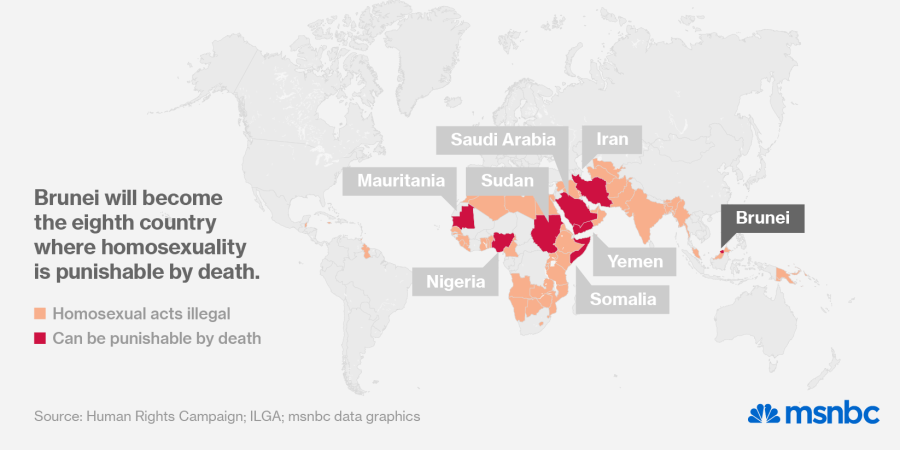
But it’s not just Uganda where LGBT people face persecution. According to the International Lesbian, Gay, Bisexual, Trans and Intersex Association, the death penalty exists in seven countries for those who engage in same-sex relationships, and approximately 70 more criminalize homosexuality in less severe ways. Once Brunei fully implements its new penal code, it will become the eighth nation with the death penalty for same-sex activity.
When paired with historic advancements for LGBT rights in other parts of the world, including the U.S., this anti-gay wave primarily across Africa and Asia becomes more striking. Some believe it’s precisely because western nations are embracing LGBT equality that the reverse is happening elsewhere. “While it’s been the case for a long time that homosexuality is generally not something that’s approved of by Ugandans, increased hostility is something that’s a little bit newer,” said an NGO worker, based in Kampala, who preferred not to be identified. “In the last few years, you get the sense of real hostility and vitriol, and I think there has been a rhetoric that homosexuality is a Western import; a Western idea that has been brought to Uganda and in some ways produced a perverse outcome. It left many Ugandans thinking, ‘Well, this is the West trying to impose its will on us.’” That view was on full display at a recent news conference in Nairobi, Kenya, where church leaders equated homosexuality to “colonialism,” “slavery,” and “a weapon of mass destruction.” Others point out, however, that anti-gay attitudes are just as much — if not more — of a “western import,” in this case, brought to Uganda by notable crusaders like Massachusetts gubernatorial candidate Scott Lively. Less than a month after Lively’s 2009 visit to Kampala, Parliament passed a resolution allowing for the submission of a bill that eventually became Uganda’s Anti-Homosexuality Act. He is currently awaiting a trial filed against him by Uganda’s Center for Constitutional Rights. Lively has since distanced himself from the law, acknowledging to The Boston Globe that he did visit the country and does hold critical views of homosexuality. But, he said, “That doesn’t mean I think people should be thrown in jail for that.” According to the Pew Research Center, a staggering 93% of Ugandans believe that homosexuality is morally unacceptable, and activists worry that Museveni will continue to push anti-gay policies as part of his reelection campaign. Already, Uganda is considering a new law that would bar NGOs from pro-gay advocacy. Should Museveni hold onto the presidency in 2016, it will be his 30th year in power.
Emma Margolin
Emma Margolin is a reporter at MSNBC.com. Recommended