








Brunei has begun to implement a new Sharia-based penal code that will soon impose death by stoning as a possible punishment for crimes including rape, adultery, and same-sex activity.
The first phase, enacted Thursday, carries fines and jail time for offenses such as missing Friday prayers, having a baby outside of wedlock, propagating religions other than Islam, and engaging in indecent behavior. But more draconian measures are on the way — including flogging and amputation of limbs for heavier crimes. The final phase, which allows stoning as a possible punishment for sodomy, will begin in 2015.
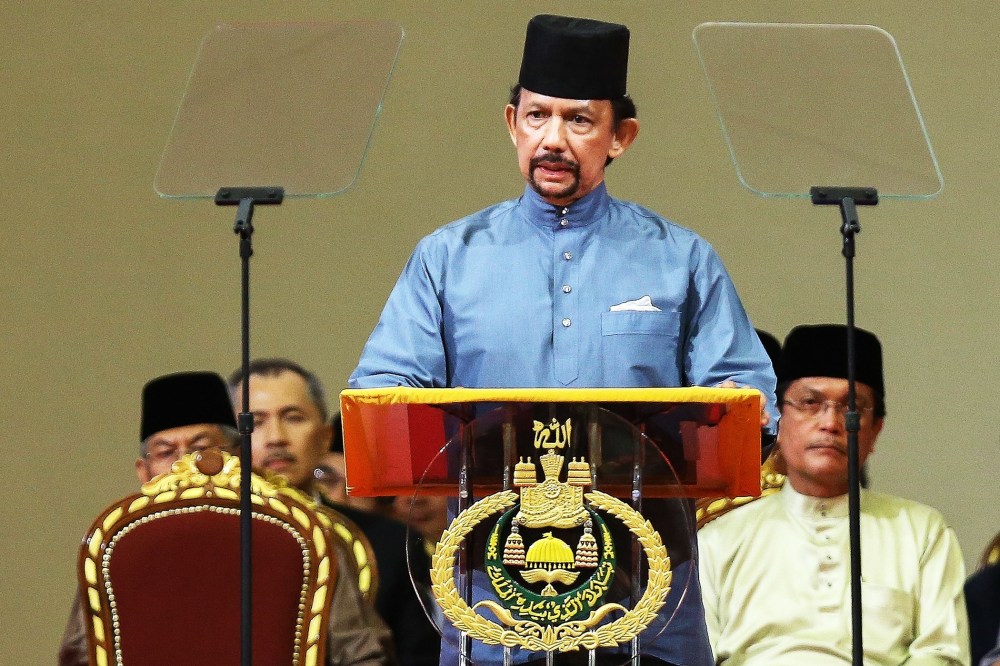
Sultan Hassanal Bolkiah, who is also the prime minister, called the law a “great achievement” for the Southeast Asian country.
“The decision to implement the (penal code) is not for fun but is to obey Allah’s command as written in the Quran,” he said in a speech Wednesday, announcing the launch. The Sultan was also quoted as saying that his government “does not expect other people to accept and agree with it, but that it would suffice if they just respect the nation in the same way that it also respects them.”
Bolkiah first announced the law in October, 2013, eliciting widespread condemnation from the international community. In a press briefing last month, Rupert Colville, a spokesperson for the U.N. High Commissioner for Human Rights, said the organization was “deeply concerned” about Brunei’s revised penal code.
“Under international law, stoning people to death constitutes torture or other cruel, inhuman or degrading treatment or punishment and is thus clearly prohibited,” he said. “The provisions of the revised penal code may encourage further violence and discrimination against women and also against people on the basis of sexual orientation.”
Located on the Island of Borneo, Brunei is the first East Asian country to adopt sharia law. Muslim Malays make up 70% of the country’s population, according to AFP, while about 15% are non-Muslim ethnic Chinese. Once the new penal code is fully implemented, Brunei will join seven other countries that have the death penalty for sex between gay people.
Ty Cobb, director of Global Engagement at Human Rights Campaign, called the development “frightening.”
“This specifically is a recent first in the sense that we’re seeing a new sharia law-based penal code being enacted in that part of the world,” he said to msnbc. “That said, there are other types of legal challenges facing LGBT people — primarily, in the last year, with Nigeria and Uganda enacting harsher penalties for being found gay.” In January, Nigeria’s president signed the Same Sex Marriage Prohibition Act, which imposes a 14-year jail sentence for gay couples who marry, and up to 10 years’ imprisonment for supporting gay clubs and organizations. A month later, Uganda passed a law carrying up to life sentences for so-called “aggravated homosexuality,” including having sex with a minor or while HIV-positive. Uganda is now considering a new law that would bar non-governmental organizations (NGOs) from pro-gay advocacy. Perhaps more so than any other country, however, Russia recently pulled focus on this issue for passing a series of anti-gay laws — one in particular banning the promotion of “nontraditional” sexual relationship among minors. “There’s been a real movement not only with harsher penalties for people who engage in same-sex relationships, but also to silence people for speaking up for their own rights,” said Cobb. Despite historic gains for LGBT equality in certain parts of the world, including the United States, approximately 80 countries currently criminalize homosexuality. That number may go up if nations that advance gay rights don’t do a better job of promoting equality outside their borders. “I wouldn’t say what’s happening in the U.S. is the problem; it’s the reaction that’s the problem,” said Cobb, in response to a question about whether anti-gay laws would continue to surface in the face of evolving western values. “I think it shows the we have a lot more work to do globally in having these discussions and ensuring that LGBT people are not ‘The Other.’ That community is part of the broader community.”
Emma Margolin
Emma Margolin is a reporter at MSNBC.com. Recommended


