








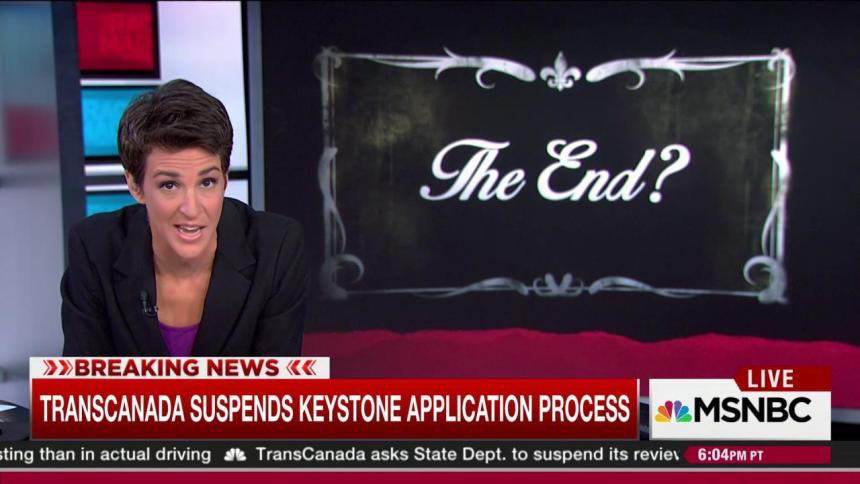
After a tortured half-decade-long process, the company behind the Keystone XL pipeline on Monday asked the Obama administration to suspend its permit application, plunging the project into a state of open-ended uncertainty.
The proposed project is a $6 billion steel straw that would double the flow of oil from Canada’s tar sands to U.S. refineries on the Gulf Coast. It would also tip the earth toward catastrophic global warming, activists say, and for that reason they’ve fought off approval for years, turning a routine review into a political acid test.
In September, Hillary Clinton came out against the pipeline, after initially indicating support. That put added pressure on the White House to kill the project or risk undermining President Barack Obama’s own high-profile efforts to forge a global response to climate change.
RELATED: Senate fails to override Obama’s Keystone veto
Now, it seems, TransCanada, the Canadian company behind the pipeline, is temporarily pulling out amid low oil prices and the risk of a permanent rejection. Officially, however, the company is suspending its application only because the company is going through a state-level review process in Nebraska.
“In order to allow time for certainty regarding the Nebraska route, TransCanada requests that the State Department pause in its review of the Presidential Permit application for Keystone XL,” the company said in its request, according to the the Wall Street Journal. “This will allow a decision on the Permit to be made later based on certainty with respect to the route of the pipeline.”
Activists celebrated the suspension of the pipeline, which many saw as a state-sponsored step toward global suicide. It’s designed to slurp the tar sands of Alberta, a repository of heat-trapping carbon so large it could tip the earth toward catastrophic climate change, they say. Tap it and “it’s game over for the planet,” in the words of James Hansen, the former NASA climate scientist.

“Clearly TransCanada has lost and they recognize that,” said Bill McKibben, the founder of 350.org and a key architect of the movement against Keystone XL. He called TransCanada’s retreat, “one of the great victories for this movement in decades.”
But the pipeline’s fate is still undetermined. The suspension request must still be approved by the Obama administration, which could opt to reject the permit instead. The suspension request itself came shortly after the White House said a decision was coming soon. If the suspension is granted, the permit decision would be pushed beyond the 2016 election, a prospect likely to create a lot of local political and economic turmoil. The pipeline would dive under Montana, South Dakota, and Nebraska, before joining an existing southern leg that connects to the Gulf Coast. This alone required hundreds of private land owners to sign off, with the expectation of checks arriving soon. A delay for the pipeline means a delay in whatever economic boost the pipeline may provide for those three states. Many of the areas along the proposed path have been caught in a spiral of decline. As costs have risen, farms have grown in an effort to increase efficiency and diversify, but fewer people are around to work the extra land and added crops. Last year, NBC News traveled to Circle, Montana, one of dozens of small towns along the route, to see what the pipeline project looked like from a local perspective. Since the 1960s, Circle has lost half of its population to moving vans and the mortuary, and Main Street looks like it’s missing a few teeth. The movie theater is closed. The bowling alley has no lanes. In the center of town, the Gladstone Hotel is a 99-year-old historical landmark with weeds growing through the floor. “If there is no pipeline, there is no future,” said Denny Hogan, the commander of VFW Post 4813. “End of conversation.”
Tony Dokoupil Recommended


