








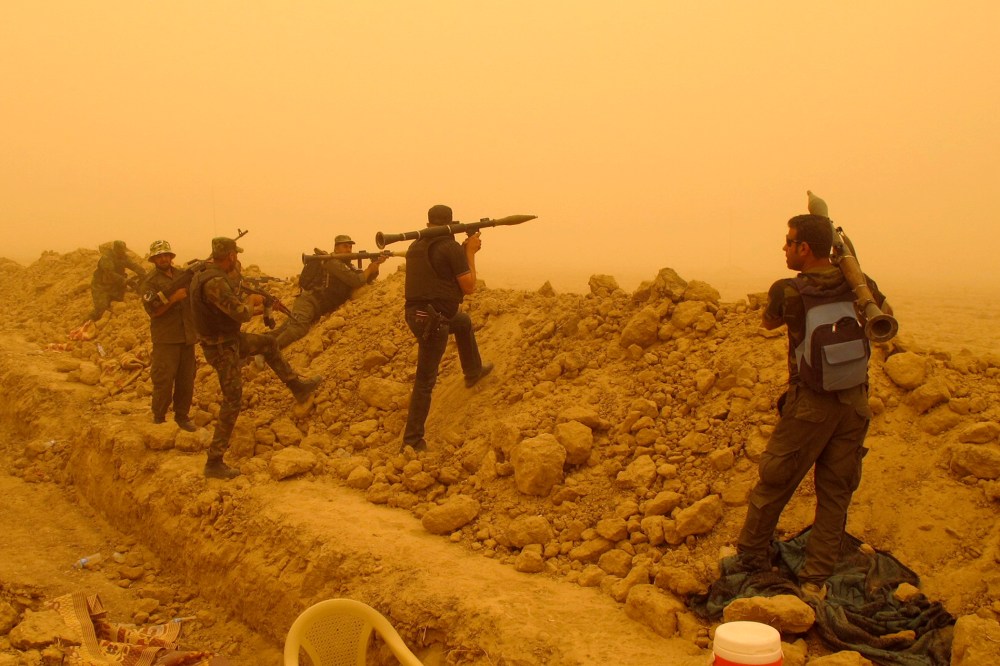
BAGHDAD, Iraq — Militiamen saunter unchallenged along Baghdad streets with rocket-propelled grenade launchers slung across their shoulders. Neighborhood after neighborhood is being ghettoized and sealed off by checkpoints manned by fighters in civilian clothes carrying machine guns. On Iraqiyya, the state TV channel, the war propaganda is so bizarre that it appears like satire: pictures of heavily-built men dancing in tandem while decked out in military uniforms and body armor, and twirling AK-47s like they’re batons.
%22Iraq%20the%20state%20is%20almost%20broken.%22′
It’s old news that Iraq is out of control. But amid the deluge of reports of ISIS atrocities and the security forces’ faltering efforts, the daily effects of the spiraling chaos on ordinary Iraqis are mostly overlooked.
Meanwhile, the capital’s residents face the daily terrors inspired not only by rumors of an impending ISIS onslaught on Baghdad but the more immediate threat posed by government security forces and militias — often, the residents aren’t sure which — who conduct random searches of people’s homes and arrest people without warrants or any apparent legal basis. These violations are just one piece of a big, broken puzzle: a peephole into Iraqis’ tragic, chaotic upside-down world.
I had a call recently from a friend in Yarmouk, a relatively upscale majority Sunni neighborhood. He told me that a frenzied phone call from a neighbor awakened him at 5:30 a.m. “There’s dozens of them,” his neighbor told him, “they’re recording our names and searching for someone – they look like army but there’s so many, I’m afraid it’s Asa’ib.” The caller was referring to Asa’ib Ahl al-Haqq, a powerful, government-backed Shia militia that controls large areas of Baghdad.
My friend was unable to leave the neighborhood despite the warning. Security forces and militiamen, nearly indistinguishable in their staple plain T-shirts and camouflage pants, had closed off the area. They arrived at his house a few hours later, searched it, recorded his name and that of each of his family members, and asked him about other people living or hiding in his house.
I saw him hours later, after the security forces had finished searching every house in the neighborhood, apparently without displaying a single warrant, and had finally allowed people to move in and out of the area again. He was still visibly shaken. “The only thing I had on my mind,” he told me, “was whether they were really security forces or militia. We used to be so scared of army, SWAT, federal police. Now, it’s almost a relief when it’s them — at least we know they won’t kill us on the spot.”
Iraq the state is almost broken. Kurdish ministers have suspended participation in the cabinet, parliament postpones forming a new government, security forces are infiltrated both by Shia militias and Sunni armed groups. Iraqis are losing hope that their country will ever be repaired: Nearly everyone I speak to tells me a break-up of the state is “inevitable.” Of course, it appears that way to people who have already lived through several wars, are endlessly harassed at random by armed men who they can’t be sure are real security forces, although they wear military uniforms, and have become accustomed to living under the daily threat of death. Yet others still cling to hope. All that needs to happen, some say, is for the government to get a grip and begin to govern, for lawlessness to morph back into law. Why, they ask, is that so seemingly impossible? Iraq’s leaders have a long way to go, and little time left, to make the reforms needed to restore the rule of law, in place of rule by brute force. For Iraq to survive, its leaders need urgently to take back the reins of power from the militias and other armed groups. These groups, inspired by the Iraqi leaders’ own abusive rule, are tearing the country apart — not only in their battles against ISIS in Anbar, Mosul and Tikrit, but through their daily trampling of their fellow citizens’ basic freedoms. Erin Evers is the Iraq researcher at Human Rights Watch.
Erin Evers Recommended


