








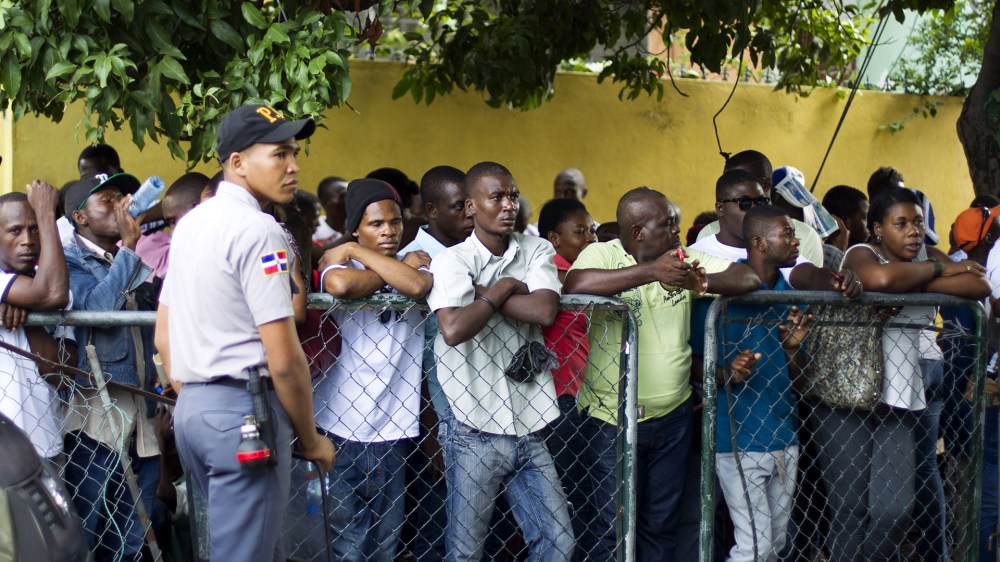
Hundreds of thousands of mostly Haitian undocumented immigrants in the Dominican Republic who didn’t register with the government could be at risk of being rounded up and deported.
The Dominican government gave undocumented immigrants until 7 p.m. on Wednesday to register with the government as a way to regularize their immigration status and avoid being deported. But many of them have not gone through the process yet.
Human rights advocates have called on the Dominican government to give undocumented immigrants more time to register. They said many immigrants stood in long lines outside government offices for days but kept getting turned away after being told they lacked the necessary documents to register. Others also had a hard time convincing their employers to give them time off of work to go register.
RELATED: Cuban refugees face uncertainty amid talks to modify law
EFE reported on Wednesday that an estimated 275,000 immigrants have registered with the government, less than half of the total population of immigrants living in the Dominican Republic without legal status. A 2012 surveyfound that there were over half a million undocumented immigrants in the country, and almost nine out of ten are from the neighboring country of Haiti. Many of them work in the sugar cane fields or as domestic workers.
Interior Minister Ramón Fadul said Wednesday that even though the deadline to register still stood at 7 p.m., the Dominican government would work to register all immigrants who were still in line at government offices by Wednesday night.
“We are going to work with those who remain in line because we don’t want to mistreat anyone,” he said, according to EFE. “We want everyone to be regularized.”

In the past, Fadul had acknowledged the difficulties many immigrants faced trying to register. On Tuesday he tried to reassure the public that there wouldn’t be any immediate mass deportations.
But that’s not what the head of the country’s immigration agency indicated will happen. The Associated Press reported Tuesday that Army Gen. Ruben Paulino said his agency will begin patrolling neighborhoods with large numbers of migrants on Thursday. They plan to use 12 buses, seven light trucks and two ambulances to conduct the immigration patrols.
“If they aren’t registered, they will be repatriated,” Paulino said, according to the AP.
Though the two countries share a border, Haiti is much poorer and was devastated by the recent earthquake. Haitian workers have traditionally gone to the Dominican Republic for work, and this increased after the earthquake. The Dominican government as well as residents have said the influx of immigration from Haiti has strained resources. In comments made to EFE, the European Union ambassador in Haiti, Alberto Navarro, said he is “confident” that the Dominican Republic will not conduct “massive deportations.” Navarro said the Dominican Republic was courageous in “imposing order where there was disorder,” in reference to its immigration issues. But for some human rights advocates, the actions are the latest in a history of mistreatment of Haitians in the Dominican Republic, which has deep roots spanning generations and different governments. In 1937, Dominican dictator Rafael Trujillo ordered the massacre of thousands of Haitians. Tensions rose in 2013 when a court declared that the children of undocumented Haitian immigrants—even those born in the Dominican Republic—would no longer be entitled to citizenship, leaving hundreds of thousands of people stateless. After an international outcry, the law was changed to giving citizenship to those whose births were in the nation’s civil registry; those who were not would have a chance at nationalization. On Twitter, the #WeAreAllDominicans hashtag drew reactions from those criticizing the Dominican Republic’s actions.
Griselda Nevarez Recommended


