








The Earth’s climate has never had a year like 2015.
It’s likely to shatter the record for the hottest year since humans started keeping track. But the most amazing part of 2015 isn’t the heat—it’s the fact that humanity finally agreed to do something about it.
The historic moment arrived on December 13, just after 7 p.m. local time, inside a high-security airplane hangar on the outskirts of Paris. Delegates from nearly 200 nations ratified a universal pact to slow manmade global warming, ending a decades-long political stalemate and — according to the best possible science — lowering the risk of ecological collapse.
President Barack Obama declared it “the most ambitious climate change agreement in history.”
RELATED: Climate deal: The good, the bad, the still unknown
The agreement commits the world to hold “the increase in the global average temperature to well below 2°C above pre-industrial levels and to pursue efforts to limit the temperature increase to 1.5°C above pre-industrial levels”; reach a “global peaking of greenhouse gas emissions as soon as possible,” and enact “rapid reductions thereafter”; and provide a minimum of $100 billion a year for developing countries to adapt to the ravages of our already overheated climate.
But all of this could also fall apart, which is why 2015 may go down as epoch-making moment—the end of one era of human history and, quite possibly, the beginning of another. Or, in a darker future, 2015 may simply be the beginning of the end.
Much depends on a series of bold, never-before-seen executive actions by President Obama. The biggest is the Clean Power Plan, which he announced in August. The plan is the first-ever effort to limit the amount of carbon that power plants can pump into the atmosphere.
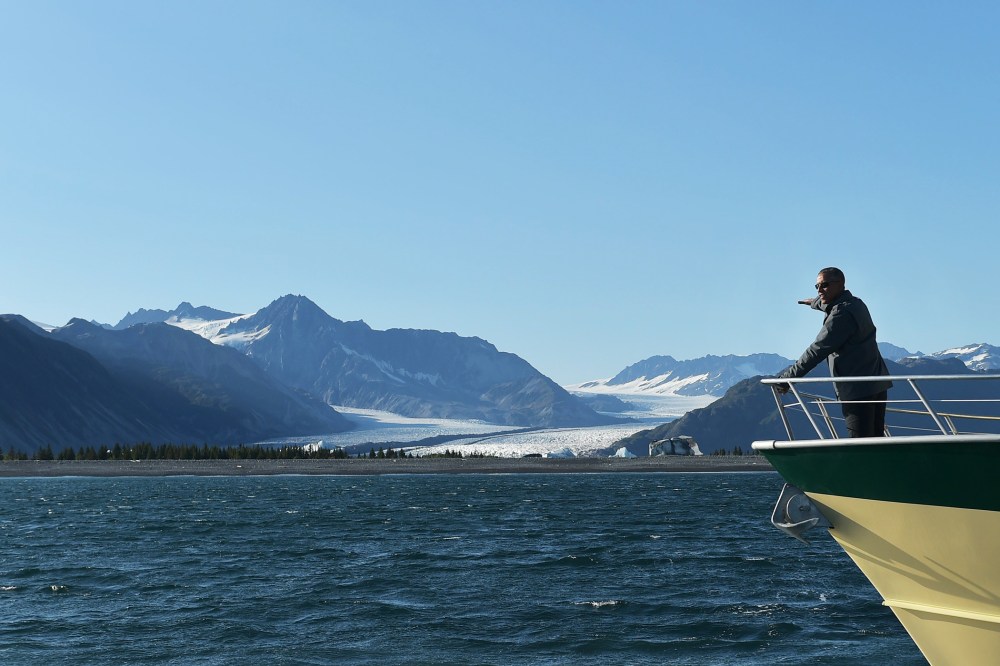
“I don’t want my grandkids to not be able to swim in Hawaii or not be able to climb a mountain and see a glacier because we didn’t do something about it,” Obama said in an emotional press conference announcing the plan. “That’d be shameful of us. This is our moment to get this right and leave something better for our kids.”
The speech already feels like the stuff of slow-mo documentaries, a moment that fundamentally rewrote Obama’s mixed legacy on global warming, and helped him make good on his 2008 inaugural promise to slow the rise of the oceans and heal the planet. It’s a move credited with giving Obama the political capital he needed to wring commitments from the rest of the world.
It’s also a position that other Democrats took up in 2015. All three Democratic candidates running to replace Obama have pledged not only to continue his plans but to deepen them, ratcheting up American ambition and urging other countries to do the same.
This wasn’t a foregone conclusion. Former Secretary of State Hillary Clinton started the year to the right of rival and long time climate hawk Bernie Sanders. The Vermont senator — along with former Maryland Gov. Martin O’Malley, another climate hawk — took an early position on three acid-test issues for environmentalists.
He and O’Malley opposed the Keystone oil pipeline, the search for oil in the Arctic and rampant drilling for fossil fuels on public lands. Clinton dithered, then joined them, making 2015 the year in which Democrats decided that climate change could be a winning political issue. By contrast, all the leading GOP candidates spent 2015 skeptical about anthropogenic climate change, or at least skeptical of the claim that it is a serious, multi-level threat to the planet. Their skepticism is dangerous and misplaced, according to scientists. But nonetheless they are pursuing it as a political pose. RELATED: How can California fight climate change? They offered almost uniform support the Keystone pipeline, Arctic drilling, and fossil fuel extraction on public land—and almost uniform opposition to the Paris climate agreement and Obama’s Clean Power Plan. What’s certain is that if a Republican is elected president in 2016, President Obama’s climate polices will be clawed back, potentially imperiling the planet in the process. But this isn’t just about politics. In another milestone, 2015 marked the start of an extraordinary legal, political and even cultural battle over how to address climate change. It’s a fight that could stretch for years, inspiring an escalating level of activism and opposition. More than two dozen states have sued to block the Clean Power Plan, which means that climate change — like universal health insurance — could end up being decided by the Supreme Court. That makes 2015 a scary year as well. In the sunnier reading of events, it’s the start of something wondrous. Every five years, according to the Paris agreement, the nations of the world are supposed to return to the negotiating table, raising their intention to slash greenhouse gas emissions. That could mean the end of the era of oil, gas, and coal, the fuels that produce the majority of planet-heating gases. But the Paris deal is almost totally voluntary, a quirk devised by the U.S. delegation, which calculated that it could never get a binding treaty through Congress. As a result, the era of oil, gas and coal may yet live on — and, if it does, many of the rest of us may not.
Tony Dokoupil Recommended


