








It was a foregone conclusion that Hillary Clinton would at some point endorse the official super PAC unofficially supporting her 2016 presidential bid. But the earliness and eagerness with which she’s embraced Priorities USA has surprised many — especially since Clinton is a candidate who has made campaign reform a central pillar of her campaign.
But the Democratic front-runner and her allies have concluded — probably correctly — that the promise of the super PAC easily outweighs its peril. While the move may hurt her marginally in the party primary, it will undoubtedly help her significantly in the far more challenging general election.
RELATED: Hillary Clinton endorses super PAC
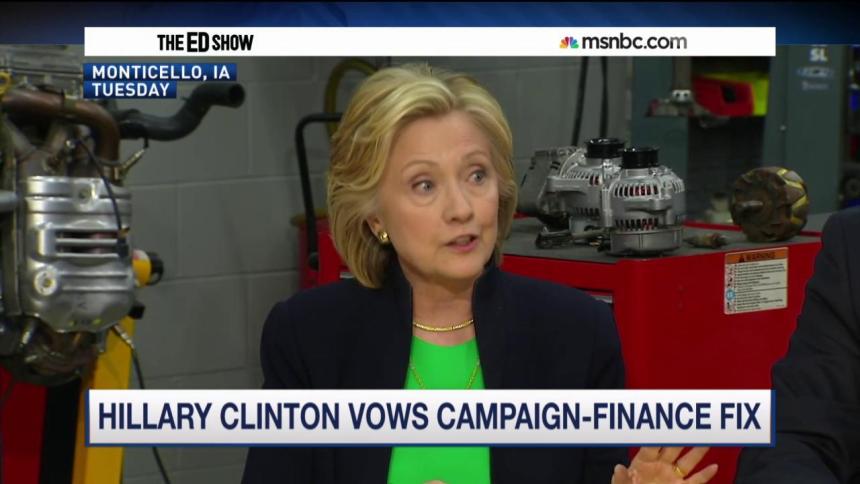
Clinton fielded harsh criticism from campaign finance reform advocates for her decision this week to meet with Priorities USA donors. The super PAC plans to soon install a former top Clinton aide at its head. After Clinton used her first campaign event to call for a constitutional amendment to curb money in politics, the move disappointed many watch dogs.
In contrast to Clinton, President Obama in 2012 dragged his feet on embracing Priorities USA, the same super PAC now backing Clinton, making it difficult for the group to convince donors to open their wallets.
It wasn’t until just 10 months before Election Day that the president reluctantly relented. Even then, he allowed on campaign officials speak at Priorities fundraisers, and never appeared at one himself.
Clinton has already gone further — and less than four weeks since declaring her presidential run. She had two meetings with small groups of donors in California this week, sources confirmed, and her top aides have committed to doing more.
The meetings with donors are possible thanks to loopholes in laws that otherwise prohibit coordination between campaigns and super PACs. Pushing the envelope of coordination may conflict with her reformist message, but she is unlikely to suffer much from her deal with the campaign finance devil.
Clinton’s move comes in response to Jeb Bush, who is going a step beyond Clinton in exploiting legal loopholes by running a super PAC himself. He plans to fill its coffers with as much as $100 million this month before formally launching his presidential campaign, at which point he will be prohibited from coordinating with the independent group.
Bush’s super PAC recently lifted its self-imposed $1 million cap on individual donations, and plans to vastly out-raise the official campaign after it launches. He’ll even outsource much of his campaign operations to the super PAC.
In this climate, it would be suicide for Clinton not to embrace the super PAC and embrace it early, her allies say.
“Voters care about what someone will do once they get into office,” Geoff Garin, a top strategist on Clinton’s 2008 presidential campaign, told msnbc. “Hillary Clinton has made it clear that she is committed to changing the system to get unaccountable money out of politics, even if that takes a constitutional amendment. On the question of who will work for meaningful reform, the contrast between Hillary Clinton and the Republican candidates is crystal clear.”
RELATED: Jeb Bush exploits major loophole in campaign finance rule
Of the biggest contributors to outside groups in the 2012 presidential race, the top three were Republicans and only six out the top 20 donors were Democrats, according to the Center for Responsive Politics. The number-one donor on that list, Republican casino mogul Sheldon Adelson, more than doubled the combined total contributions from all six Democrats.
Clinton’s team is expecting to get outspent by Republicans, so the quicker and more aggressively she can signal to donors that she needs them to give to Priorities, the easier it will be for the super PAC to hold its own and reach its $200 million-plus fundraising goal.
One dollar donated to an actual campaign goes much further than a dollar to a super PAC, since campaigns pay a legally mandated discounted rate for television advertising not available to super PACs. Mitt Romney learned this the hard way when he and his super PAC outspent Obama by almost a third, but ended up running 50,000 fewer ads.
But individual donations to campaigns are capped at just a few thousand dollars, and Clinton has yet to prove that she can generate Obama-level enthusiasm in firing up a massive base of small-time donors. The super PAC is a hedge in case she can’t.
Clinton’s allies also note that the candidate’s anti-money-in-politics message is technically consistent with her embrace of a super PAC, since she called for eliminating “unaccountable” money from politics, not “unlimited” money. “Unaccountable” is a reference to so-called “dark money” groups that don’t have to disclose donors, while super PACs do make such disclosures. Clinton, a lawyer, chose that word carefully.
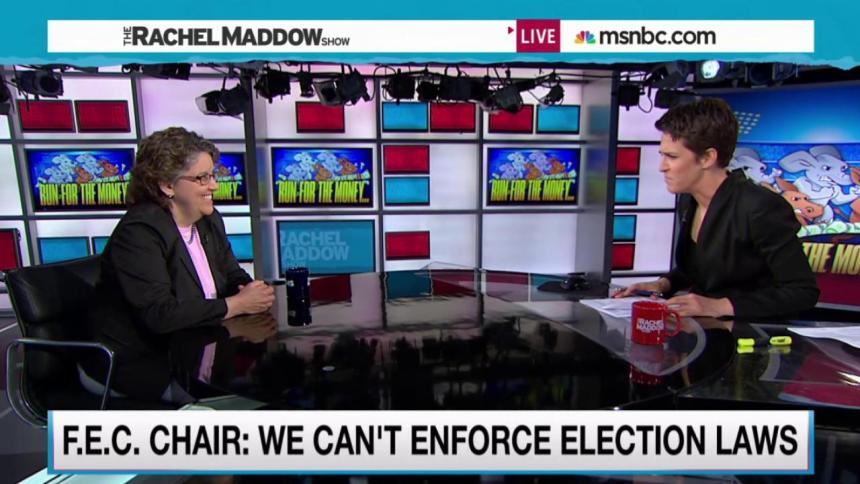
Despite her cautious choice of language, campaign finance watchdogs argue that super PACs are also unaccountable, since they can disband and disappear if they run intro trouble — unlike candidates or political parties. Critics also note that Priorities USA has its own “dark money” affiliate, but that group has never run ads.
Average voters are unlikely to parse these differences, and the Clinton campaign probably doesn’t have to worry about them doing so.
Despite polls showing Americans are overwhelmingly fed up with the amount of money flooding politics, even campaign finance critics acknowledge that politicians are rarely damaged by taking giant checks.
RELATED: Why Hillary Clinton’s immigration policy is a big deal
“The public is not happy with the finance system, but they’re not voting on this issue primarily,” said Rick Hasen, a University of California-Irvine professor who runs a popular election law blog.
Hasen, the author of a forthcoming book on how both parties have sold out to plutocrats, doubts the genuineness of Clinton’s commitment to campaign finance reform, but he notes campaign finance reform is not a key issue for most voters.
%22The%20public%20is%20not%20happy%20with%20the%20finance%20system%2C%20but%20they%E2%80%99re%20not%20voting%20on%20this%20issue%20primarily.%22′ According to Pew, only 28% of Americans think campaign finance reform should be a top priority for Congress — ranking the issue 21st out of 22 issues polled. And it’s difficult for anyone to land a clean blow on Clinton regarding the issue, since almost everyone — including many of Clinton’s critics on the left — are tainted by their own use of super PACs. Labor unions, environmentalists, grassroots progressive organizations, and even campaign finance reform advocates themselves have started their own super PACs. Even Ready for Warren, a group hoping to draft Sen. Elizabeth Warren into the 2016 presidential race, which has taken shots at Clinton’s left flank, was organized as a super PAC. Republicans typically oppose major restrictions on money in politics, and several likely candidates, like Bush, are running their own super PACs. Recent political history is littered with candidates who took the high road on campaign finance reform — only to lose. Last year, MayDay PAC, the super PAC started by lefty Harvard Professor Lawrence Lessig to help candidates who support campaign finance reform, lost nearly every race in which it was involved. In 2008, Barack Obama audaciously backtracked on his own pledge when he became the first presidential candidate to forgo public financing since the system was created. “If I am the Democratic nominee, I will aggressively pursue an agreement with the Republican nominee to preserve a publicly financed general election,” Obama said in the fall of 2007, before destroying the public-financing system by opting out. RELATED: Bernie Sanders out-raises Republicans in first day of campaign Republican John McCain stuck with public financing and pounded his Democratic rival on the flip-flop, but to no avail. Today, few remember who broke public financing, and Obama has hardly suffered. The voters who care most about campaign finance reform tend to be well-educated liberals. So while Sen. Bernie Sanders — whose spokesperson did not return a request for comment on Clinton’s embrace of Priorities USA — may have picked up some votes this week because of her decision, that’s an entirely acceptable price for the front-runner to pay in a relatively safe primary if it will help her during the general election campaign. By then, liberals who care about campaign finance reform will have a choice between Clinton, who says she wants to fix the system, and a Republican who will probably be openly hostile to reform. Meanwhile, those most directly affected by the rise of super PACs are the mere millionaires whose four-and-figure donations no longer buy them as much influence inside a campaign as they used to — thanks to the multi-million donations super PACs can net. It’s hardly a sympathetic audience. And David Donnelly, the president of the campaign finance reform group Every Voice, told msnbc that Clinton can still convince activists she takes their issue seriously, even while working with a super PAC. “The rules are the rules. Everyone needs to play under the same rules. We are mostly interested in a set of positions that candidates take that truly addresses money in politics, and a clear statement about how much of a priority it is,” he explained. Clinton will need to do much more than she’s done thus far, and embrace solutions that are more immediate than a constitutional amendment, Donnelly said, but it’s possible. They’re hoping for a bold rhetorical statement on this issue that will surprised doubters, like the one she made on immigration reform this week in Nevada. “A pillar of a campaign is not a toothpick. So we have to see something that will literally hold up our democracy,” he said. Correction: An earlier version of this story misspelled the last name of Prof. Rick Hasen.
Alex Seitz-Wald Recommended


