








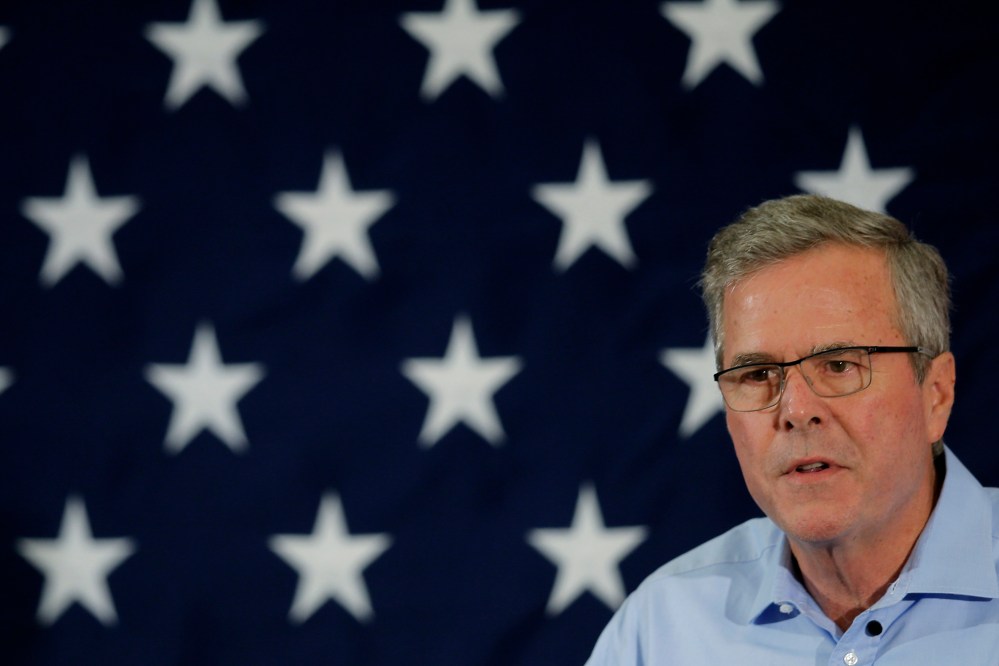
Today, thanks to a Supreme Court decision that unleashed unlimited money into politics, even the unlikeliest of long-shot presidential candidates needs only one very wealthy patron to run a credible campaign. It’s a system that many campaign finance reform advocates see as messy and bordering on corrupt. But now, Former Florida Gov. Jeb Bush is taking things to an entirely new level: putting off his official entry into the 2016 race so he can raise vast sums for a super PAC that’s supposed to be entirely independent of his all-but-certain campaign.
%22Until%20he%20says%20the%20magic%20words%20%E2%80%98I%E2%80%99m%20running%20for%20president%2C%E2%80%99%20he%20can%20raise%20as%20much%20money%20as%20he%20wants.%22′
The 2016 GOP field is already crowded. Sens. Ted Cruz of Texas, Marco Rubio of Florida and Rand Paul of Kentucky are in, with announcements expected next week from former Hewlett-Packard CEO Carly Fiorina, retired neurosurgeon Ben Carson and former Arkansas Gov. Huckabee. Missing from that group is Bush, an early GOP frontrunner who says he’s still “exploring” a possible candidacy. Why is he waiting? In a word, money.
By not officially jumping in the race, the former Florida governor doesn’t have to abide by the “hard money” rules of presidential campaigns, which cap primary donations at just $2,700 per individual. He’s raising unlimited funds for his Right to Rise super PAC instead.
Super PACs, which sprang to life in the wake of the Supreme Court’s 2010 Citizens United decision, can accept unlimited donations from wealthy individuals and from corporations. The only rule: they must operate independently of a candidate’s official campaign operation.
The word ‘candidate’ is key. Since Bush isn’t yet an announced candidate, he is essentially exploiting a loophole in the law and soliciting for his own super PAC.
According to the Sunlight Foundation, a non-partisan group that advocates for government transparency, Bush has headlined at least 47 appearances –many of them fundraisers — on behalf of Right to Rise since January. Indeed, he recently bragged to have raised more money in 100 days (estimated to be as much as $100 million) than any other political operation in his party.
It may seem obvious that Bush is competing for the GOP nomination. “But until he says the magic words ‘I’m running for president,’ he can raise as much money as he wants,” said Bill Allison, a senior fellow at the Sunlight Foundation. “He’s really using the super PAC like we’ve never seen before.”
RELATED: Jeb Bush: I’m not ‘auditioning’ for the Koch brothers
That’s especially true because Team Bush reportedly has plans to have his super PAC essentially take control of the many operations that a candidate’s campaign would typically handle, like expensive television advertising and direct mail. The advantage is simple: the super PAC can raise unlimited funds, while his campaign will be subject to much stricter rules. And by waiting to declare his candidacy, Bush is giving himself plenty of time to coordinate with the super PAC and come up with a winning strategy for how it will later spend money on his behalf. According to the Associated Press, Mike Murphy – Bush’s longtime strategist – is likely to take the super PAC’s reins when the GOPer officially announces.
A Bush spokesperson did not respond to requests for comment.
Of course, there are other ways to skirt the spirit of campaign finance rules too. One popular way in recent cycles has been to score a billionaire donor who will set up a super PAC for a specific candidate – like Sheldon Adelson did for Newt Gingrich or Foster Friess did for Rick Santorum in 2012, keeping those candidacies alive far longer than they would have under the old rules.
%22The%20whole%20theory%20behind%20Citizens%20United%20is%20large%20money%20can%E2%80%99t%20corrupt%20because%20it%E2%80%99s%20independent%20…%20What%20Jeb%20Bush%20is%20doing%20undermines%20that.%22%0D%0A’
In this presidential cycle, Rubio has already bagged the support of Florida billionaire Norman Braman, while Ken Langone, the billionaire co-founder of Home Depot, has lined up behind New Jersey Gov. Chris Christie. Even Bush recently acknowledged to msnbc that the conservative, billionaire Koch brothers will likely play a big role in the 2016 presidential race, and that if he does run for president he’ll reach out to reach out to every sector of the party, including the Kochs.
“If you have a big backer, it buys you additional chances to make your case,” said Rick Hasen, a campaign finance regulation expert and professor of law and political science at UC-Irvine School of Law.
But even in a post-Citizens United world, Bush’s moves regarding his super PAC are new territory.
“The whole theory behind Citizens United is large money can’t corrupt because it’s independent. It might not even help the candidate because it’s not being done with any coordination,” said Hasen. “What Jeb Bush is doing undermines that … Giving money to the super PAC is just about the same as giving it to him.” Bush is not the only GOPer coming under criticism over how he’s operating early in the game. Similar complaints have been lobbed against former Pennsylvania Sen. Rick Santorum, Wisconsin Gov. Scott Walker, and Democratic former Maryland Gov. Martin O’Malley. The Campaign Legal Center and Democracy 21 have filed complaints with the FEC accusing the four of “actively organizing and running early presidential bids without abiding by federal rules related to fundraising limits and disclosure.” RELATED: Top 2016ers may be violating campaign finance law Some allege that what Bush is doing is more than squeezing through a fundraising loophole, arguing his behavior is flat-out illegal. The liberal American Democracy Legal Fund this week filed a complaint with the Federal Election Commission against the ex-governor’s super PAC, alleging it is breaking campaign finance laws by coordinating directly with Bush. “Bush’s motivation for failing to declare his candidacy is to skirt the prohibition on federal candidates raising soft money. By failing to declare himself a ‘candidate,’ he takes the position that he can fundraise for Right to Rise super PAC, Inc. without violating the law,” the complaint says. It adds that Bush “triggered” candidate status several months ago when he began traveling the country to raise money in excess of what would be reasonably expected for someone who is merely considering running. Ben Ray, a spokesman for ADLF, said “it is clear this is the mechanism [Bush] is using to escape campaign finance law and he needs to be held accountable for it,” asking, “On what planet do we need $10, $20, $30 million for someone who is just thinking about running?” FEC Spokeswoman Julia Queen verified receipt of the complaint but said the commission was prohibited from discussing any aspects of an open case. Several experts said the likelihood that the FEC would take any action before the next election cycle is unlikely. “The FEC’s wheels turn very slowly … If we do see any action, it will likely be after the [2016] election,” said Hasen. Also the composition of the FEC — made of six committee members split along party lines — matters. “If there’s a 3-3 split, that means no action is taken and they close the case,” said Scott Thomas, a former FEC chairman and Democrat. The three conservatives, Thomas said, would likely cite First Amendment rights and be “hesitant to find anything that will be a violation of the law.”Recommended


