








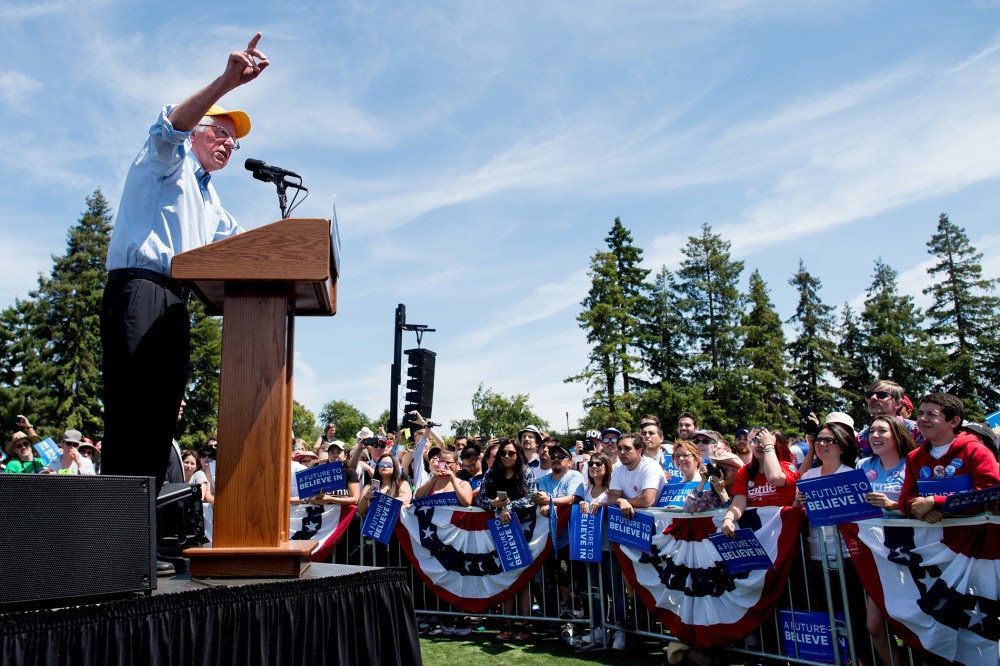
Hillary Clinton could be the declared the Democratic Party’s presumptive nominee by Tuesday night, when voters in California and five other states make their preferences known. That makes it Bernie Sanders’ last chance to stop Clinton from winning the nomination — even under the specious delegate math favored by his campaign.
Winning California, which Sanders has made his top goal, will embarrass Clinton but not be enough to stop her. Instead, if he wants to block Clinton, he’ll have to keep her from accumulating another 256 pledged delegates between now and Tuesday, which would require him to win about two out of every three delegates still outstanding.
RELATED: Bernie Sanders’ California Challenge
Here’s why that’s a tall order.
To win the nomination under Democratic Party rules, Clinton needs to accumulate a majority of all delegates. But Sanders doesn’t like those rules.
He says pledged delegates, the ones acquired by winning primaries and caucuses, are the only “real delegates.” Meanwhile, he dismisses superdelegates, the party leaders who can vote whichever way they chose.
The problem is that Clinton is on track to win a majority of both all delegates and pledged (“real”) delegates by Tuesday night. She’s only 256 pledged delegates away from crossing the threshold to a majority, and in a world where superdelegates don’t exist, Clinton would win if she gets them. And with 763 pledged delegates available between now and Tuesday, Clinton can win by securing just one out of every three remaining delegates.

Of course, superdelegates do exist in this world, but Sanders claims that since they won’t technically vote until the Democratic National Convention in July, they shouldn’t be counted now.
That technically leaves open a path to the nomination for him, but it’s ugly. If Clinton gets her 256 pledged delegates and claims the majority of pledged delegates, Sanders’ only option will be to ask un-elected superdelegates to overturn the so-called “real delegates” — and thus the results of the primary and caucuses. That has never happened before in the history of the modern Democratic nominating process and goes against the pro-democratic ideals championed by Sanders.
At this point, Sanders’ delegate math is probably best viewed not as an actual road map, but purely as a messaging tool for his base. Sanders has decided that he’s going to stay in the race until the bitter end, and appears to have reverse engineered justifications for doing so.
That’s led Sanders to repeatedly move the goalposts as his prospects dimmed.
First, he set about trying to actually win the nomination outright with a majority of all delegates. Then, he aimed to win a majority of just pledged delegates, predicting superdelegates would follow rather than overturn the Democratic electorate.
RELATED: Did Clinton just finally figure out how to hit Trump?
Now, Sanders and his campaign are advancing a sly new argument.
“Our basic argument is really just a fact,” Jane Sanders told MSNBC’s Andrea Mitchell this week. “It doesn’t look like either one of them will be able to reach [the majority of all delegates] threshold by all — after all the primaries are taken. Then it goes to the convention and then, at the convention, the superdelegates weigh in.” Sanders wants superdelegates to count in the total number of delegates a candidate needs to win, but he doesn’t want them to count towards actually reaching that number until July. In math terms, he wants wants superdelegates to count in the denominator but not the numerator. As The New York Times’ Nate Cohn put it, “Sanders needs superdelegates to exist to have a chance of vetoing voters, but he also needs their preferences not to count to survive.” That has the benefit of setting an impossibly high bar for Clinton to meet, since he’s asking her to reach a threshold with pledged delegates alone that candidates are supposed to reach with both pledged and superdelegates. But that’s not a standard any candidate has been expected to meet in previous primaries. The idea that Sanders can win with superdelegates assumes that he can be vastly more successful in wooing party elites to his side than other candidates in the past. While superdelegates can switch allegiance anytime they want, few do, historically. In 2008, for instance, no more than 30 superdelegates switched sides. It seems far fetched that party elites would be uniquely inclined to bail out Sanders, who has sued the Democratic National Committee, ridiculed the “Democratic establishment,” and come close to calling the Democratic Party corrupt and obsolete. So far, only one publicly declared superdelegate has switched sides — from Sanders to Clinton. Meanwhile, Sanders and his top aides have repeated a claim about superdelegates that appears to be demonstrably false. “This whole process is absurd. Hillary Clinton won support of over 400 superdelegates before anybody was in their race, eight months before the first ballot was cast in Iowa,” Sanders said this week in California. But as The Washington Post‘s fact checker noted, the first reports of 400 super delegates siding with Clinton didn’t come until August, and the first actual survey didn’t occur until November — both long after Sanders had entered the race.
Alex Seitz-Wald Recommended


