








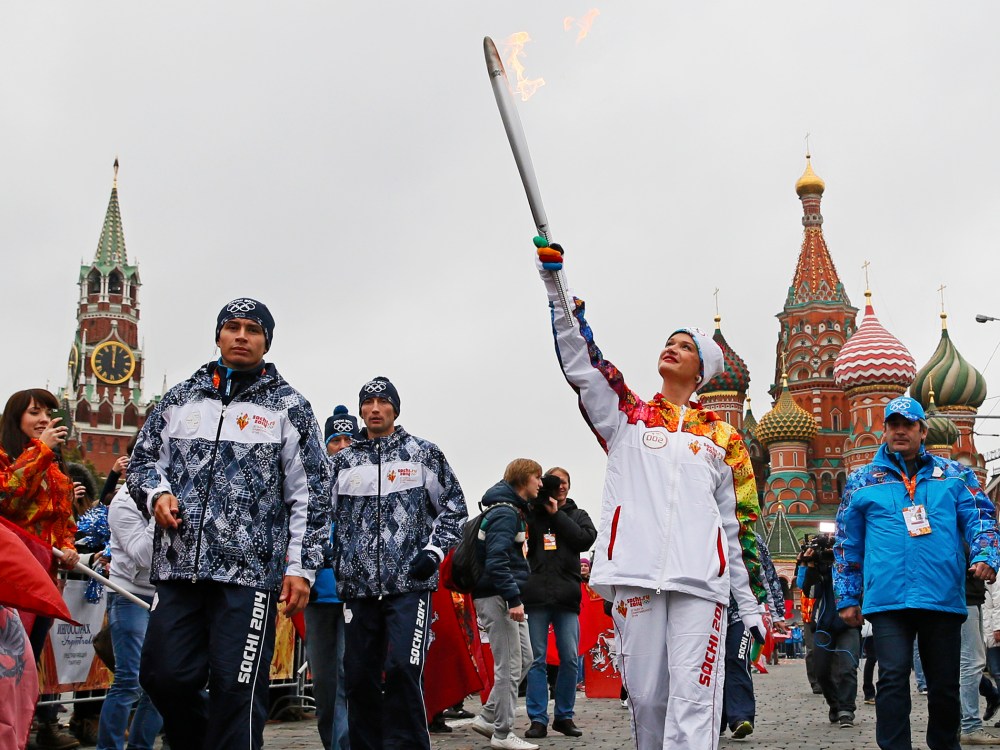
In fewer than 100 days, all eyes will turn to Sochi, Russia, as the international glare of the Olympic torch illuminates the athleticism and fanfare of the 2014 Winter Games.
But perhaps as prominent as the spectacle itself will be an array of political and social tensions that have paved much of the road to the Olympics and, at times, created potholes.
In addition to its anti-gay laws, Russia has drawn criticism for its positions on religious liberty, freedom of the press and ties to neighboring countries; the Obama administration was angered by the decision to grant asylum to NSA leaker Edward Snowden. Here are some of the issues to watch as athletes, spectators, and journalists prepare for a contentious version of one of the world’s most prized symbols of comity.
Nationalist clashes and fears of terrorism
A legacy of acrimony between President Putin and the Muslim-dominated North Caucasus came to the fore last week when a female suicide bomber from that area blew herself up on a bus in Volgograd, killing six people. The town where she was from–only a day’s drive from Sochi–had been under counterterrorism surveillance for at least a year, according to Time magazine.
The bomber’s motives remain unclear, but she appears to have been aligned with an insurgency group whose aim has been to transform the region into an Islamic stronghold and expel Russian forces, whom they view as occupiers. Over the summer, the movement’s self-proclaimed Chechen leader released a video message calling for the use of “maximum force” ahead of the Winter Games.
The attack follows a bloody two months in which over 130 people have been killed in clashes between government forces and militants, sparking nationalist riots this month in southern Moscow. A majority of those deaths took place in Dagestan, where the Boston bombers lived before emigrating to the U.S.
As prime minister, Putin directed the second Chechen war. Over a decade later, those separatist powers remain strong. Experts have warned that last week’s suicide bombing could be the first in a chain of attacks against Russian targets.
The crackdown on neighbors
In what sounded a lot like a threat to former Soviet satellite Moldova–a country entirely dependent on Russian gas for heat–Russia’s Deputy Prime Minister Dmitri O. Rogozin said recently, “We hope that you will not freeze.”
Moldova, along with several other countries in the region, has been seeking closer ties to Western Europe, a pursuit Russian officials have tried to suppress with sweeping condemnations and restrictions on exports critical to their neighbors’ economies. The Kremlin denies accusations of bullying, but that’s certainly what it looks like.
Moscow’s goal seems to be to deter former Soviet republics from linking up with the European Union through various political and trade agreements. Russia has been pushing its own customs union with Kazakhstan and Belarus as an alternative.
These conflicts will come to a head at a conference next month when the EU is expected to advance its Eastern Partnership program. The tension could spill over to the Olympics in February.
Diminishing religious freedom
Russia’s 1993 Constitution declared the country a secular state. But since reclaiming the presidency in 2012, Vladimir Putin has advanced several initiatives that seem to favor the Russian Orthodox Church (Moscow Patriarchate) while restricting other religions.
The most aggressive measure, enacted over the summer, criminalizes “offense to religious feelings” in vaguely-worded terms. No formal prosecutions have followed, according to Forum 18 News Service, but critics fear it carries the potential to inhibit any religious activity the government dislikes.
Another initiative, championed by a senior figure at the Moscow Patriarchate, cleared the way for long-distance Russian trains to play special audio programs covering topics on history, philosophy and, yes, Orthodox Christianity. These trains run through predominantly Muslim territories, angering some who feel the accounts ignore Islam.
A Russian Railways spokesperson told Radio Free Europe the aim of the programs–which passengers can reportedly mute–is not to proselytize, but to give an accurate portrayal of Russia’s history, in which Orthodoxy plays a sizable role.
The Snowden situation The former NSA contractor who leaking thousands of classified documents became a sore spot in U.S.-Russian relations this year. President Obama canceled a scheduled meeting with his Russian counterpart during the G20 summit in St. Petersburg, and said he was “disappointed” that Russia granted temporary asylum to the 30-year-old, who is facing espionage charges at home. Snowden, who fled to Russia after releasing documents to reporters, exposed the breadth of the U.S. government’s surveillance programs. He recently told The New York Times that he no longer had any classified items, and that there was no chance Russian intelligence caught a glimpse of U.S. secrets. Some lawmakers called for an Olympic boycott before Russia granted Snowden a year’s asylum last summer, but those protests have died down. Gay rights and the “propaganda” law Few events created more anti-Olympic fervor than President Putin’s signing into law a measure forbidding “propaganda of nontraditional sexual relations among minors.” That law, along with two others targeting the gay community, sparked worldwide protests and calls to either boycott the Winter Games or ban Russia from participating. They also created mass confusion about whether gay athletes and other Olympic guests could be prosecuted under the law’s guidelines. Putin and Kremlin officials have insisted that gay Russians enjoy the same rights and freedoms as everyone else, but accounts of violence and public humiliation continue to surface. A bill that would remove children from gay and lesbian parents was recently withdrawn from Russia’s parliament, but the MP who introduced it has vowed to submit the bill again after some changes are made. After months of mounting international pressure to take action, the International Olympic Committee quietly caved to Moscow, declaring it was “fully satisfied” the law did not violate the Games’ charter, which prohibits discrimination. Gay rights activists are discussing ways to express their views during the Games.
Emma Margolin
Emma Margolin is a reporter at MSNBC.com. Recommended


