









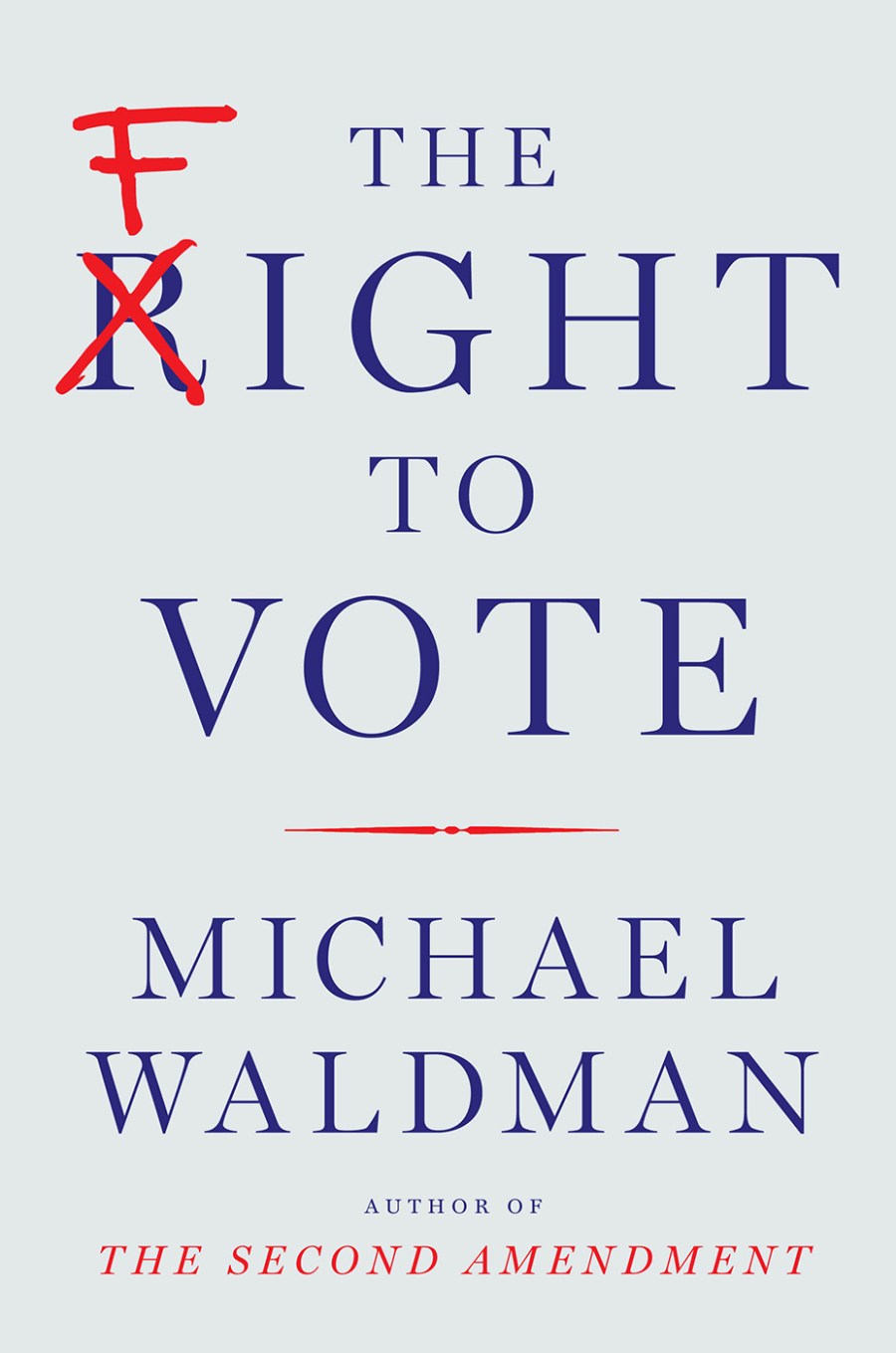
Michael Waldman is the president of the Brennan Center for Justice, and a former head of speech-writing for President Bill Clinton. His new book, The Fight to Vote, traces the contentious history of voting and democracy in America, from property requirements at the founding to today’s battles over voter ID and money in politics.
Waldman sat down with MSNBC to discuss the book—as well as what Mitt Romney’s “47 percent” comments owed to John Adams, how Donald Trump goes further than George Wallace, and why President Obama hasn’t done enough for democracy.
This interview has been lightly edited and restructured for clarity and length.
You write that as the 2016 election approaches, democracy is under strain. How?
I think that, as we are undergoing this crazy 2016 election, democracy in America is under stresses and strains that is hasn’t seen in years. In 16 states, there are new voting rules designed to make it harder to vote for the first time in a high-turnout election. This is the first presidential election in 50 years without the full strength of the Voting Rights Act. But that’s not the only thing. It’s also an election where the flood of big money from a tiny handful of mega-donors is dominating much of the campaign finance. You have the longstanding problem of gerrymandering. In the last election, voter turnout plunged to the lowest level in 72 years. These are all real threats to our democracy and suggest we could be moving backwards.
%22This%20could%20be%20a%20spring-time%20moment%20for%20democracy%20reforms%20that%20are%20taking%20shape%20all%20over%20the%20country.%22′
But we are also seeing the possibility of some significant forward progress. People are reacting, the political system is reacting and all across the country we’re now seeing positive developments and breakthroughs for reform, especially in the states. The biggest single change that would make the most difference in voting would be to move to automatic voter registration, which would add tens of millions to the voting rolls, and for those who really worry about it, curb the possibility of fraud. California and Oregon have passed laws moving towards this. The New Jersey legislature passed it, though Gov. Christie vetoed it. It’s starting to move in places from Illinois to Arizona, and it would be a big breakthrough. You’re seeing new models of public financing enacted in cities around the country as the way to stand up against the super PACs. And you’re seeing bipartisan redistricting reform, blessed now by the Supreme Court, pushed in California by Gov. Schwarzenegger, in Ohio recently by Gov. Kasich. This is not a left-right issue, so this could be a spring-time moment for democracy reforms that are taking shape all over the country.
How are these issues connected?
Sometimes these days we tend to think of these issues all as separate and somewhat arcane technical matters, where it’s voting over here that affects some people, and campaign finance over there. It really is the same issue. The issue is democracy and the power of everyone’s vote to matter. And throughout our whole history, going back to the Founders, Americans understood these to all be a part of the same issue: Who would be represented? How would they make their voice heard? What would their vote mean? From the beginning, they understood the formal rules mattered a lot, but also making sure the system wouldn’t be overly dominated by wealth and that there wouldn’t be shenanigans and manipulations that kind of rigged the system, the way James Madison worried about, and the way we see today.
You know, a lot of this bears the mark of a very concerted political strategy. Throughout history, one party or another has either been pushing to expand democracy or restrict voting rights. There is no question that right now and in recent years, it is the conservative movement that has pushed for more restrictive voting laws, that has pushed to weaken campaign finance laws whenever conservatives have gotten so much as a pinky on a lever of power. They’re moved to change the rules of democracy, whether it’s in the state capitals or in the Supreme Court. What’s striking is that, until recently anyway, Democrats and progressives didn’t have their own strategy to expand democracy in this day in age.
You show how these fights over democracy go back to the founding. We like to think of ourselves as the world’s oldest democracy. But why have voting and democracy always in fact been so controversial?
Well, I wanted to understand, has it always been this way? And it turns out we’ve been having this fight, the fight over who can vote and what mattered in our democracy, from the very beginning.
You know, at the beginning of the country’s history, we weren’t a democracy. Only white men who owned property were allowed to vote, and that was a small part of the population. But even at that time, that was controversial. And the momentum of the Revolution and the American ideal began to set things in motion. Benjamin Franklin led a workingman’s revolt in Pennsylvania in 1776 to expand voting rights to all men. John Adams on the other hand was one of those people who were really worried about this. He said if you do that, women will demand the right to vote. And men, he said, who hath not a farthing to their name will think themselves worthy of an equal voice in government. There will be no end of it. And of course that’s exactly what happened, there has been no end of it.
Does the success of both Donald Trump and Bernie Sanders reflect popular anger about the state of our democracy?
This is an election where people are angry. They are angry at the system, and they think the system is rigged, and you see it in both parties. You see a really wide recognition on the part of the public that it’s not only this policy or that policy but the basic state of our government and our democracy that’s on the ballot. And there are very different solutions that people are talking about, but whether it’s Sanders talking about campaign finance reform as the heart of campaign, Trump bragging that he is the only one in the Republican party who can’t be bought, or Hillary Clinton in a more muted way putting out the most advanced policies on voting rights and campaign finance.
This is an election where for the first time in a long time we’re debating not just what government does but how it does it.
You say we’re having a debate over democracy, but the GOP has worked mostly under the radar. They don’t seem to want to debate these issues openly, because they know restricting democracy is unpopular.
You’re right that before the 2010 elections when they took control of so many state legislatures, it’s not as if they ran on, let’s pass voter ID in the first month. But that’s a lot of what they did as soon as they got in. But you heard a great deal more about voter fraud, ACORN being a threat to America in the 10 years before than you did the opposite on the left. The Democrats were caught flat-footed and didn’t really offer much of an effective response to most of these moves.
And this isn’t a partisan point. Right now the Republican Party is pushing these things. In the past the Republicans were the party that was most for voting rights, they were for voting rights for African-Americans in the 1800s and for women in the 20th century, and it was Democrats who expanded the right to vote for working men, the white working class, but who opposed it for African-Americans, but who supported it for immigrants. The parties switch back and forth. So it’s not a surprise that one of the parties is taking this restrictive stance. What was something of a surprise, or unusual, was that the Democrats weren’t pushing for democracy. When the Democrats had a filibuster-proof majority in the Senate, and a majority in the House, they didn’t introduce any major voting legislation. They didn’t move universal voter registration which was an idea then, too. Barack Obama was the first major party candidate to refuse public financing for his race in 2008. And he said, don’t worry I’m going to pass campaign finance reform, and then he never did anything. The administration has even failed to take some of the unilateral steps it could take. Dark money is this phenomenon, as you know, of campaign spending supposedly through nonprofits that can be done with the donors masked by secrecy. It’s hundreds of millions of dollars. The Republicans filibustered legislation to disclose that spending. President Obama could sign an executive order requiring federal contractors to disclose their spending. It wouldn’t reveal all the dark money but it would reveal a lot of it. And for whatever reason, he hasn’t done it. He did talk about democracy issues in this year’s State of the Union … A sentence or two in the State of the Union on democracy is great, but when the cap stays on the pen that could sign the executive order, I’m not so thrilled about what they’ve done. I think those of us who care about these issues, who fight to expand democratic rights, need to hold our political figures to a high level. I mean, there’s been barely anything even said by national politicians from this administration about this topic. Have these fights over democracy been only about power or partisanship? Or has there also been an ideological level to them? It’s true that there’s a great deal of raw power and partisan jockeying. But it’s also a fight that unfolds at a fairly deep level of debate over who we are, whether the country should be a democracy, and who are the people that should have a voice in that democracy. I mean, even going back to the very beginning, it’s not only that the vote was restricted to white men with property, but there was a whole philosophical approach that justified that: That you had to have a stake in society through ownership of property to have that voice. And as I describe and argue, the ideals set out in the American Revolution and even in Jefferson’s drafting of the Declaration of Independence, the idea that government was only legitimate if it rested on the consent of the governed. That was obviously hypocritical – he was being attended to by a slave when he wrote it – but there was such power in that ideal that it began to take on a life of its own. And over and over, throughout American history, the advances for the vote and democracy have appealed to that core civic religion of political and civic equality and the consent of the governed. And whether it was the Abolitionists, Lincoln appealed to it overtly many times, including at Gettysburg, the Seneca Falls declaration calling for voting rights for women, certainly the modern civil rights movement. What’s interesting is there’s another line of argument throughout American history, which you heard from John Adams and you heard in the 1800s. The defenders of slavery were making the argument that too much democracy was not a good idea, that the slave owners of the South and the new business moguls of the North ought to join hands. And the modern conservative movement has resuscitated a lot of this alternative philosophical approach to America. There was a guy named John Randolph of Roanoke, who is not exactly a household name. He fought very hard against expanding voting rights to working men, to men without property, and his best known aphorism was, “I am an aristocrat, I love liberty, I hate equality.” And when the modern conservative movement was getting started, one of the key books was a biography of this guy, praising his devotion to opposing voting rights, by Russell Kirk. And a key movement in the conservative configuration that dominated American politics for decades, in many ways, came in 1980 when Ronald Reagan had just won the Republican nomination and he went for a major speech to the Evangelical movement, which was just getting politicized as a conservative force. And Paul Weyrich spoke, and he said, let’s be frank, we don’t want everybody to be able to vote. When more people vote our chances go down. Weyrich co-founded the Heritage Foundation, which is a major popularizer of voting restriction laws, and he co-founded ALEC, which drafted so many of the voter ID laws around the country. And that was at the very moment of birth of the conservative era. And even today you hear it come out … %22The%20times%20when%20incumbent%20groups%20in%20power%20have%20tried%20to%20change%20the%20rules%20of%20democracy%20is%20often%20when%20they%20think%20the%20demographic%20winds%20are%20blowing%20against%20them%20or%20the%20political%20winds%20are%20blowing%20against%20them.%22′ Is Donald Trump a threat to democracy? It’s been decades since a major candidate has been as overtly racist in his public arguments. I mean, George Wallace spoke in euphemisms. Trump says Mexican immigrants are criminals and kick the Muslims out. The strongman aspect, having his crowds swear their loyalty to him, these are not things that are in the American tradition. The one way in which his campaign fits with the American democratic tradition is that it’s voters loudly giving voice to something that hasn’t been heard in the halls of power. But you hear voters of all political stripes voting with their anger this year. But what he’s doing is just utterly out of the mainstream of how Americans have governed their country. And as intense and passionate as you want partisan politics to be, the level of violence and rhetorical violence—it’s really hard to sustain that and have a working democracy.
Zachary Roth Recommended


