








KEYSTONE, South Dakota — Past the T-Rex sculpture, the reptile garden, and the empty water slides, the black light mini golf, elk-crossing signs, and the world’s largest teddy bear collection, Shari Harvey knits behind the counter of the National Presidential Wax Museum and tells herself that it’s all part of God’s plan.
“Our kids are being sent overseas,” she says, referring to the new U.S. military operations in Iraq and Syria. “Being in this war—we need to be getting them back.”
She doesn’t believe it’s her job to stop it, though. “It’s in God’s hands, that’s how I see it. It’s all up to Him,” says Harvey. “I’m not into politics even though I work here,” she adds, standing a few feet away from wax figure Al Gore, who’s permanently frozen in a 2000 debate with wax figure George W. Bush.
Tourists stop by tiny Keystone, population 337, on their way up to Mount Rushmore. The high season is now winding down, with most shops already shuttered for the season. But business wasn’t all too bad this year. “One of our best seasons,” proclaims Alex Woolley, 19, who waits tables at BaRLee’s restaurant.
But there’s still that tinge of worry in the air—about this place, this country, and our place in the world—even at this monument to American patriotism and exceptionalism on a sunny afternoon.
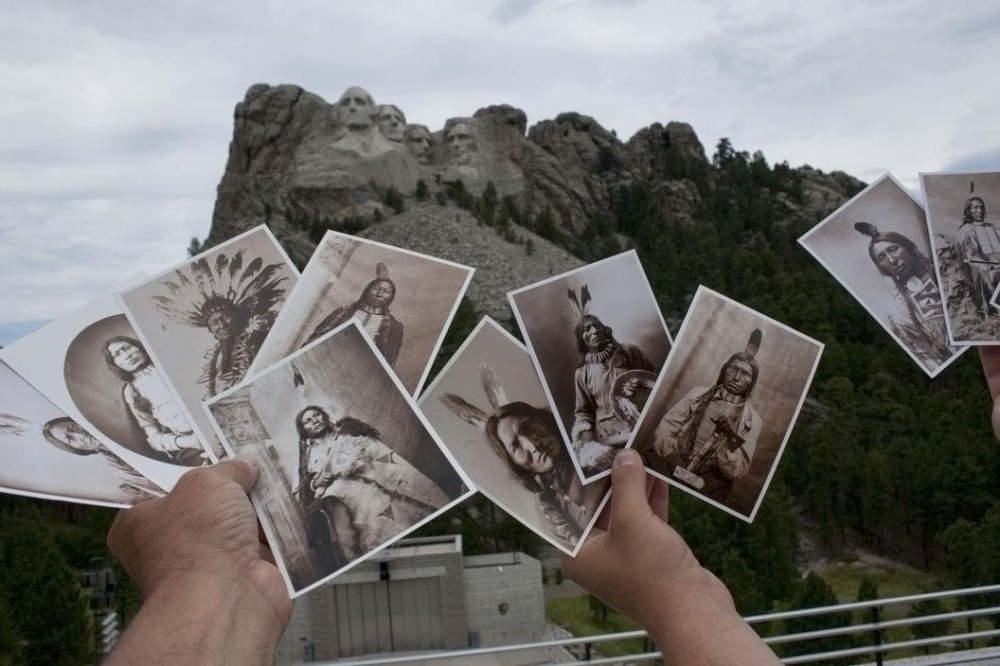
“I’m scared,” says Del First, a Native-American tourist from Montana, shortly after getting a photo of himself at the base of Rushmore. “ISIS, Ebola…”
“Ebola’s nothing compared to other problems…” a British tourist interrupts.
First ignores him. “The loss of my tribal language,” he continues. At 51, he’s the youngest member of the Sioux tribal leadership on his reservation at Fort Peck, which sits in the northeast corner of Montana. Oil fields have brought more money and jobs to the area, as in other stretches of the Great Plains and Mountain States. But the new riches have also fueled the drug trade and human trafficking, he notes, and drawn more young people away from traditional Sioux ways.
“Everyone cut their braids,” First says.
He does like the new look of Mount Rushmore, though, where they’ve carved out an expansive viewing platform lined by the flags of every state since his first visit in the 1990s. “This is all new, it’s beautiful,” he says.
The monument—completed in 1941, after nearly 15 years of construction—was originally a ploy to attract more tourists to the area. Now more than three million people are estimated to visit the monument every year, turning the surrounding Black Hills area into a full-blown tourist trap, with highway billboards that battle for motorists’ attention (“A Life-Changing Patriotic Experience!” promises one nearby museum. “Get ‘Buck Naked’ and ‘Tickle Me,’” says a wine bar with cheekily named vintages).
But the tribute to the four presidents—Washington, Jefferson, Lincoln, and Teddy Roosevelt—was supposed to bring more than just prosperity to South Dakota’s Black Hills. “Other people have marveled at the growth and strength of America,” President Coolidge said at the 1927 dedication of the monument’s cornerstone. “They have been amazed at our genius for self-government.” A few years later, President Franklin D. Roosevelt returned for an unveiling of Thomas Jefferson’s head. “This can be a monument and an inspiration for the continuance of the democratic-republican form of government, not only in our own beloved country, but, we hope, throughout the world,” Roosevelt said here in 1936. That’s why Leon Mixer stopped by on his way back home from hunting antelope in Wyoming—to remember America’s great leaders. “It’s important,” says Mixer, still dressed in full hunting camouflage and a white cowboy hat. But the future still looks grim from his point of view. “I see this as a religious war. I see a lot more fear,” says Mixer, who works for the local government in Oklahoma. He asks me whether I’m Christian, then whether I’m Muslim. “The Christians are thinking that the other religions are trying to change the world into one world religion,” he says. ISIS certainly wants to establish an Islamic caliphate, but Mixer doesn’t believe that the U.S. should be involved in the conflict, either. Instead, he says, we should “stick our nose in the Good Book.” There, the Book of Revelation will tell us what’s to come. The signs are already there, he says. “We may be near the End.” This is part of msnbc.com’s “Road Trip ” series, which has msnbc.com reporters traveling across the country to profile movements that sparked change in America. For more, click here.
Suzy Khimm Recommended


