








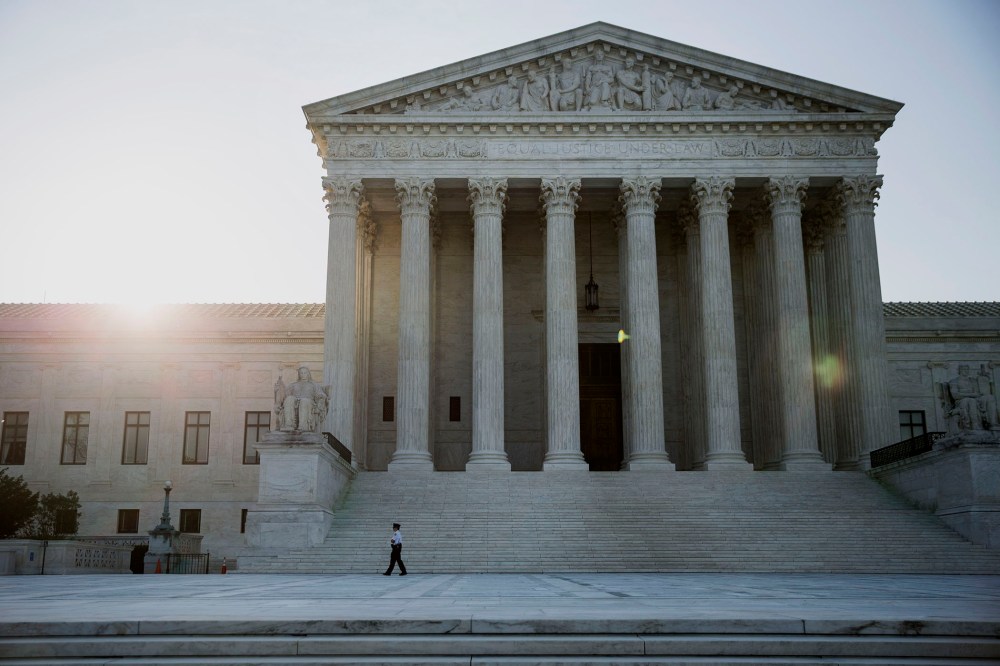
The start of the U.S. Supreme Court’s new term is still a month away, but a petition filed today in a case challenging Texas’s abortion restrictions suggests that the new session will once again revolve around Justice Anthony Kennedy, whose swing vote was critical last June to extending the right to marry to gay couples across the United States.
The Texas law at issue in Whole Woman’s Health v. Cole is part of a recent explosion of different types of restrictions that impose weighty burdens on women trying to exercise their constitutional rights. But arguments based on equality grounds historically have had less sway with Kennedy. If the court grants today’s petition — as is widely expected — then securing the conservative justice’s vote in favor of reproductive rights will require a focus on his commitment to an expansive concept of liberty, not equality.
RELATED: Texas abortion clinics ask Supreme Court to keep them open
House Bill 2, the law passed by the Texas state legislature and signed by then-Gov. Rick Perry, is one of many new abortion restrictions across the country that impose significant burdens on women trying to exercise their Constitutional rights. With this law, the state of Texas imposed several medically unnecessary requirements — mandating that clinics meet the same structural facility expectations as ambulatory surgical centers, and that clinicians have hospital admitting privileges — which have the purpose and effect of reducing the number of abortion providers. If all the provisions of the law are allowed to go into effect, 75% of the state’s clinics will be shuttered.
In 1992, in Planned Parenthood v. Casey, Justice Kennedy consciously moved the court’s abortion jurisprudence away from its previous focus on privacy to an expansive concept of liberty that protects an individual’s personal decisions about marriage, family relationships, procreation, and contraception – and in the process laid out a test for deciding whether abortion regulations violate that constitutional right to liberty. It is this focus on liberty that will likely animate his understanding of the issues in Whole Woman’s Health.
Under Casey, a regulation imposes an unconstitutional “undue burden” if it “has the purpose or effect of placing a substantial obstacle in the path of a woman seeking an abortion of a nonviable fetus.” While the Supreme Court found insufficient proof in the record in that particular case to conclude that making a woman wait 24 hours before having an abortion failed that test, it acknowledged that such provisions “increase[d] the cost and risk of delay of abortions.” That left the door open for future challenges, recognizing that, at some point, increased costs could be an “undue burden.”
We have now reached that point.
Imagine that a pregnant Texan of very limited means expends considerable time and money to make the long journey to what is now her “nearest” abortion provider. Once there, she must wait 24 hours between receiving counseling and the abortion – expending more money and time. Is that an unconstitutional, unduly burdensome impact on her “liberty”? The language of Casey suggests it is.
Since Casey, Kennedy has continued to focus on liberty, in cases addressing abortion and gay rights. For example, in Lawrence v. Texas, the landmark 2003 decision striking down state laws criminalizing homosexual sodomy, Justice Sandra Day O’Connor called for the case to be decided on equality grounds. Relying on his Casey reasoning, Kennedy explicitly rejected an equality-based approach; he saw no constitutional comfort in a ruling that homosexual sodomy laws were void because they imposed a burden upon a particular group in society.
RELATED: Liberal SCOTUS? Not so fast.
That Kennedy continues to care passionately about protecting an expansive notion of liberty was evident in last term’s gay marriage case, Obergefell v. Hodges. Many court pundits overlooked the language of liberty dominating Kennedy’s landmark opinion in Obergefell, instead focusing on the egalitarian components of his decision making. Those readings miss the fact that “liberty” remains the primary animating theme of many of Kennedy’s civil liberties decisions. In Casey, the joint opinion very consciously opened with the following sentence: “Liberty finds no refuge in a jurisprudence of doubt.” Obergefell similarly begins with a nod to liberty, not equality: “The Constitution promises liberty to all within its reach, a liberty that includes certain specific rights that allow persons, within a lawful realm, to define and express their identity.” There is every reason to believe that, should the Supreme Court decide to hear the Texas case, Kennedy will view the female residents of that state as falling “within the reach” of the Fourteenth Amendment’s liberty protections. For, as he wrote in Obergefell, those protections “extend to certain personal choices, central to individual dignity and autonomy … [l]ike choices concerning contraception, family relationships, procreation, and childrearing …” There is no disputing the fact that abortion regulations unequally impact women, making the call to decide their constitutional fate using the concept of “equality” appealing. But as long as the tie-breaking vote goes to Kennedy, the concept of “liberty” may hold the key. Dr. Helen J. Knowles is Assistant Professor of Political Science at State University of New York at Oswego.
Helen J. Knowles Recommended


