








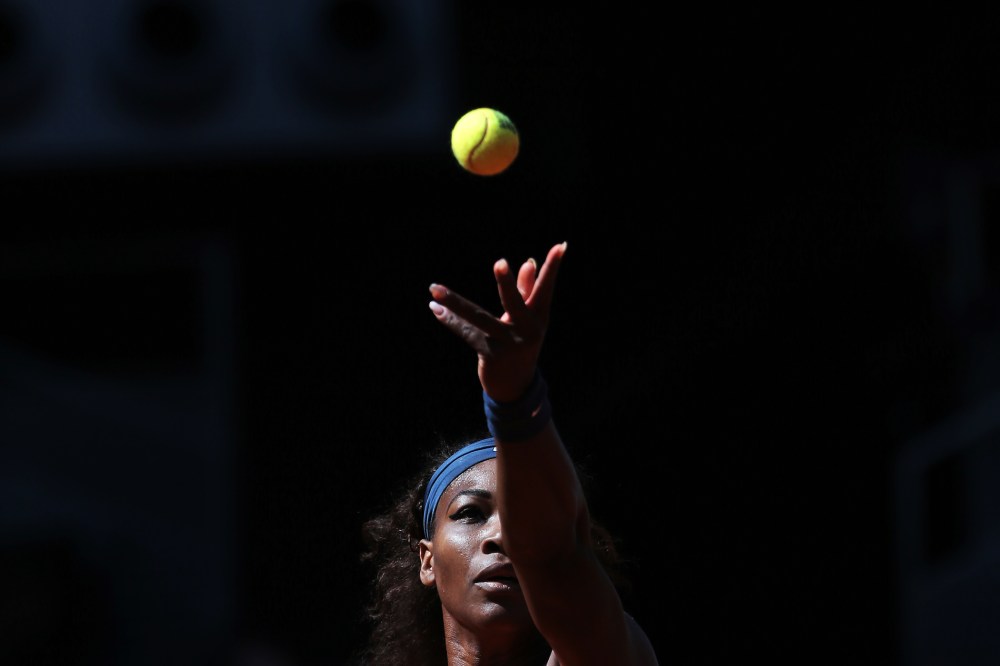
BNP Paribas Open tournament director Raymond Moore’s claims that female tennis players are “lucky” and “ride the coattails” of men were not only sexist — and “in extremely poor taste,” as he admitted — they were also wildly inaccurate.
The veteran tennis official courted controversy and renewed scrutiny of gender bias in his sport by denigrating the role of women in the game on Sunday, arguing: “If I was a lady player, I would go down every night on my knees and thank God that Roger Federer and Rafa Nadal were born, because they’ve carried this sport.”
However, for the last several years, it has been tennis’ female stars who have arguably been the biggest draw for fans. For instance, the women’s US Open has drawn higher ratings than the men’s matches for the past two years in a row, and its audience keeps growing — tickets for last year’s match sold out before their male counterparts for the first time in history. Maria Sharapova boasts one of the largest social media followings of anyone in the game and ranks as the highest paid female athlete in any sport. Meanwhile, Serena Williams’ historic run of tournament victories last year and dramatic face-offs with her sister Venus are the closest things to must-see TV in tennis. And although there has been an uptick in interest in men’s tennis over women’s as of late, it makes little sense to pit them against each other from both financial and philosophical perspectives.
RELATED: Serena Williams’ Sports Illustrated honor only inspires more haters
Perhaps unsurprisingly, Williams was quick to condemn Moore’s comments. “Obviously, I don’t think any woman should be down on their knees thanking anybody like that. I think Venus [Williams], myself, a number of players have been — if I could tell you every day how many people say they don’t watch tennis unless they’re watching myself or my sister, I couldn’t even bring up that number. So I don’t think that is a very accurate statement,” she told ESPN. “I think there [are] a lot of women out there who are more … are very exciting to watch. I think there are a lot of men out there who are exciting to watch. I think it definitely goes both ways. I think those remarks are very much mistaken and very, very, very inaccurate.”
Lindsay Gibbs, the sports reporter for Think Progress, credited the Williams sisters with elevating equality in the sport. “It’s sad that they have to keep addressing this,” Gibbs told MSNBC on Monday. “There’s no better female athlete right now than Serena Williams. We need her voice stepping out like this.”

Williams’ words took on even more significance because her appearance at the BNP tournament at Indian Wells last year was her first since 2001, when she was booed and allegedly subjected to racist invective from the crowd there.
“She’s a major media draw, and it’s not because of Roger Federer or Rafael Nadal. It’s because she’s been ranked No. 1 in the world for 286 consecutive weeks and is on the brink of making history. She earned that,” Shana Renee Stephenson, editor in chief of All Sports Everything told MSNBC on Monday. “To ‘welcome’ her return to the tournament, and one year later sling sexist remarks towards her and other WTA participants is offensive and deserving of another boycott by Williams — and her female and male cohorts.”
“As a society, we’ve evolved beyond that, but in a brief one-minute sound bite, Moore managed to take us back to the stone age,” she added.
Meanwhile, Steve Simon, the head of the Women’s Tennis Association also condemned Moore’s comments. “As the Tournament Director of one of the preeminent events in professional tennis, the comments made today by Raymond Moore were extremely disappointing and alarming. The WTA stands on its own and was founded on the principles of equality and empowerment,” he said in a statement to MSNBC. “I am proud of all the strong athletes on the WTA who put in hard work and sacrifice every single day. Tennis as a whole is enriched by the contributions and accomplishments of every player, both female and male.”
And while women have been dominant in tennis, their success can hardly be attributed to luck. The top women in tennis still earn less than their male counterparts, are subjected to widespread objectification and personal vitriol and, more often than not, reduced to puerile commentary on their grunting during a serve. They can’t even count on their male counterparts to consistently be allies. After his victory at BNP Paribas Open tournament this weekend, men’s champion Novak Djokovic lamented the fact that women and men receive equal prize money for grand slams and other tournament play.
RELATED: Maria Sharapova fails drug test, prompting Nike to suspend relationship
Djokovic, who admitted Moore’s statements were “not politically correct” and that women “fought for what they deserve” in terms of compensation, nevertheless argued that male players “should fight for more” to reporters, according to The Independent, citing more spectators at men’s matches to make his case. But that wasn’t all. “Their bodies are much different to men’s bodies. They have to go through a lot of different things that we don’t have to go through. You know, the hormones and different stuff, we don’t need to go into details,” he said. “I have great admiration and respect for them to be able to fight on such a high level. Many of them have to sacrifice for certain periods of time, the family time or decisions that they make on their own bodies in order to play tennis and play professional sport.” “I have had a woman that was my coach and that was a huge part of my tennis career. I’m surrounded by women. I’m very happy to be married with one and to have a child. I’m completely for women power,” he added. Disappointed in #RaymondMoore comments. He is wrong on so many levels. Every player, especially the top players, contribute to our success Gibbs said she found it “frustrating” that Djokovic used his victory at the tournament as an opportunity to raise the equal prize money issue, something even Moore didn’t do. “You don’t see this in other sports,” she said. “Where does it end? Where do you draw the line?” Two years ago, Gibbs wrote a guide for male tennis players and journalists on “How to Talk About Women’s Tennis.” Ironically, she called for a moratorium on complaints about equal prize money and talk of hormonal issues effecting female players. She has grown accustomed to these same debates over equal pay cropping up every few years and she believes it will simply take more time for opponents of gender equality to relent. “We’re just a generation or two removed from Title IX,” she said. “You still have people who say women’s sports aren’t interesting and they say it like it’s a universal truth. I think that what you have is a lot of people who believe what Raymond Moore said, they just don’t say it in quite as crass and ridiculous a way.” “We have to start to recognize what he’s saying and these horrible stereotypes when its less obvious,” she added. “We need to start recognizing this in people who aren’t Raymond Moore.”
Adam Howard Recommended


