








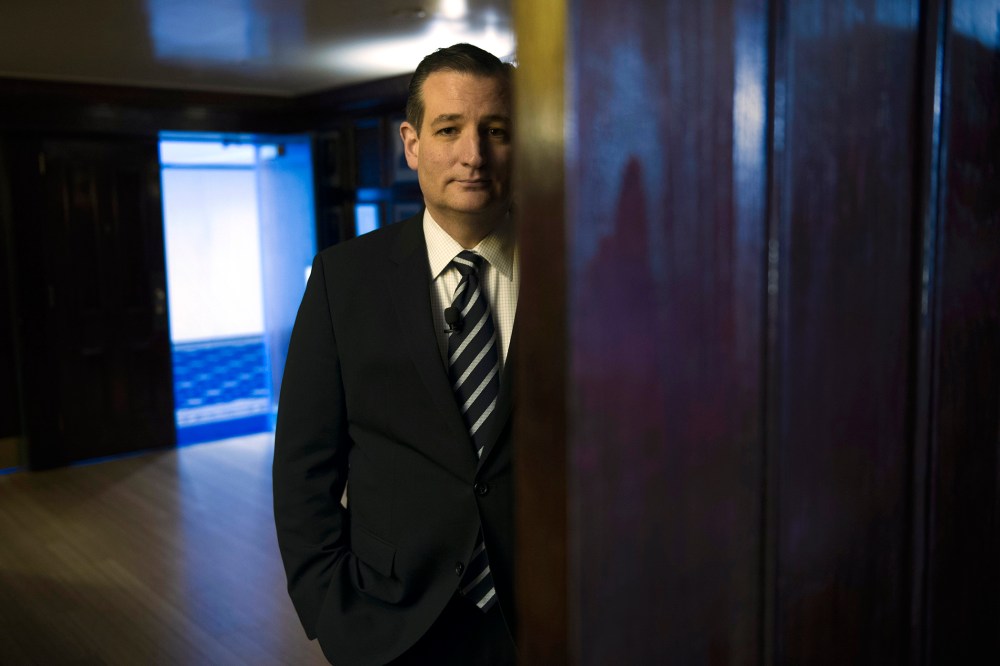
WASHINGTON – Speaking at a Q&A hosted by the Hispanic Chamber of Commerce, Sen. Ted Cruz (R-Texas) pledged a vigorous effort to improve on Mitt Romney’s abysmal margins with Hispanic voters in 2012, but downplayed the role immigration would play in his outreach effort. His Republican rivals may not give him the choice of minimizing the issue, however, as they take increasingly pronounced stances that threaten his position from the right and left alike.
Cruz argued that Hispanic voters were “fundamentally conservative” but that Romney, who garnered just 27% of their support in exit polls, had alienated them by giving the impression he did not care about their needs.
“If you look at the values that resonate in our community, they are faith, family, patriotism, hard work,” he told host Javier Palomarez, the CEO of the Hispanic Chamber of Commerce. “Some years ago I was having lunch with an Hispanic entrepreneur in Austin and he asked me a question: He said ‘When was the last time you saw an Hispanic panhandler?’ It’s a great question…I’m not sure I’ve ever seen an Hispanic panhandler and the reason is in our community it would be shameful to be begging on the street.”
RELATED: Gay hotelier ‘made a terrible mistake’ in hosting Ted Cruz
In his remarks, Cruz deemphasized immigration as a major factor in rallying the Hispanic vote and indicated he would instead focus on issues like the economy, national security, and education in making his case.
“I think [Democrats] are treating immigration as a political cudgel where they want to use it to scare the Hispanic community and their objective is to have the Hispanic community vote monolithically Dem as unfortunately they succeeded in scaring the African-American community.”
Palomarez nonetheless asked Cruz to address the issue in more detail, noting that his own group’s members considered passing reform as an “economic imperative” and that their own polling showed it to be a “unifying issue” for Hispanic small business owners.
Here, Cruz’s position is still not entirely clear. On the one hand, he’s a leading opponent of the president’s executive action to protect millions of undocumented immigrants from deportation, which he has derided as unconstitutional, and voted against a bipartisan bill co-authored by 2016 rival Sen. Marco Rubio (R-Fla.) that aimed to simultaneously reduce barriers to legal immigration, bolster border security and enforcement, and put millions of immigrants on a path to citizenship if they paid a fine, passed a background check, and met other requirements. But while Cruz derided the Senate bill and other proposals to offer legal status and citizenship to undocumented immigrants as “amnesty,” he has left significant wiggle room when it comes to how he would deal with the estimated 11 million unauthorized immigrants living in America himself.
RELATED: Ted Cruz takes a little off the top
Many conservative activists are opposed to any policy that allows such immigrants to remain in the country, but Cruz has taken care not to rule out eventual legalization short of citizenship once he feels the border has been properly secured. He maintained this ambiguity on Wednesday when pressed by an Associated Press reporter to clarify his stance, indicating that would address other issues first before announcing a final position.
“We need to focus where there’s agreement: securing the border and improving legal immigration,” he said. “And once we demonstrate we can secure the borders, I think then we can have a conversation about people who are here illegally.”
Cruz added that he tried unsuccessfully to pass an amendment to the bipartisan immigration bill that passed the Senate in 2013 that would have barred undocumented immigrants from receiving citizenship but still allowed them to obtain permits to live and work in America. Its failure, he said, showed Democrats were unwilling to compromise on citizenship at all costs.
Cruz’s anecdote again left things open to interpretation. At the time he offered his citizenship amendment, The New York Times described it as Cruz seeking a “middle ground” between full citizenship and mass deportation in which undocumented immigrants could still work legally in America.
On Wednesday, however, a spokesman for Cruz, Brian Phillips, clarified to msnbc on Twitter that this interpretation was incorrect and Cruz merely offered the amendment as an exercise to prove Democrats’ obstinacy on citizenship. It was not an endorsement of the work permit component of the bill that his amendment left intact.
“Cruz’s amendment had nothing to do with that issue,” Phillips said.
Cruz offered an unambiguous defense of greater legal immigration, where he boasted that he had offered to expand an annual cap on H1B visas for high-tech workers “fivefold” in order to attract more talent to the United States. “There is no stronger advocate of legal immigration in the U.S. Senate than I am,” Cruz said. Cruz, who is trying to corner market with the conservative grassroots, faces pressure from all sides on immigration as the Republican primary heats up. While the debate has been dominated in recent years over the question of how to handle undocumented immigrants currently living in America today, Cruz’s comments come as two possible 2016 contenders are beginning to target legal immigration as well. Wisconsin governor Scott Walker recently raised questions about whether immigration levels drag down American wages and employment and name checked Sen. Jeff Sessions (R-Ala.), a leading proponent of reducing work visas, as an influence. Former Sen. Rick Santorum (R-Pa.) has gone further, claiming explicitly that current immigration levels harm current American workers. Cruz’s remarks also came hours after likely presidential rival Jeb Bush delivered a speech before the National Hispanic Christian Leadership Conference in Houston, an evangelical group whose leaders are strongly supportive of immigration reform. The two events proved a study in contrasts between Cruz, who pitched avoiding the legalization question indefinitely, and Bush, who argued it needed to be dealt with now. Like Cruz, Bush led by emphasizing economic and social issues unrelated to the immigration fight. Switching freely between English and Spanish, Bush touted his success closing achievement gaps between white and Hispanic students in Florida, recalled how he met his wife Columba, while studying in Mexico as a teenager, and told the audience that he shared their views on the importance of faith in daily life. “There is no more powerful liberating force on this Earth than the Christian conscience in action,” he said. Unlike Cruz, he brought up immigration in his remarks unprompted and made his position unambiguous: politicians can’t deport the current undocumented population and must offer them “earned legal status” instead. “This country does not do well when people lurk in the shadows,” Bush said. “This country does spectacularly well when people can pursue their God-given abilities.”
Benjy Sarlin Recommended


