








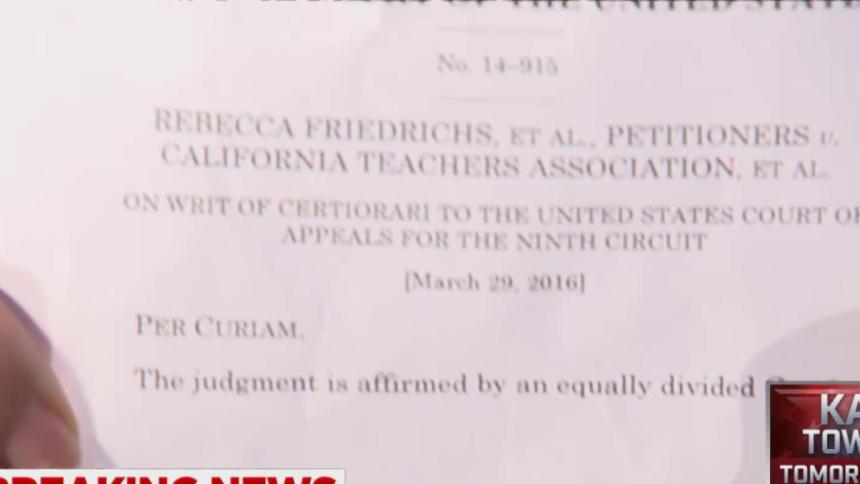
The nation’s public sector unions avoided a serious setback Tuesday when the U.S. Supreme Court reached a tie vote in a case that could have reduced their influence.
The justices split 4-4 on whether state government workers who choose not to join a union can nonetheless be required to pay a share of union dues to cover the cost of negotiating contracts. At stake was the future power and financial health of public sector unions in the 23 states where they have a duty to bargain for both members and non-members alike.
The tie vote leaves a lower court ruling standing — a victory for the unions because it rejected a challenge to the dues requirements.
Justice Antonin Scalia, who died in February, almost certainly would have voted with the challengers and against the unions, judging by his past writings and comments when the case was argued in January.
A loss for the unions “would call into question thousands of public-sector contracts covering 9.5 million public employees and affecting scores of critical services, including police, fire, emergency response and, of course, education,” said David Frederick, who argued the case for union teachers from California.
The Supreme Court has long held that requiring non-union members to pay the full amount of union dues would violate their right of free expression, forcing them to subsidize a union’s political activities whether they agree with its goals or not.
But since 1977, the Court has said non-union employees can be required to pay a portion of union dues to cover the cost of collective bargaining and prevent “free riders” — workers who get the benefits of a union contract without paying for it.
The Obama administration is likely to cite Tuesday’s tie as a reason for the Senate to confirm Merrick Garland, President’s Obama’s nominee to succeed Scalia.
Garland was to meet Tuesday with a Republican Senator, Mark Kirk of Illinois.
The case which brought Tuesday’s tie was brought to the court by non-union teachers in California hoping to get the earlier decision overturned, the justices were asked to decide whether even that requirement violates free expression.
“In this era of broken municipal budgets and a national crisis in public education, it is difficult to imagine more politically charged issues than how much money local governments should devote to public employees, or what policies schools should adopt to best educate their children,” said Michael Carvin, a lawyer for the challengers. He argued that the government has no legitimate interest in enhancing a union’s treasury at a dissenting employee’s expense. As a fallback, the challengers urged the court to rule that teachers should not have to “opt out” of paying the full amount of dues by filling out a form once a year. Instead, teachers should “opt in” if they wish to pay the full amount. The California Teachers Union urged the court not to overturn its earlier ruling, which held that a state’s interests in an orderly workplace outweigh the modest interference with employee expression involved in paying a portion of union dues. The positions the union takes in negotiating contracts involve “bread-and butter employment issues. Collective bargaining does not resemble the wide-ranging, open, and public debate that the First Amendment traditionally protects,” said Frederick, the lawyer for the union. Supporters of the union position say represented workers generally make more money. A study by the National Women’s Law Center found that women represented by public sector unions are paid 24 percent more and are more likely to have employer-based health insurance.Recommended


This article originally appeared on NBCNews.com.

Pete Williams